
Spoiler Free
[EDITORS NOTE: If this is your first experience with the Feng Shui 2 Roleplaying Game, you may want to consider starting with our previous review of the Core Rulebook. -dc]
Feng Shui 2 is, without a shadow of a doubt, one of my favourite roleplaying games ever made. I also think it is one of the most underrated RPGs ever made, and when it sort of slipped into the shadows of the Atlas Games catalogue I was beyond disappointed. When I discovered that Atlas was bringing out at least four new “Action Movie Adventures” I was over the moon.
If you skipped my review of the Core Rulebook, that’s ok. I’ll pull out the appropriate paragraph for some context: The “Chi War” is basically the overall setting that uses time travel to mix and match characters and themes from across the spectrum of Hong Kong movies. It’s set up in such a way that players can (normally) only travel to specific time periods. Junctures (as they are called) regularly lead to four eras: Ancient (640, Tang Dynasty era), Past (1850, European Colonial era), Contemporary (now-ish), and the Future (2074). “Pop up junctures” will occasionally appear, leading to other times as well, as needed for the GM’s story. This allows the game to seemly blend swords and sorcery with machine guns and machines.
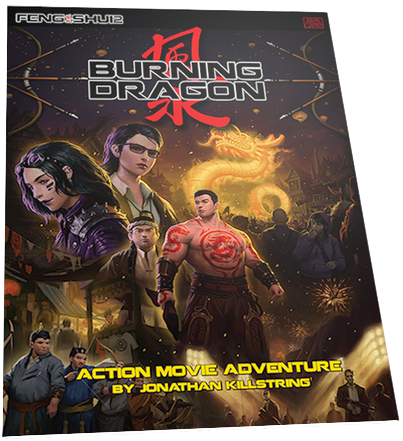
Burning Dragon has connections to the Ancient juncture, but takes place in the Contemporary juncture. I promised a spoiler free review, but I never really consider the back cover as counting as a spoiler: Burning Dragon is a counterculture phenomenon held annually in the Gobi Desert. A raw celebration of creative talent and Mongolian culture to “forge the dragon” creating a temporary city dedicated to art, age-old athletic competitions, and extravagant performances.
This year, however, Burning Dragon has been suborned by Damien Wu- festival organizer, Triad big shot, and secret Eater of the Lotus sorcerer. When the dragon effigy burns during the closing ceremonies, Wu will use a blood sacrifice to harness the attendees’ souls and reawaken the ancient feng shui site that smolders beneath the festival grounds!
Burning Dragon, the fictional festival, is much more than a music festival. It’s a mix between modern events like Gobi Heaven and traditional events like the Naadam Festival. Gobi Heaven is a much more heavily commercialized version of Burning Man while Naadam (literally “games”) is a centuries old Mongolian tradition featuring “the three games of men.” The games are wrestling, horse racing and archery, all of which are also in Burning Dragon. The festival site is split into five districts: the Badlands, Dragon’s Head, Dragonstreet Commons, Dust Town, and the Seven Lakes Artist Commune. As the players explore these districts they will have the opportunity to interact with competitions both traditional modern equivalents. Archery, Sharpshooting, Traditional Equestrian, a Desertpunk Rally, Mongolian Wrestling, MMA, and Modern Dance are all brought into the story in a variety of ways.
Everything is set up for the GM to give a maximum amount of flavour, without the Players knowing which interactions might be important later and which are for flavour alone.
It’s been a few years since Atlas Games has published any new Feng Shui 2 adventures. One of the things I noticed is that both this and Apeworld on Fire are much tighter in terms of flow and general formatting. The older format isn’t “bad” but this is still a big improvement on it. Unfortunately, something that hasn’t been improved is the Sylvan Master app. The app lets you run some or all of the combat encounters from your phone or tablet. It’s super useful, But only after struggling to figure out the functionality on your own. There doesn’t seem to be any sort of instruction book for it anywhere.
I’ll be back in a few weeks to talk about the second adventure Apeworld on Fire! until then you can find Altas Games at www.atlas-games.com or on Facebook at facebook.com/AtlasGames.

TheRatHole.ca does not accept payments for our reviews but may have received a promotional copy of this product for review.