
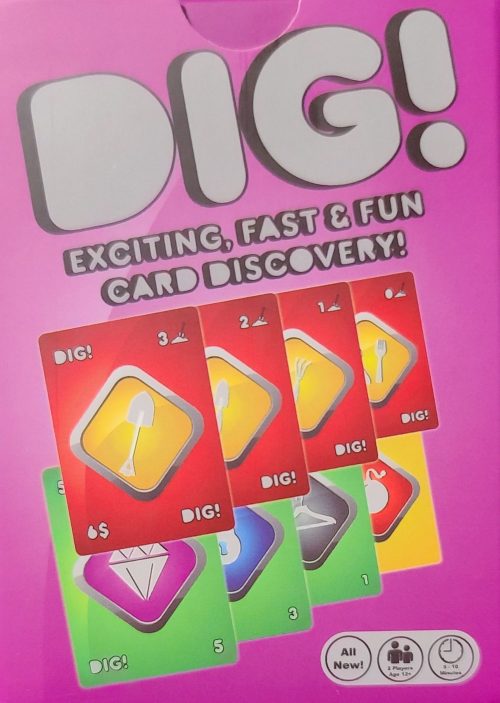
Dig. Such a simple name for a simple yet enjoyable game. Dig is designed as a two-player game, that is easily expandable with the addition of a second and third deck.
Each player starts with a single tool card, a spoon and fork. As the game progresses they have the opportunity to upgrade to other tools. All of the Treasure and Bomb cards are dealt out (buried) into 11 piles, and when you use the spoon and fork, you can peak at the top of any pile. If you go back to a card that you have already peaked at you instead reveal and take it.
You can eventually pay, using your revealed treasure cards, to upgrade from the humble spoon and fork to a rake, that allows you to “dig” the top card of the pile. The rake can be upgraded to a spade that allows you to take one or two cards, then to a shovel that allows you to take one, two, or three cards from a pile. But the downside to upgrading is that you are trading the speed taking more cards for the safety of knowing what you’re taking by peaking first. You’ll continue to reveal and collect treasure cards in this manner, but if you reveal a bomb you lose everything you’ve collected.
A single deck is enough to play the standard two-player game, and there are rules to add part or all of a second deck for three and four players or five and six players with a third deck. I haven’t had the opportunity to play with a third deck, but whether you are playing two, three, or four players it moves quickly and is a great way to cleanse your pallet between other games or just kill time for whatever reason.
I was shocked at just how good this game is for being so simple. I played with a group of heavier gamers and even they loved it. Really, the hardest part bout the game is sorting out the cards after combining decks.
I know that this is a shorter review, but there are only so many ways to express that Dig is a shockingly good game.
You can find Syther Gaming online at www.SytherGaming.com or on Facebook at facebook.com/SytherGamingCo

TheRatHole.ca does not accept payments for our reviews but may have received a promotional copy of this product for review.