
There are many ways that you can acquire a game, you can participate in a Kickstarter, buy online, buy from your local game store, try it out from the library of a Board Game Cafe, or even get it from the “toys and games” aisle in a bookstore or department store. If you are lucky, you might be able to get a preview copy of a game from the publisher, or participate in a beta test at a gaming convention. Other times, a game can just fall into your lap in odd ways: a garage sale, a thrift store, or the increasingly popular social media marketplaces.
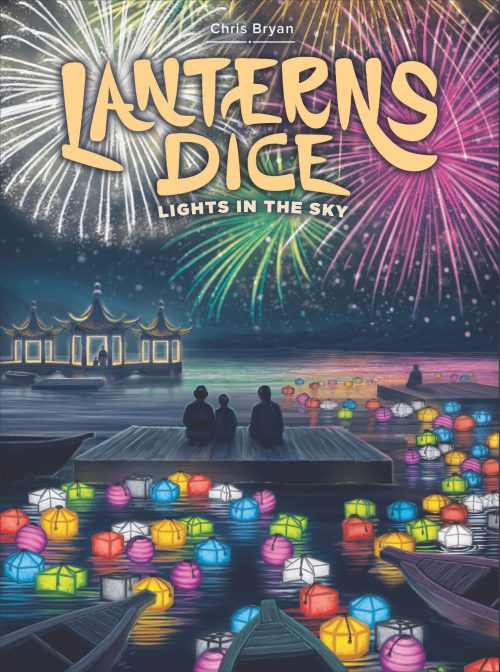
I discovered Lanterns Dice by Foxtrot Games/Renegade Game Studio in a place I never would have expected: in a Liquidation store, for $5. Why did it end up Liquidated? Because the box was mildly damaged: a bit more than a dent, not quite a hole, but enough to keep it off retail shelves. Damage that I was able to fix with four pieces of packing tape.
But enough about me, let’s talk about the game. After Istanbul: The Dice Game, Lanterns Dice: Lights in the Sky is my second “simplified dice version of a more complex game”. The original game, Lanterns: The Harvest Festival, was published in 2015. It’s a set collection, pattern based game using a combination of tiles and cards. I haven’t seen it, but based on the descriptions I found, it has a bit of an Azul or Sagrada vibe, with an Asian Festival theme focusing on creating beauty and gaining honor. The dice game was published in 2019 and plays around with both the theme and the play style. Players are still artisans ordered by the Emperor to create the most beautiful combination of floating lanterns and fireworks to celebrate the annual Harvest Festival. But where the original game involved creating patterns and designs, in this version the designs already exist, and you are trying to claim them. It’s less set collection and more roll and write. It’s a 2-4 person game, and there are 4 versions of the game board (or more accurately, a Player Sheet). Everyone uses the same dice, but they each have different bonuses that they are able to claim. In addition to the Lanterns, you also have Fireworks tiles, which look a bit like Tetris pieces, and can only be placed over areas that have been completely filled in. There are 8 Firework patterns, but only 4 are used in each game. You can also get bonus actions, these bonuses may allow you to reroll dice, shade in an extra space on your board, etc.
Gameplay consists of a specific number of turns, depending on how many players there are. Each turn is divided into 4 stages, some of these stages are only for the Active Player, others allow all players to act. Stage one is Roll and Orient; the active player rolls the 4 six sided dice into the funnel shaped dice tray. The shape of the tray brings the 4 top faces of the dice into a square (or diamond) shape. The active player then rotates the dice tray so that one die faces them, and the other dice face the other players. Stage 2 is Match and Shade. All players look at the colour on the die that is facing them, and choose a triangle shaped area on their Player Sheet of a matching colour/pattern and shade it in. Each triangle is a Lantern, and the square made of 2 Lanterns together makes a Pool. There are several things that you can do that give a bonus. If you shade in a Lantern that completes a Pool with a Platform in the center, you are allowed to shade any other Lantern in a Pool orthogonally adjacent to that Pool (above, below, left or right, but not diagonal) regardless of colour. If you shade either Lantern of a Pool that has a Pavilion in the center, you earn an Emperor’s Gift. You count your gifts by colouring in a gold circle at the bottom of your play sheet. Other Pools have Boats in the center; the location of Lanterns around Boats affects the score at the end of the game. Each turn of the game has a Bonus Lantern on the side of the player’s sheet. At the end of Stage 2, the active player (but not the other players) can shade in a Lantern of that turn’s colour. Cross off your Turn Bonus when you have shaded in your extra Lantern. Stage Three: The Emperor’s Action, is optional. There are three Emperor Cards set up for each game that shows Actions that cost 1, 2 or 3 Gift points. If you have enough Gifts, you can perform one Emperor Action. (You can also spend one Gift during Stage One to reroll your dice.) You indicate that a Gift has been used up by crossing out the gold circle completely. Stage 4: Launch Fireworks is also optional, and can only be done by the Active Player. If you have enough completed Pools to match the shape of a Firework Pattern, you place the Firework Tile onto your player sheet. A Tile can be rotated or flipped to fit the shaded area. Play continues clockwise until the last player finishes the number of turns for that game (10 Turns, 8 Turns, or 6 Turns, depending on if it is a 2, 3 or 4 player game). After the last turn is complete every player has the opportunity to place one more Firework tile before scoring begins.
What I love about this game is that so many things are integrated into the theme. For example, even though all of the player “Artists” are competing to create the best display and earn the Emperor’s favour, no one wants the Harvest Festival to fail. This is why the game is in the “multiplayer solitaire” style, and why there are many copies of the Fireworks tiles. Being the first person to launch a particular Fireworks pattern gives you more points, but it doesn’t stop another player from also launching that Firework. With the exception of Stage one: Roll and Orient, nothing that one player does directly affects the other players. And even when orienting the dice, you would need to have been watching every player’s sheet extremely closely to deliberately keep a player from getting a colour they need. The bonuses also have (implied) reasons within the storyline. Pavilions give you Gifts from the Emperor, because I assume that it is the Emperor and his guests who will be observing from those Pavilions. Platforms allow you to shade more Lanterns because in reality, you would be able to stand on that Platform to reach nearby Pools. And you want to shade in Pools around Boats, but not Pools containing Boats, because presumably, the lower ranked guests are observing from the Boats.
Even the scoring, which like most Roll and Writes is notoriously complex, is made easier to understand if you think of them in the context of the storyline. The first points scored are for the number of Fireworks launched. This is because the Emperor wants this year’s Harvest Festival to be the best possible, and that means Fireworks as well as Lanterns. And a Firework tile placed first gets more points than one placed later because a Fireworks display takes place over time. Next, you get points for your second largest grouping of filled in Pools. Why the second largest? Because the Emperor does not want a single blob of floating Lanterns. He wants several displays that can be seen from different places on the lake. He wants beauty, balance and harmony. Finally, you get 4 points for every Boat Pool that is not filled in, but is surrounded on 4 sides by Pools that are filled in. Because these Boats are filled with honoured guests, who will be able to see beauty wherever they look.
There are a few things about this game that I dislike. First of all, it is a game based around the theme of creating beautiful patterns and displays, but in practical terms gameplay involves covering up colourful patterns with scribbles of pencil or pen. There isn’t any easy way to resolve this, unless you get very ambitious and replace your pencil with 6 coloured pencils for the 6 colours on the dice. Like all pencil and paper games, you have the problem of a limited supply of Player Sheets. There are a couple of solutions here. You can set aside one of each version to be able to photocopy them, or scan them to print them out. You could also laminate one of each version to make reusable boards. Another component issue is that the dice tray is made of cheap plastic, less durable and with a tendency to bounce the dice rather than hold them. One thing that I found a bit awkward was the fact that, even though the box describes it as a game for two to four players, most of the rules book is written from the assumption that you are playing with at least three players.
This wasn’t the only rules related problem. Sometimes difficulties in understanding rules can be as small as a single word. In this case, the word was “may”. There are many things that you may do in this game. You may claim a fireworks tile, if you qualify. You may spend gift points to gain an extra action, if you wish. You may spend gift points to reroll dice if you want. But there was one “may” that was slightly confusing. “On your turn, you may shade 1 lantern area matching the colour shown for this turn in the ‘Turn Bonuses’ section of your scoresheet”. Since this section was also being used as a way to count the number of turns in the game, the fact that this was optional seemed odd. Not to mention, there is no clear indication of what happens if you don’t take the Turn Bonus. Is it gone forever? Can you save it up to use on a later turn? Can you shade multiple “saved up” bonuses in a single turn? We never really found a proper answer, but it seemed like an excessive advantage to say “oh, I didn’t use my White bonus on Turn 7, can I use it now?”.
Finally, Lanterns Dice is one of the few Roll and Writes that doesn’t have an official single player game, something that has become more important in the last few years of isolation. However, there is a fan-created solo mode available on the game’s Board Game Geek page.
Lantern Dice is a pleasantly themed, visually attractive game. It’s a mildly competitive game that is moderately easy to learn and can be finished in under an hour. It’s familiar to people who have played the original Lanterns game, but you aren’t required to know the first game to play this one. Aggressively competitive players who enjoy “sticking it to the other guy” would probably find it a bit boring, but it’s a good casual game.
You can find Foxtrot Games online at foxtrotgames.com or on Facebook at facebook.com/FoxtrotGames.
Renegade Game Studios is online at www.renegadegamestudios.com or on Facebook at facebook.com/PlayRGS.
