
The term cryptid was coined in the 1980s as a way to help legitimize the cryptozoology field in the eyes of the public, rather than using the sensationalistic – and more often than not, inaccurate – term “monster” as the subject of study. The term stuck but has expanded into the cultural zeitgeist in recent years. Originally meaning a creature who has the quality of being hidden, the youth of Gen Z co-opted the term for themselves as individuals who just want to be left alone and hidden, regardless of how they may choose to dress or act.
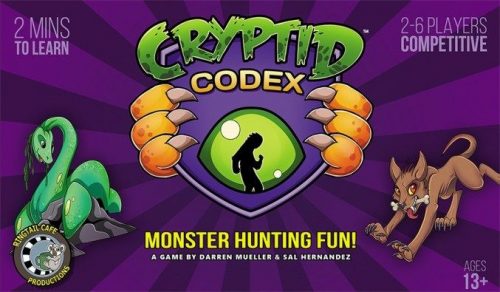
Ringtail Cafe Productions’ card game, Cryptic Codex uses the term in the original sense, as players compete to capture monsters (interesting that they use that term at all, but it is occasionally used interchangeably with cryptid) using evidence and equipment cards. They often have to work together to defeat any given monster, but just as often will want to work against other players, since only the player that finally captures the monster will get credit for it. Not unlike the rest of the scientific world…
Each player starts with a hand of five Capture Cards, then a cryptid is drawn from the Monster Deck to start the game. On each player’s turn they start by drawing another Capture Card, then may play a single card onto any Monster in play. If the card played, and any previous cards played, add up to that Monster’s Capture Total and it is… well… captured. If there are no more Monsters on the table, a new one is drawn. If there are multiple Monsters in play, the player may choose which one to play on so long as there are no other cards preventing it. The first player to capture three Monsters wins.
Monster Cards break down in a reasonably intuitive way: The Monster’s name (shocked Pikachu face), Capture Total, unique special abilities, some fun flavour text at the end, plus they have a coloured title bar. Similarly, Capture Cards have a colour, Capture Value, special effects, and more fun flavour text. The colour is an important element here, as it is common for cards to only affect certain colours, or have a different effect depending on the colour.
It would be very easy for this game to play it straight, with a dark aesthetic and realistic feel, and honestly I wouldn’t mind seeing that as a special edition, but instead they wisely went for an irreverent and cartoony feeling. The furry-forward artwork is fun and just perfect for the feel of the game. The gameplay works a bit like Cutthroat Caverns, with the need for semi-cooperative play with only the final blow getting any credit, but it honestly feels more like Munchkin in that you will often set the other players up to fail in the hopes of playing that final card to capture the Monster. It also has some of Munchkin’s cheekiness, playing on monster names like using Bandshee instead of plain old Banshee. Just for the record, I’m aware that Munchkin is a very divisive game that people either love or hate, if you are in the latter group please don’t take this comparison as a bad thing, Cryptid Codex isn’t nearly as chaotic.
I adore this game, and I adore the artwork most of all. If you ever find them at a convention, look at buying a shirt because wow. But the gameplay is that delightful mix of working with your friends and working against your friends all at the same time. It’s not a mechanic that I’d want to play all the time, but when it works (and it very much does here) it’s a ton of fun.
You can find Ringtail Cafe Productions online at ringtailcafe.com or on Facebook at facebook.com/ringtailcafe.

TheRatHole.ca does not accept payments for our reviews but may have received a promotional copy of this product for review.