
[EDITORS NOTE: If this is your first experience with the Starfinder Roleplaying Game, you may want to consider starting with our previous review of the Core Rulebook. -dc]
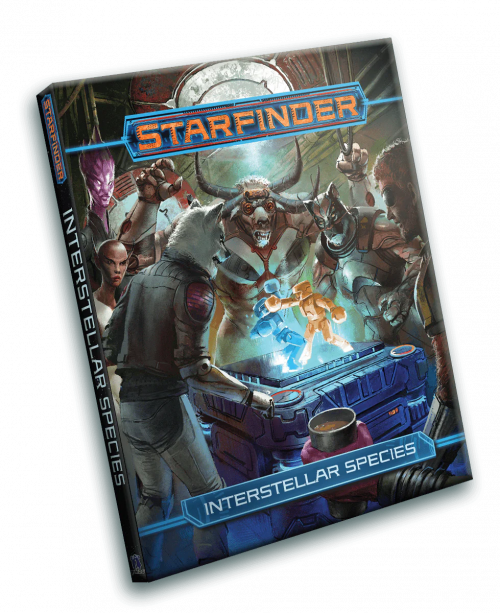
The Starfinder universe is in the middle of a Drift Crisis. Here in The Rat Hole, we’ve recently looked at the main Drift Crisis sourcebook, the Drift Crasher Adventure Path, and we’ll be looking at the Drift Hackers AP soon enough. But in the middle of this massive MCU-style epic event, comes Interstellar Species. I was expecting another sourcebook connected to the ongoing saga. Of course, after the fact, I looked back at the (notably incomplete) list of connected books in Drift Crisis and it’s not there. I made assumptions. Others may do the same, and that’s not ideal. But once the realization and minor disappointment passed, what I found was an incredible book. Not always perfect, but incredible and invaluable.
I’ve often said that the Alien Archives sourcebooks (and any given game’s version) are the most important books on a game. Interstellar Species is largely the player-facing version of those books. Since the beginning, Paizo has felt it’s very important to always expand the playable options available to players. This is a game about finding new things. It’s right there in the name: Star-finder. Alien Archives, various Adventure Paths, and even the Alien Character Deck include strange new species that a player could face off against, or put their face on and play as that species.
Interstellar Species is split into 3 chapters. Classes, Species, and an NPC Gallery. The Classes chapter starts with the brand new player class, archetype, and class graft for NPCs: the evolutionist. This takes up a good 10 pages, and I’m sure someone has done a deep dive into it that’s longer than this whole review. But in a nutshell, an evolutionist uses a polymorph spell-like ability to change their body and abilities. Sometimes these abilities are triggered intentionally and other times they just happen automatically in situations like combat.
There are also new class abilities for the Biohacker, Envoy, Mechanic, Nanocyte, Operative, Precog, and Soldier classes. Now, having new abilities laid out in sourcebooks isn’t new. But this time Paizo takes a slightly different approach to them. A lot of classes assume certain cultural or physiological baselines. Not all playable species feel appropriate for all classes and vice versa. Interstellar Species encourages players to adapt –basically everything– to fit with the species or culture that they want to play. Some examples given are adapting the biohacker class, which assumes you are dealing with a typical meat and blood species, to work with a silicon-based lifeform such as an urog. The nanocyte class shares a physical body with a swarm of nanites, but how would that work for a cephalume and krikik who already share a similar symbiotic bond?
The bulk of the book is the second chapter dealing with the various (and ever-expanding) list of playable species. The “ever-expanding” part of that list includes a section on building your own species. I was a bit surprised that the Custom Species Builder only takes up six pages in the book. Being such a potentially impactful addition to the overall Starfinder mechanics, I expected more. But, as we are reminded, this is intended to create a general species rather than an individual within that species.
From there it covers 25 different species, with each getting four pages worth of details. These are laid out similarly to the Species Builder, but not exactly since they are existing species. The fact that they are existing is part of my only complaint. about this book. Paizo products, as a whole, are very good at providing reference citations pointing players to other books. The species chapter opens with a five-page, alphabetical, grid of playable species along with their sources. The exception is the species detailed later in the book. As an example, let’s look at Dragonkin.
The initial grid shows the source as “PAGE 64.” Turn to page 64, and yes they are there.
After the name header, these entries list that species’ homeworld. In this case, “Triaxus (Pact Worlds).” This is good information, and I appreciate that it says Triaxus is located in the Pact Words region of space. But there is no citation to the Pact Worlds sourcebook (PW 98 for the record) despite that book having 9 more pages of relevant information. There are another two pages in the first Alien Archive book (AA1 40) which is the source the grid would have listed had they not expanded on the species here.
Kobolds have a similar issue, with their source being listed as “PAGE 84” instead of “Alien Character Deck“. Kobolds have no homeworld, but four of the five Feats listed have a prerequisite of the dragonblood theme that also appears in the Traxis info (PW 107).
I get that citations can easily get out of hand, but when the entire point is to expand on the information players have access to when building cool characters, I would happily live without a few sample names or have the artwork be a centimetre smaller to accommodate an “Additional Sources” box. Heck for a species like Kobolds, I would even toss in some Pathfinder sources.
Going back to a more positive note, I was pleasantly surprised by the third chapter: NPC Gallery. I was expecting something more like I would find in the back of an Adventure Path. Here’s Mr. Mario, LG Medium Human, (CR 44) Hazard Professional (PAGE 162). Blah Blah Blah, very specific biography, blah blah blah. But no, the NPCs are presented as generic categories, then more detailed sub-categories.
Sports Figure
>Parabolas Revivalist
>Magical Duelist
>Battleflower Master
Medical Staff
>EMT
>Physician
>Psychic Healer
>Special Forces Medic
The stats attached to these entries are species-specific. So the Paranormal Investigator NPC is a Hadrogaan (PAGE 72) and their statistic reflect that. This allows a GM to just slap a name onto a fully formed NPC and run with it. For an NPC, the species often won’t impact the story, but the entries also list special abilities and other details that would be very easy to port over to whatever suits the narrative.
Interstellar Species wasn’t anything I expected going in. The missing citations bother me more than they probably should. But I’ve pointed this out before, I often write these reviews surrounded by stacks of other books that I’ll cross reference with. Depending on how you approach your games of Starfinder, Interstellar Species will either become a major go-to for you or completely irrelevant to you. For me, I can definitely see this coming out not only when I want to look at building a new character, but also anytime I pull out my Alien Archive books. It might even come out with Pathfinder books for extra character context on things like Kobolds (who have replaced the now-a-core-species Goblins in the PF2 Free RPG Day offerings).
You can find Starfinder, and all things Paizo, online at paizo.com or on Facebook at facebook.com/paizo.

TheRatHole.ca does not accept payments for our reviews but may have received a promotional copy of this product for review.