
Dreaming in Technicolor.
I had heard of Hues & Cues for quite a while now but really had no interest in it (I’d heard it was a light, sort-of party game). Now I’m not opposed to that type of game but I’m also not seeking it out.
Well that all changed a few weeks ago, when I met the designer, Scott Brady & his wife at a local get together. There were quite a few of us, with ages ranging from 10ish to the mid-50s & someone brought it out to play. I said what the heck. Let me tell you, I was pleasantly surprised (& purchased my own copy within the week).
Overview/Gameplay
The idea of the game is simple. One person chooses a shade colour from 4 swatches on a card, then gives a 1-word clue to the group. The clue can be anything as long as it’s not the actual colour (not “green”, “blue”, etc). It can be turquoise though (who really knows what colour that actually is).
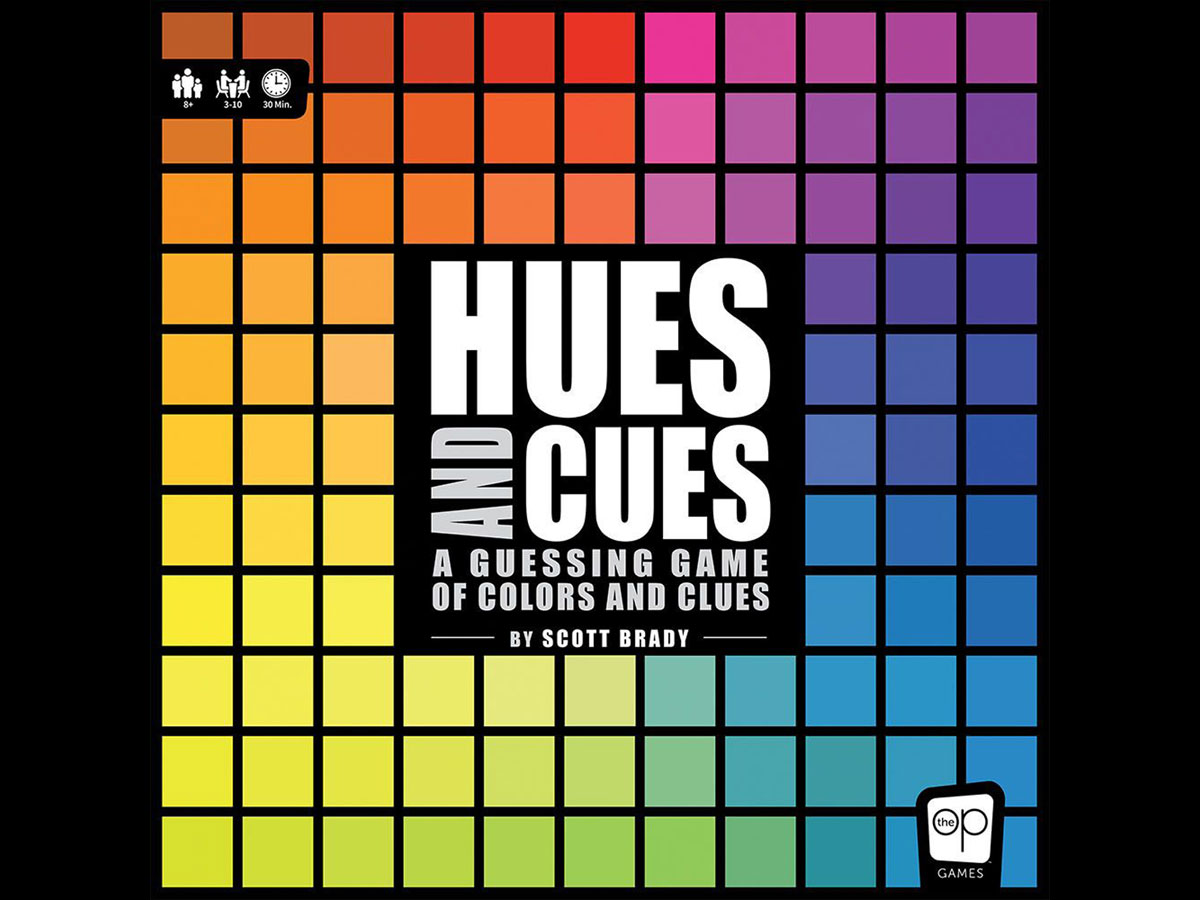
In turn order, each other player with place one of their 2 pawns on a swatch on this good-sized board, which shows a rainbow of colors, across the spectrum (no shades of grey though). Each swatch has a letter/number combination along the side/top which is how the clue giver knows exactly what swatch they’re using as a reference.
Once each player has had a chance to place a pawn, the clue giver will give a 2nd clue, this time up to 2 words (it can’t be “darker green” or “pale blue”). It can be something like cloudy sky or Kermit (again, this is always debated on the actual colour of Kermit the frog). This time, in reverse order, each player will add their last pawn to the board (only 1 pawn per space).
After all pawns have been placed, the clue giver will place a 3×3 “box” on the board, with the actual reference swatch in the center. If one of your pawns is the exact spot, you get 3 points. If you missed the exact spot but are just 1 off, meaning you’re still in the “box”, you get 2 points for each pawn. If you just missed the box, so your pawn is just outside the box, you get 1 point. The clue giver gets 1 point for each pawn within the box, so the clue giver wants to give really good clues, so they can score as well.
Once you’ve recorded the points, you take back your pawns & the next player becomes the clue giver. You can play as many rounds as you’d like, with smaller groups going around the room 2 or 3 times and with larger groups, maybe just once. The game plays 3-10 players so it will accommodate a large group.
Final Thoughts
The game is simple fun. Just about anyone can play it (the box says 8+). The components are fine. Wooden pawns, a board, the “box” (which you build before playing your first game) & a stack of cards. I was recommended to find the original “Made in China” version, since the US version’s components are lower quality.
My only real complaint about the game is more on me than the game. It’s hard to come up with items to match the colour, like something for light blue that’s not “sky” or “water” (& you can’t use items in the room, so you can’t look at someone’s shirt & say “aqua”).
Other than that, I don’t have any complaints. It’s a nice, simple game that even non-gamers will enjoy. Not my standard fare (it’s not a mid-weight Euro) but I enjoy pulling it out with the family & friends every now & then.
7.5/10
You can find The OP online at theop.games or on Facebook at facebook.com/theopgames.
