
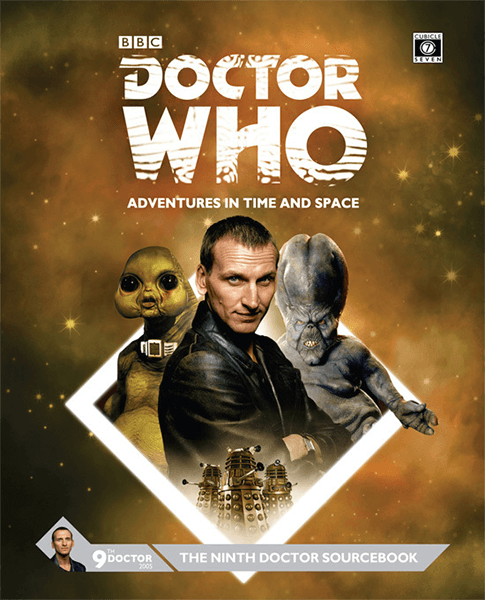
Well, as regular readers may recall, I wrote an article for Cosmic Masque entitled “Classic Who is Better Backwards.” In that article, I explain why I think Classic who should really be watched in reverse Doctor order, 8-1 rather than 1-8, and mention that I’d be reviewing the Doctor Who Roleplaying Game sourcebooks in a similar order. But then there is New Who, or Nu Who, or ‘the reboot”, or Modern Who, or whatever you want to call the show from Christopher Eccleston’s Ninth Doctor until now. For this era of the show, I will often suggest starting with David Tennant’s Tenth Doctor and going forward, then going back to Eccleston after you have a better idea of what the show is like once it got its feet under it. If Jody Whitaker’s Doctor suffered from poor writing, Eccleston’s short run was marred by money, or more accurately a lack thereof. I appreciate the time of Nine, it did what it needed to do and brought the show back to life. But watching from almost 20 years later, it’s easy to see that the always insufficient BBC Budgets were blatantly insufficient as always, with the effects being very dated even for 2005.
Overall, the Ninth Doctor was very much a hit-or-miss season for me. End of the World was an amazing episode that balanced humour with dark allusions to the tragedies that the Doctor faced between Paul McGann’s Eighth Doctor’s lone (television) appearance and when we pick up with Nine. At the same time, I just can’t get past the godawful effects in Rose. So I wasn’t really in a rush to review the Ninth Doctor Sourcebook. Plus, with Cubicle 7 allowing the current editions of the Doctor Sourcebooks to fall out of print, I had even less incentive to tackle it. However, the Universe conspired against me and here we are. Cosmic Masque editor, Nick Smith asked if I’d be doing this review anytime soon. The Legend of the Traveling TARDIS showrunner, Christian Basel, decided that we would take the months leading up to the 60th anniversary to review the first season of the reboot. (Something we hadn’t done up to this point.) Even Earth Station Who was planning to review the two-part Aliens of London & World War 3 just after TLTT had it scheduled. Well, if I have to go through and watch the season, and I’d be using the Sourcebook as reference material anyway, I may as well write about it now. <insert shrug emoji here>
Eccleston’s Doctor is unique. We don’t know how long he’s been in this body. We don’t know what happened in any of the Eighth Doctor’s life after his initial adventure. New fans may not have even realized there WERE previous Doctors at the time. Stephen Moffat used this ambiguity to his advantage, with The Doctor being incredibly upbeat until a memory from his past casts a shadow over any given moment, and then the shadow moves on equally fast. Moffat deftly intertwined hints of the past with foreshadowing of the future. These longer threads subtly woven through a tapestry of (mostly) Monster-of-the-Week style adventures make for a goldmine of potential for a good Gamemaster. Similarly, the book points out that the Ninth Doctor represents a new era of storytelling in a familiar world of stories. It illustrates how a GM can pull together a long-time group of players to both pick up where they left off and still start anew. Many groups of gamers drift apart. Work, life, pandemics, it happens. But even in the Doctor’s own classic era timeline, the Doctor had only really visited the 1990s three times, yet that doesn’t stop him from picking back up in 2005, just like you can in 202X.
The format of the book is pretty standard for the Doctor Who Adventures in Time and Space series, and the later rebranded Doctor Who the Roleplaying Game. It starts with a brief introduction to the Ninth Doctor and what to expect from this book for people who may not have picked up the prior Doctor sourcebooks. That is followed up by “Playing in the Ninth Doctor’s Era” which looks at how things may have changed around Earth (and potentially around your game table) in the years since the Doctor was last on our little ball of dirt, and working with those changes rather than against them. Finally, there is a 7 – 17 page description of all the televised adventures in the Eccleston era.
One of the noteworthy points mixed in with the episode summaries comes with the episode Dalek. There are four full pages covering the history of the Daleks. Now, I obviously haven’t read every DWRPG release, and as I’m writing this I don’t have my library handy to flip through, but this seems like both an odd and a perfectly reasonable place to put such a history lesson. The episode Dalek was the first time a Dalek had appeared on screen since Remembrance of the Daleks kicked off the series’ 25th anniversary season in 1988.
Also of special note, is that the entry for the episode Fathers Day does not include a stat block for Reapers. My assumption, and it is nothing more than an assumption, is that since Reapers are wholly indestructible and impossible to physically interact with non-lethal results, they are more obstacle than adversary. They are effectively a Diabolus ex Machina that should be brought into play sparingly outside of running this specific episode as an adventure.
As I write this, David Tennant’s return as the Fourteenth Doctor has yet to air, and Cubicle 7 has released the Thirteenth Doctor Sourcebook as a PDF only, but I haven’t seen more than the cover. Again, this is nothing more than an educated guess, but my assumption is that Doctor’s 1-11 will eventually be released without the fun spine art mural that the original editions featured and that they will be updated to the Second Edition rules as that happens. There are two reasons I bring this up. First is to reiterate that I am not planning to dive into another Doctor Sourcebook until the physical edition of Thirteen comes out, or until they announce either plans for Four (going backwards) in Second Edition or for Fourteen (which would likely encourage my looking into 10 regardless of whether it’s 1E or 2E).
The second reason, being more relevant to the review at hand, is that the climax of the Ninth Doctor’s time involves a massive invasion story. Ostensibly, this invasion can be treated as a simple plot device to set up the adventure for the players and a background location for the same. But there is a mention that a GM could use the rules in Defending The Earth: The UNIT Sourcebook to actually run large scale battles like an invasion. The UNIT sourcebook has been out of print for a VERY long time. So I’m curious if that will also be updated and republished for Second Edition, or perhaps its mention will be omitted entirely from the assumed update to this book.
I respect what this Doctor needed to be and what the show needed to do. Christopher Eccleston is a fantastic actor and was a fantastic Doctor. But everything else around his era just fails to connect with me. Aside from End of the World, which is easily the best episode of the season, even the episodes I like I’m lukewarm on at best. Because of that, personally, this is the sort of sourcebook I might pass on in other contexts. That being said, I know that my opinion is in the minority on this. Objectively, the Ninth Doctor Sourcebook is every bit as great as the other Doctors’. In the right circumstances, it honestly could be one of the most important sourcebooks in the series. I have a hard time recommending most things Nine, but for the majority DWTRPG players and GMs, it’s a good investment.
You can find Cubicle 7 online at www.cubicle7games.com or on Facebook at facebook.com/Cubicle7Entertainment.
The official Doctor Who homepage is www.doctorwho.tv and the official Facebook Page is facebook.com/DoctorWho.

TheRatHole.ca does not accept payments for our reviews but may have received a promotional copy of this product for review.