
Every now and again I take a few minutes to think about how society consumes things. We, as a whole, tend to be tribal. We will watch ALL of an IP franchise. We will shop at a chain of stores anywhere we can or eat at a chain of restaurants whenever and wherever possible. We buy every possible song from certain artists (something made easier with the ability to buy individual digital tracks. This carries through to gaming as well. Predominantly in RPGs where players will buy all the books, but it also carries through to other areas of tabletop games. There are certain designers and publishers that some people want everything from.
I’ve never been over the top in my consumer tribalism. I don’t seek out brand names. I’m more likely to pick up a single song than a whole album from most artists. Half the time I don’t even notice the designer or publisher of a game until after I decide if I do or don’t want it. But that doesn’t mean patterns don’t exist. What I games get is obviously skewed by virtue of being a reviewer, but even then patterns exist. It would be disingenuous if I didn’t admit this to myself, and my readers. If you go back through TheRatHole.ca (or my work on other websites prior to striking out on my own) you’ll see some of those patterns. One is that I can’t think of a single game I’ve reviewed from Smirk & Dagger that I haven’t appreciated. I haven’t loved everything they put out, but even what I haven’t been completely enamoured with, I can’t and won’t deny their quality. To go down that tangential rabbit hole just a bit farther, Paramedics: Clear! is a game that I’ll never play again if I can avoid it. Everything about it is not for me. BUT the game does what it aims for and does it extremely well. When a producer asked me to create some video segments for their show, I chose that game as my first video because it’s a great game… for not me. I know several people who bought copies based on my review and/or video. (Something that I love hearing about happening, by the way.) They loved it, just as I knew other people would.
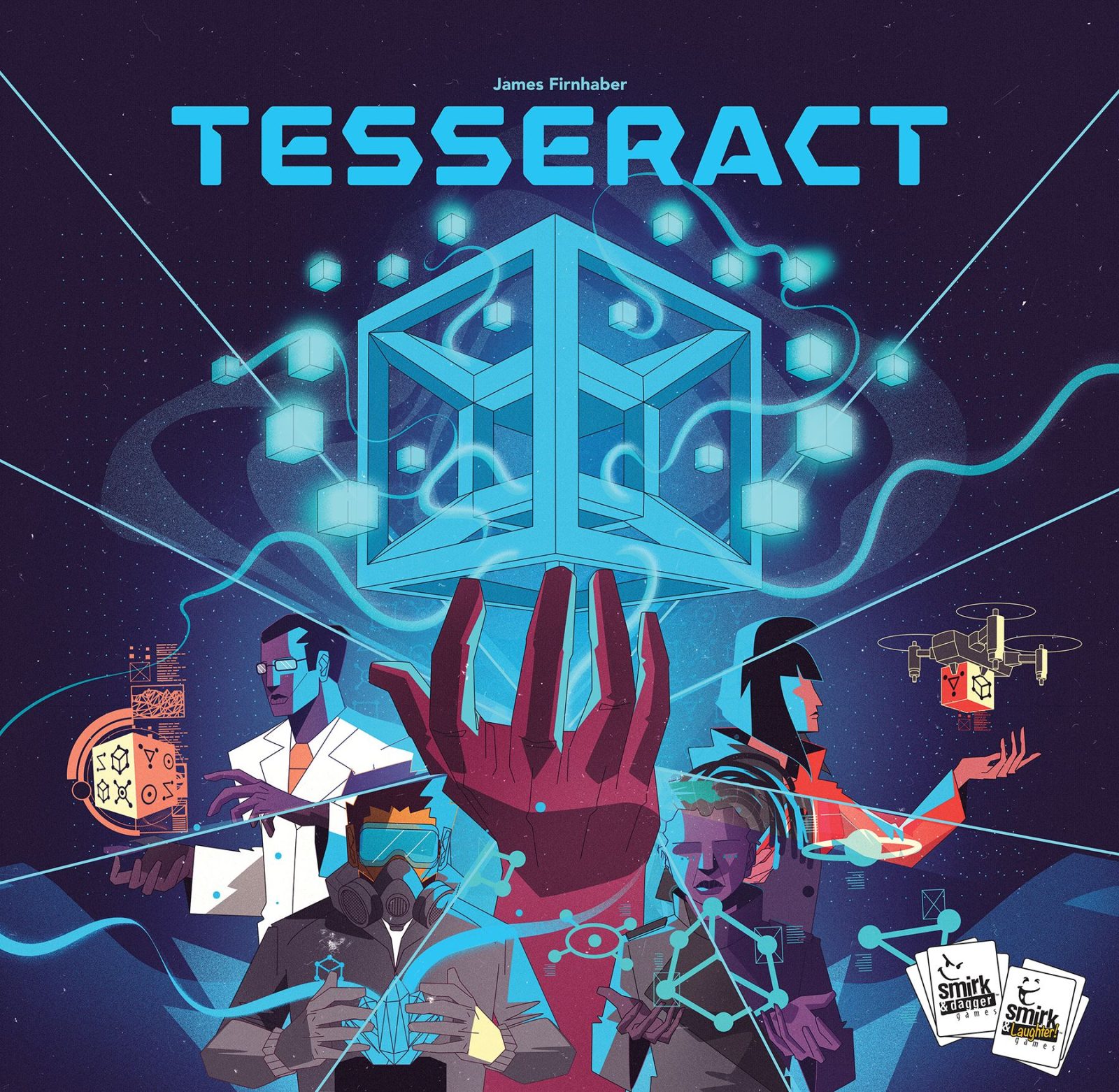
So why am I talking about what I do and don’t like? Because it sort of feels like the last few Smirk & Dagger games that I’ve reviewed have been one-upping each other, and I don’t want to just sound like a hypemachine-shill for them. They don’t pay me for good reviews, they just make great games. Which brings us to their upcoming game, Tesseract.
I was very lucky to get an advance copy of the game at GenCon, but I had another two weeks of travel afterward. But, as soon as I got home this was one of the first games I cracked into. I streamed a few playthroughs of it on our new Twitch channel (with the VoD on our YouTube) and then had a hard time getting it off the table at FallCon this past weekend. What a reception, everyone who played it was blown away and there were always Lookie-Lues checking it out. There were a few Friendly Local Gaming Stores in the vendor area that mentioned having it on order and that took at least a couple of pre-sales that I know about. Sufficed to say, when I say the game is great, I’m saying it based on more than just myself.
Let’s start with the table presence. It takes up a surprising amount of space, but not an excessive amount, and looks stunning. The player mats and the Breach Tracker are made from simple cardstock, which is fine, and they are extremely well laid out. The player (Laboratory) boards have a list of all of the possible actions that players can take during their phase and a reminder of how the Threat Phase works. Similarly, the Breach Tracker Board has a key for all the event icons that can come up. It could be argued that both of these things could have been made significantly smaller without the player aid portions, thus reducing the game’s overall footprint. This is true. The Lab portion of the board could plausibly be reduced to a playing card, with additional player-aid cards if needed. Maybe if Smirk & Danger releases new Base Plates as an expansion or promo, (I’ll explain Base Plates in a moment) cards could be an additional thing. But as-is, they are suitable, functional, and fit the overall aesthetic. There is a heavier gauge Containment board for the dice. Several Base Plates of increasing difficulty. A board for the Tesseract, which is mostly for show, but also delineates top of the Primed area. There is a pair of cardboard vertical supports that slide together, to hold a very well made Lazy Susan ( a plastic rotating base). There is a cardstock sleeve, that you fill randomly with custom dice (cubes) in four brightly (but not obnoxiously bright) colours. When you remove the sleeve, you are left with a 4×4 cube of smaller cubes on top of the Base Plate and Lazy Susan.
Before I get to gameplay, knowing the win/loss conditions are important. Yes, they are always important, but are somewhat more directly intertwined with player actions than in many games. Players win if they can Contain one Cube of each colour and value. They lose if they run out of Cubes on the Tesseract, or if seven Breaches happen. A Breach occurs when three or more Cubes of the same value are in the Primed area. Those terms will make more sense in a moment but Contained good, Primed bad.
Gameplay is straightforward and happens in two phases. First, is the player’s Action Phase. Players can choose three possible actions and play as many Research cards as they want. Actions include Removing Cubes from the Tesseract; Adjusting the value of a Cube in their Lab (player board) or the Primed Area; Transferring a Cube between Labs; Researching by discarding a card to draw a better one; Containing a valid Cube from their Lab and (hopefully) destroy a matching Cube from the Primed Area; or use a Unique action on their individual character card.
To Contain a Cube, a player needs to have a sequential run or a matching set of at least three dice. This run or set must either be all the same colour or all different colours.
Research Cards, provide additional free bonuses or actions, and are separated into three levels of increasing power. As I noted above, as an action, a player can discard a Research card to draw one of the next higher level. The only other way to gain cards is as part of the Containment action. After Containing a die, that player may roll the remaining dice from the used set or run, and draw a research card. Normally that will be two dice, but a valid set or run of more dice is entirely possible, which would gain the player a higher level card.
When the player is finished, the Threat Phase happens. First, the physically lowest Cube on the Tesseract is removed and rolled, this is called Priming the Cube. The Cube is then placed in the matching numbered row of the aforementioned Primed Area. If that results in three or more matching cubes in a row, a Breach happens. If it results in six or more Cubes in a row, you have either had very bad luck or made very bad choices, but either way, it will cause two Breaches to occur, rather than only one.
The Base Plate on which the Tesseract is sitting has a grid on it with each square showing an Event icon. When an icon is revealed, that Event happens immediately, regardless of whether it is the Action or Threat phase. None of the Events are good, but some can be less bad, and I’ll just leave the rest of the descriptions for you to experience firsthand. Good luck.
Tesseract is a fully cooperative game, and talking through your plans is important. It’s easy to accidentally set yourself up to Contain a Cube that has already been Contained, and more eyes help reduce that and more brains can come up with better ideas. The downside is that this game –because it is almost more puzzling than strategic– is extremely vulnerable to player quarterbacking. If you don’t know what that term means in a tabletop context, it’s when a player goes past being helpful and starts controlling what the other players do on their turn. I caught myself doing this with groups after teaching them how to play, and they thankfully were still grateful for the help. But I had to force myself to back off more than once.
Other than the quarterbacking potential, there are very few things I can criticize about the game that isn’t me just being nit-picky. Each of the four numbered Base Plates gets progressively more difficult, but even at the first Plate’s difficulty, every game was a challenge. A win or loss almost always came down to the wire in either direction, which is pretty close to a perfectly balanced outcome. Because I’ve almost always played with newer players, I haven’t attempted the other difficulties, but if you follow our Twitch and/or YouTube channels, I’m probably going to jump straight to the highest level on a stream. (Live on Twitch with the VoD going onto YouTube afterwards.)
Bringing this full circle, and without sounding like a hypemachine-shill, Tesseract is probably going to be one of the best games of 2023. I have yet to come across a player who hasn’t loved it.
You can find more about Smirk & Dagger Games online at www.smirkanddagger.com or on their Facebook page facebook.com/SmirkDagger-310592125355.

TheRatHole.ca does not accept payments for our reviews but may have received a promotional copy of this product for review.