
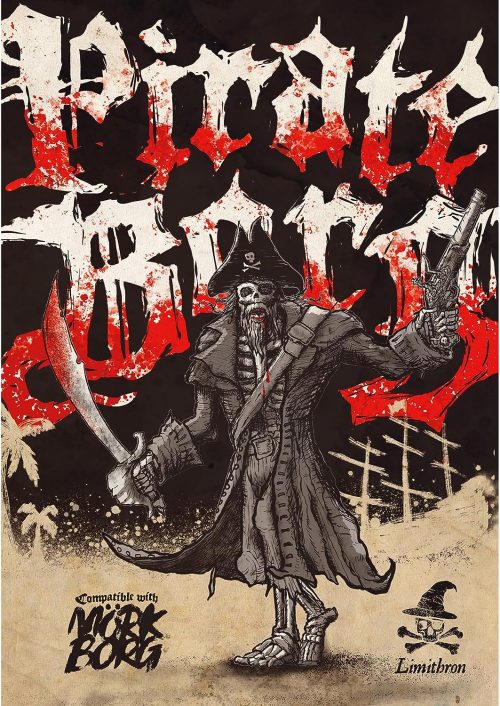
Yo ho! Yo ho! it’s a pirate’s life for… OH MY GOD IT’S ZOMBIES!
No, that’s not me trying to get around the stupidity of new password-sharing policies to download The Walking Dead from the 🏴☠️Bay. Admittedly that’s only because I don’t watch The Walking Dead, but that’s not the point here. The point is pirates and zombies, not that I couldn’t think of an actual zombie pirate movie to reference here. Right, anywho… Pirate Borg
For the uninitiated, Pirate Borg is a reskinning of Mörk Borg. Swedish for Dark Fort or Dark Castle, it’s pronounced Murk Borg and has nothing to do with Star Trek. Taking the theme out of it, the best description of both Mörk Borg and Pirate Borg (and most other 3rd party games using the licence) is that they are “rules light, art heavy”.
So try to start anywhere with this review other than the art honestly feels like a disservice to the chef. Despite the game’s Swedish roots, there’s sadly no actual Chef here, any more than Locutus of Borg is here. But one of the most important things any good chef knows is presentation. We eat with our eyes first. The same often goes for games, with this being a veritable smorgasborg of incredibly stylistic artwork. (No, that’s not how smorgasbord is spelled. Yes, that joke is terrible. No, I’m not ashamed of it.) The not-Swedish not-Chef in question is Pirate Borg creator Luke Stratton who also did the majority of the art (and everything else) with a small handful of well-chosen public domain images. I suspect I can pick the public domain pictures out, but only because I know that they exist from the note in the credits. They are vastly different but that is part of why they work. They are in places meant to stand out as unique against a book full of unique art. I’m only going to gush about one more art thing before moving along. For context, it’s fairly well known to regular readers that I despise working with digital products. They just don’t “feel” right, and they rarely do the books justice. I have a physical first edition copy of Pirate Borg, courtesy of Limithron and a digital Second Edition courtesy of Free League Publishing, who has picked the title up. One of the best decisions Free League has made with the digital version on DriveThruRPG is to break it up. It includes the full book, a “Player Version” that removes anything a GM might want to keep hidden, and most relevant to what I’ve been talking about here: a version exclusively of the two-page art spreads.
The book isn’t intended to be viewed in single-page chunks, or even two side-by-side single chunks. It’s intended to have individual pieces of artwork (or sometimes just a table) splashed across continuous two pages. Having that simple addition shows a level of awareness and respect for the artist that I don’t often see from the bigger companies.
Let’s move on to some of the guts of the game, with Character creation. Creating your Player Character can be incredibly fast and easy. If you want to build a character with more specificity, that can be done, but there is something fun about the spontaneity of rolling virtually everything and playing with what you get in a few easy steps.
- Roll some starting stuff
- Roll your raw ability scores. These will change, and at the end of the process what you rolled won’t be used.
- Roll a class. There are six “regular” classes, plus an additional two optional classes that are more fantastical. Based on your class, roll your hit points, weapons and clothing, and “Devil’s Luck.” You’ll also adjust your ability scores to determine the modifier that will be added or subtracted when rolling a test against that ability.
- Roll a bunch of non-mechanical attributes that contribute more to your role than the playing.
- Name your piratical masterpiece.
- Play the game.
Does that seem like too much work for you? Good news, one of Limithron’s patrons designed a random pirate generator that can spit out a new Player Character at a click.
Ready for the other rules? For most die rolls the player will be given a Difficulty Rating that they will need to roll over on a D20, plus or minus their character’s modifier for whatever the Stat is that they rolled. Players roll Strength for Melee combat, Presence for Ranged combat, and Agility for defence against attacks. All of these are usually rolled against a Difficulty Rating of 12 for the average enemy. Enemies don’t roll at all, just the players, so if the player fails their Agility roll for defence, they get hit. Violence rules take up a whole 2 pages. Naval Combat takes up a whopping three more pages and another four pages for Maritime Travel including the optional Wind Rules. What’s a pirate game without boats, after all.
Speaking of the pirates, I guess I should circle back to the Character Classes. Before I get to the classes themselves, I want to point out the graphic design. I already raved about the art, and the Character Classes are no different there. But what I skipped over is the graphic design side of the art. Each Class has a completely different look and feel, with a two-page spread whether they need it or not. Less information just means more space to fill with cool art. The Brute feels like indigenous cave/stone art. Rapscallion features skeletal hands holding cards. The Buccaneer feels more classically “pirate” whereas the Swashbuckler is much darker. The Zealot has a very clean 1800s “religious text” style whereas the Sorcerer wouldn’t feel out of place in a very gothic Sleepy Hollow. The other two “optional” classes have much more info and less art, but they are Haunted Souls (including Ghosts, Vampires, Skeletons, etc.) and Tall Tales including things like Merfolk and Sentient Animals.
There’s a good-sized bestiary, rules (tables) for Treasure Maps, creating Uncharted Islands, Quests, and more. If you can think of a game element, it can probably be procedurally generated from tables.
The book closes out with a sandbox-style adventure called The Curse of Skeleton Point. Not all, but most introductory adventures tend to be relatively linear in nature. Easy to follow as a new GM and as a Player. This module needs both a better plan but also requires no planning whatsoever. The introductory section points this out, along with advice to use it to run a one-shot, a short story arc, or even a full campaign using the same adventure. The way it’s designed, a GM could run it in the background of an existing campaign as almost a series of interconnected side quests between larger stories. Oh, and the art is great.
I saw a comment in an online group, that Pirate Borg really should market itself as a Solo RPG because so much of the game is or can be quickly generated on tables. Mörk Borg does have a solo-specific ruleset, called Dark Fort that was included in the Feretory supplement, and Limithron has a short solo adventure based on that, called Dark Tides. (There are also several 3rd Party Solo Rulesets.) I’ve been doing more solo gaming on our Twitch channel, so maybe, just maybe, I’ll try that out someday.
I know this review might feel a bit all over the place, and that reflects a bit of the book formatting as well. As beautiful as the art is, and as cool as the graphic design is, it is also the game’s challenge. There are no chapter breaks, and there is a new header every few pages. Because there is so much art, everything blends together a bit. There are also more fonts used than I even want to try to count. Each Character Class, for example, has at least three mostly unique fonts used for each two-page spread. This made some things difficult for me to read, to the point of being a potential accessibility issue for a lot of people.
Those two criticisms aside, I absolutely adore the game. I’ve spent the past few years actively avoiding Mörk Borg products because I didn’t want to learn another new system that would open me up to doing way more reviews than I have the brainpower for. Well, I’m in now and loving it. Yes, that means you’ll see a few more Mörk Borg reviews pop up in the coming months.
For now, you can find Limithron online at limithron.com or on Facebook at facebook.com/Limithron.
Free League Publishing can be found online at freeleaguepublishing.com or on Facebook at facebook.com/FreeLeaguePublishing.

TheRatHole.ca does not accept payments for our reviews but may have received a promotional copy of this product for review.