
In a recent issue of Cosmic Masque Magazine, I reviewed the new (now not so new) Doctor Who: Nemesis tabletop game from Gale Force Nine. At the end of that review, I promised a part two would be coming, to look at the different player options in the game. It took longer than planned, but here we are. By all means, I recommend pulling out that issue or heading to TheRatHole.ca/dw-nemesis-1 to re-read that review, as I don’t intend to go over the mechanics of the game in any sort of detail here. If you decide to simply read on (which you are more than welcome to do) and feel a bit lost, you know what to do. But for today, and over the next few weeks, I’m going to dig into each of the Doctor’s various nemeses that are featured in Doctor Who Nemesis.
While I won’t go over the mechanics again, I will remind you of what the concept of the game is. Each player will take on the persona of one of the Doctor’s classic nemeses: Daleks, Cybermen, Weeping Angels, or The Master. Each nemesis has a unique, double-sided, Control Board with a different faction or iteration of their chosen nemesis on either side. I’ll be going into the details of each of those factions in these articles, but as an example, when playing as the Daleks you would play as either Davros or as the Dalek Emperor. Each player also has a unique deck of cards for their chosen nemesis and an additional set of cards added to that for their chosen faction. Further added to their deck are cards representing two randomly selected Doctors (Doctors 1-13 plus the War Doctor). Since I used the Daleks as an example, I may as well start with them.
DALEKS Core Deck and Control Board
We all know the Daleks. We all know their battle cry of “EXTERMINATE!” The Daleks are probably as synonymous with Doctor Who as the TARDIS itself. Being such an aggressive race, it should come as no surprise that the core Dalek deck has a strong focus on Conflict bonuses. Its two core Scheme cards, ‘Exterminate’ and ‘Annihilate’, are each triggered by having two or more Captured Doctors. Now, there are a lot of adjectives that could be used to describe the Daleks, but generally speaking, “dumb” is not one of them. So the core Dalek deck also has a strong focus on deck manipulation. Multiple cards allow the player to draw more cards, force their opponent to discard cards, or even Retrieve cards from their own discard pile. One of the more interesting cards is the ‘Dalek Puppet’ (Nemesis, Character ; Slave, Minion). The ‘Dalek Puppet’ card can be played on any Location on any player’s Control Board, then choose a Character card at that Location and look at that Character’s Owner’s hand. The player may discard the ‘Dalek Puppet’ to choose and discard a card from that other player’s hand.
When playing as the Daleks, you may choose to play as either Davros or the Emperor Dalek.

DAVROS faction
Davros first appeared in the Fourth Doctor serial Genesis of the Daleks, written by Terry Nation, creator of the Dalek concept. As the chief scientist of the Kaled race on Skaro, Davros used his intelligence and status to expedite the evolution of his species who were destined to die of radiation poisoning. The result was the tentacled monstrosities that he would name Daleks. To protect his creations, he developed the Mark III travel machines that even the most casual fans can identify as being “Dalek”. Unless, of course, said Dalek’s image is on that t-shirt that says how great R2D2 was in Star Trek…
In the game, Davros’ Control Board Locations are Skaro, Occupied Earth, the Dalek Fleet, and the Medusa Cascade, with an Ongoing Ability to gain 1 Power whenever he moves a Planet Constant card. Four of his faction-specific cards are a ‘Stolen World’ (Nemesis, Constant ; Planet, Scheme), which must be played at the Dalek Fleet Location. One of the actions that can be taken at that Location allows all Minions or 1 Planet to be moved. As noted in parentheses after the card name, the ‘Stolen World’ cards have the Nemesis and Constant card type, with the traits Planet and Scheme. If Davros ever has three Planet Nemesis Constants at the Medusa Cascade Location the ‘Stolen World’ Scheme is triggered and he wins. His fifth card is ‘Reality Bomb’ (Nemesis, Constant ; Installation), which must be played on the Medusa Cascade Location and allows Davros to discard 2 Power to vanquish a Hero card or a Hero Constant there, so long as there is also a Planet Constant at the location. A Planet Constant like, I don’t know, a ‘Stolen World’?
EMPEROR DALEK faction
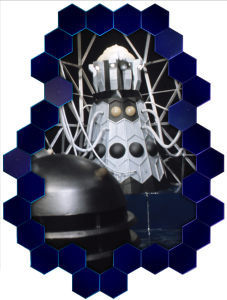
Although the Dalek Emperor first appeared in the First Doctor story, The Dalek. The later (mostly missing) Second Doctor serial, The Evil of the Daleks, was intended to be the last for the Daleks in Doctor Who, as Terry Nation was trying to sell them to American audiences. In hindsight, that obviously didn’t happen and the story is widely considered one of the best classic Who stories ever made. Sadly, only one of the seven parts of the serial remains in its original form. The Daleks would soon return and remain a mainstay of the Whoniverse, even today. The Dalek Emperor, specifically, had a major impact on the newly returning Ninth Doctor’s entire story arc. However, it is the original 1967 Emperor that appears on the Control Board for the game.
In the game, Emperor Dalek’s’ Control Board Locations are a Dalek Control Room, Dalek Lab, Dalek Mothership, and The Time War and has a permanent Conflict Effect that allows the player to discard one card and draw one card when they win a Conflict. Both of their two Scheme cards are ‘Locate’ (Nemesis, Moment ; Scheme) which, when played, allows you to gain 1 Plot if there is a Dalek Character at the Time War Location. To trigger a win with this scheme the Emporer Dalek must have 5 or more Plot tokens. The other three cards are ‘Disposable Allies’ (Nemesis, Character; Slave, Minion), which allows you to search for 1 Moment card in your deck. ‘Recovering Davros’ (Nemesis, Constant ;) has the Ongoing effect of, as an Action, allowing the player to Retrieve one Moment card from the discard pile if there is both a Dalek Character and a Slave Character at that Location. ‘Local Labour’ (Nemesis, Character ; Slave, Minion) rounds out the five Emperor Dalek Scheme Cards. This Character, as an Action, gives the player 1 Plot if there is also a Dalek Character at the same Location. While this gives a significant boost towards triggering the ‘Locate’ Scheme’s win condition, ‘Local Labour’ also gives a -3 in a Conflict. -3 is a signifigant detriment in conflict and an opponent who is paying attention may be able to use that to their advantage.
Over the next few reviews, I’ll be looking into the remaining three nemeses. Until then, you can find Gale Force Nine at www.gf9.com or on Facebook at facebook.com/GaleForceNine. You can find more of my Doctor Who gaming reviews at TheRatHole.ca/who*. Enjoy.
[Editor’s Note: at the time this goes live we are experiencing some technical difficulties behind the scenes. Our Doctor Who Games landing page is specifically impacted and may not include our most recent Who reviews, including our Nemesis reviews. -dc]

TheRatHole.ca does not accept payments for our reviews but may have received a promotional copy of this product for review.