
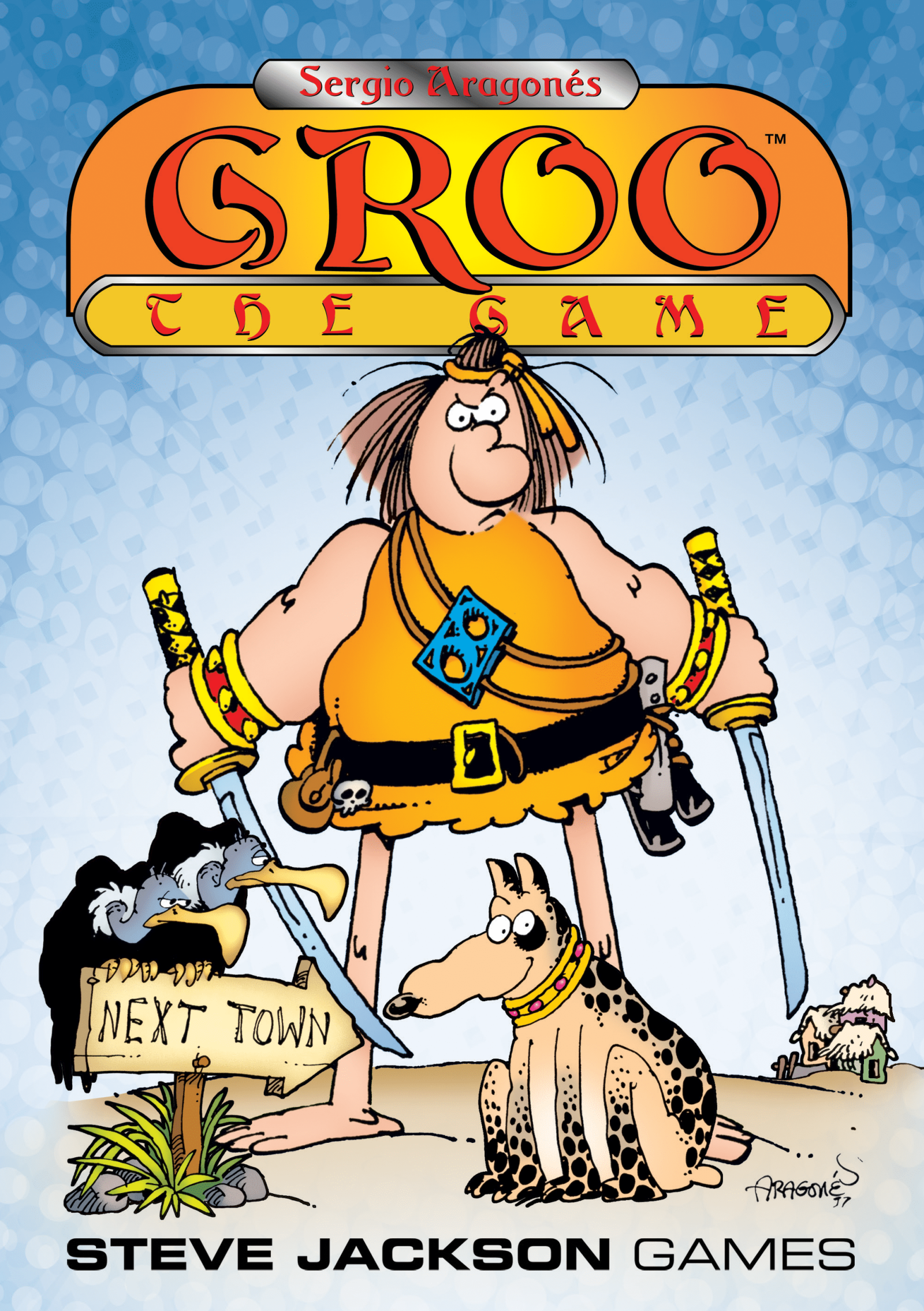
Let’s talk Groo. No, not Gru from the Despicable Me movies. I’m talking about the legendary comic book, Groo the Wanderer. On its surface, Groo looks like a goofy kids’ comic. It’s not. I mean, to a certain extent it is. I first encountered it when I was quite young and I won a copy of the short Graphic Novel, Death of Groo. At the time I was a big fan of Marvel’s Star Comics imprint, and even though Groo wasn’t part of that line it was stylistically very similar. Many years –and several publishers– later, Groo is one of the few comics that I continue to actively collect (albeit only the Trade Paperback collections.) I’m going to apologize in advance if I bring the discussion back to the comics too often. I promise I could ramble and rant way more. Did I mention I’m a fan?
So imagine my surprise a few years ago when I found out there was a long-out-of-print Groo card game. A copy found its way into my hot little hands and I had originally planned to review it, along with Teenage Mutant Ninja Turtles and Usagi Yojimbo as part of a month-long series focusing on games based on comics that had a major impact on my life. Little did I know that TheRatHole.ca would be successful enough that I quickly had no time for those older games. But now, there is a new edition of Groo: The Game. So now I have a new chance to discuss this delightful game.
The new Steve Jackson Games version of the game is not an exact clone of the original, but it’s darn close. The cards are a bit smaller, a bit thicker, and have a less dated layout. This edition also includes both the original 60-card base game and the 55-card expansion set. One of the observations on the original game was just how much better it plays with both sets, so I’m pleased they are both included from the get-go. For myself I couldn’t imagine only releasing the original base set, mechanics aside the expansion is where the vast majority of Groo’s vast array of characters show up. It’s these other characters that make the world of Groo so special.
You see, in the comics, Groo is the titular character but isn’t strictly the protagonist. One of the things that makes the Groo comics so unique is that the lines between literary definitions are both fuzzy and often fluid. More often than not, Groo is a catalytic character, affecting the story of the characters around him. Groo is inevitable. Groo doesn’t *do* things, Groo *happens* to things.
Within the game, this is mechanically represented by the omnipresent Groo card and Groo Effect cards. There is only one Groo (be thankful for that small mercy) and he moves from one player’s town to another at the whims of the black movement die. When a player uses a Groo Effect card, that card only impacts the town where Groo is currently located.
The gameplay is very straightforward. But the order of the phases is important. The active player first may discard any or all cards from their hand, before drawing back up to five cards. Then, if they want to, they can attack one of their enemy’s towns. Then comes the construction phase, which has its own order.
The player rolls all seven dice. If the black movement die shows a MOVE result, Groo immediately moves around the table accordingly. Spend any dice showing a Groo Head to play Groo Effect cards. Then spend the Kopins (money), Supplies, and Labor results to play Troops or Buildings into your town. Buildings have many effects once built, but most importantly provide Victory Points while standing. Troops may be generic soldiers or specific characters that may be used to attack or defend a player’s town. Like buildings, Troops may also provide other benefits while in play. When a Troop card is used in any sort of combat they are discarded, so it is not uncommon for a player to need to weigh the consequences of their actions.
Any Leftover dice (both Groo Heads and Raw Materials) are then passed on to the next player who may use any of them before passing any further Leftovers to the next player, and so on. Finally, the original active player draws back up to five cards and the next player begins their turn.
For the average player, Groo the Game is a lightweight –but not too lightweight– game that can be taught and played quickly. The game ends when a player finishes their turn with 7 points worth of buildings in their town or when the draw deck runs out twice. For a fan of Groo, it’s a chance to play in Rufferto’s sandbox and revel in all of the the destruction and cheese dip that is Groo.
I really have only one complaint with the new edition, and it’s a deep cut complaint from a longtime fan. The Minstrel card should have had a different lute head. In the comics, the character of The Minstrel often acts as a de facto narrator and always speaks in rhyme. This is mechanically part of the card, which must be discarded if the player stops speaking in rhyme. But the other important characteristic of The Minstrel in the comics is that the head of his ubiquitous lute is never the same between panels. This is never referenced (that I can recall) and is completely ridiculous. It is peak Sergio Aragonés. The artwork throughout the game is exactly the same between sets, but The Minstrel’s lute should have been different. 99% of players would never know the difference, but everything else in the world caters to the 1% so dang it I want this. Mr. Jackson…. Steve baby… promo card(s)… pretty please? Include a new Minstrel card in an expansion. Include a new Minstrel card in EVERY expansion. Come onnnnnn….
You can find out more about the world of Groo online at groo.com or on Facebook at facebook.com/Officialgroothewanderer.
Steve Jackson Games is online at sjgames.com and on Facebook at facebook.com/sjgames.

TheRatHole.ca does not accept payments for our reviews but may have received a promotional copy of this product for review.