
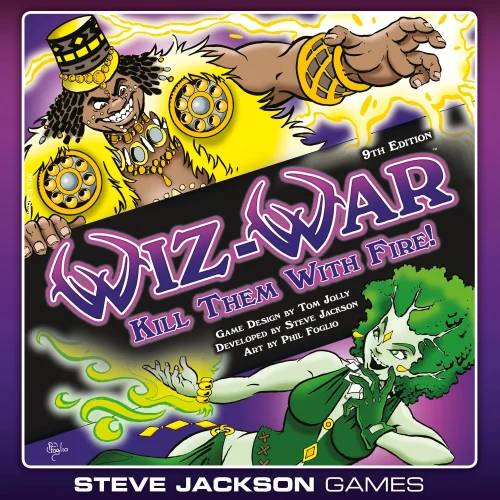
Wiz-War is a game with a long and fascinating history. The year was 1985. The entire landscape of entertainment was about to be changed with the introduction of the Nintendo Entertainment System and Super Mario Bros. The landscape of sports would soon be changed by NBA “Rookie of the Year” Michael Jordan. The less said about New Coke, the better. The top-selling board game was Mattel’s Pictionary. It was into this unexpecting world that Tom Jolly self-published the first edition of Wiz-War. Little more than handmade components and photocopied rules, who could have thought that four decades later we would be sitting here talking about a NINTH edition of the game.
Being a game older than many of its new players, there will always be some controversy over “the best” version of Wiz-War. In fact, the Eighth Edition even has its own separate entry on Boardgame Geek. I don’t plan to go over all of the differences, but there are a few that I probably would mention in any case, so I may as well start with those.
The biggest difference is that the current edition plays up to six players, compared to four in the previous edition. During setup, one of six double-sided map tiles is placed for each player. Each tile has a unique map layout and each player count uses a different layout of the tiles. This brings us to another major improvement. Previously the Wizard’s Lair space for each player was printed on specific tiles. Now, each tile has a hole and each player has a token in their colour that fits snugly into that hole. What that means is that there are more possible board layouts at any player count than I’m willing to do the math for. The next difference doesn’t segue quite as seamlessly. I already mentioned the increased player count from four to six. So there would inevitably be some sort of change to the player markers. Previously there were miniatures representing each wizard. Well, minis are not always the right decision, so rather than increasing the cost of the game with minis Steve Jackson Games decided on cardboard standees. Standees take up less space in the box, cost less to manufacture, and probably show off the new artwork better. Now, that’s not to say that I wouldn’t love to see Phil Foglio’s inimitable art models and made into minis that we could feature on our Slinging Paint show. But standees are the better choice out of the box. [Editor’s note: Those actually exist as 3D print files.]
Let’s back up a bit. What is Wiz-War? Essentially, it’s hardcore Capture the Flag with magic. The winner is the first player to gain two victory points. You gain a point for stealing an opponent’s treasure (“the flag”) and returning it to your own Lair. You also gain a point for killing an opposing player’s wizard.
You can just run around using your basic 3 squares of movement if you want. Similarly, you can just punch your opponent for 1 damage and eventually do the 15 damage needed to take them out if they don’t heal. But those are both boring options. When you attack, there are cards you can play that make things way more interesting. There are cards you can play to physically block the path for other wizards (and sometimes yourself). There are defensive cards. There are magical cards. Basically, there are cards that do everything you might expect. But wait, there’s more! There are cards that even do nothing! Well, they do nothing on their own. These are cards that only have a number on them and they are used to amplify an effect or action. So instead of walking 3 squares, you could walk 6 or instead of hitting someone for 1 you could hit them for 5.
Arguably the most interesting cards are the ones that allow you to rotate or swap segments of the board. One moment you could be mere steps from victory and the next you are hosed. Just as evil is the card that switches places with another wizard.
I haven’t had the chance to play with a full six wizards, on the six-wizard sized board. But I can certainly envision the chaos after playing with 3-4 players. The game has enough potential to hose your buddy that it fits the vibe that many Steve Jackson games give off. As long as you don’t rules lawyer it to hard, the game is straightforward and easy to learn. I can see why this game never became a staple in the tabletop world of the 1980s and 90s. But at the same time, there is a good reason that we are sitting here in 2024 playing a ninth edition of the game:
The game is great, review done.
Steve Jackson Games is online at sjgames.com and on Facebook at facebook.com/sjgames.

TheRatHole.ca does not accept payments for our reviews but may have received a promotional copy of this product for review.