
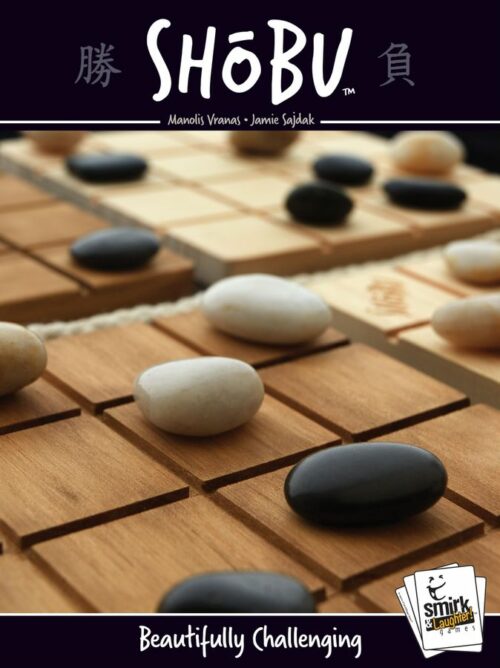
The first thing I noticed when I saw Shōbu by Smirk and Laughter Games (a division of Smirk
and Dagger) was that it feels like a traditional game. Looking at the layout and the components
gives a sense of games like Go, Backgammon, Chess or Checkers; a game that has been
around for centuries, if not millennia. The boards are made of solid wood; the playing pieces are
genuine stones, polished but otherwise not shaped in any way; and the division between player
territories is a simple length of rope. Even the name itself feels traditional. Shōbu means “a
game or contest” and is the English pronunciation of the Kanji for “Win” and “Lose”. Despite all
this, the game was created by Jamie Sajdak and Manolis Vranas, in 2019.
The game box describes Shōbu as “timeless”, “elegant”, and “beautifully challenging”. If I were
to describe the game in only one sentence, I would say, “It’s like playing four games of checkers
at the same time, with the assistance of a twin who can only copy your moves exactly.” If that
sounds intimidating, I apologize, but this game fits solidly into the “easy to learn, fun to play,
years to master” category. The setup for the game consists of four square boards, each one
having 16 squares in a 4×4 pattern, themselves arranged into a square, divided by the rope.
There are two light-coloured boards and two dark-coloured boards, and each board has 4 black
stones and 4 white stones. Players decide who plays what colour; black always plays first.
Now come the rules, which are a lot easier to demonstrate than they are to describe. A player’s
turn consists of two phases, the Passive move and the Aggressive move. The Passive move is
on either one of the player’s boards (the near side of the rope), and is a sliding move, one or
two spaces, in any direction. The passive move cannot push another stone. Next is the
Aggressive move, which is on either one of the opposite coloured boards (light or dark). You
can move any of your stones, but only the exact same direction and distance as the first,
Passive move. Aggressive moves will push your opponent’s stones, but cannot push your own
colour. Two pieces side by side, regardless of colour, are a block that cannot be pushed. The
goal of the game is to push your opponent’s pieces off the board while protecting your own
pieces. The game ends when all 4 of one player’s stones are removed from any one of the four
boards.
Shōbu requires both tactics and strategy; as well as the ability to split your focus. You often
have to “think backwards”, deciding on your Aggressive move first, and then creating a Passive
move that will make it possible. You need to think about both defense and offense, and pay
attention to what is happening on all four boards. As the game goes on, and there are fewer
stones in play, there are fewer options. There’s a chance that one or both players will be stuck
in a holding pattern, waiting for the other person to make a mistake.
Every time I played this game, I immediately wanted to reset the board and try again. I could
definitely see this becoming a new classic, as popular as chess or backgammon. Try this game
if you want to exercise your brain.
You can find more about Smirk & Dagger Games online at www.smirkanddagger.com or on their Facebook page facebook.com/SmirkDagger-310592125355.
