
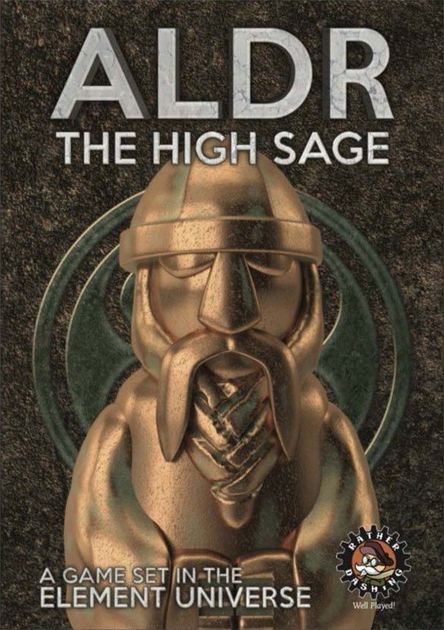
ALDR: The High Sage is “a game set in the Element Universe” so before I started writing this review I figured I’d go back and read my review of Element…
Wow. I need to just take a moment to say thank you. I published that review in July 2018. Almost five years ago. Rather Dashing was one of the first publishers to support the opening of TheRatHole.ca, trusting me with review copies before I had even officially launched. So thank you to them, thank you to the other publishers who have trusted “me” (which has grown to “us”), and most of all thank you to all our readers and followers who have joined us for almost five years. It blows my mind, and I am both humbled and immensely grateful.
Sorry, that had to be said. Plus, Element being at least five years old isn’t totally irrelevant. But I’ll start again…
ALDR: The High Sage is “a game set in the Element Universe” so before I started writing this review I figured I’d go back and read my review of Element. At the time I said it was one of my favourite abstract strategy games. Unfortunately for me (but fortunate for others), I donated it to a charity event so it’s been a while since I’ve been able to play it. That also means I’m not able to try out integrating ALDR into Element, but I’ll give an overview of doing just that a bit later.
The game begins with a square start card on the table, the size of two regular game cards with each of the four elements represented on it, and each player has a hand of five cards as well as a “tapestry” that acts as both a player aid and scorecard.
On a player’s turn, they take four actions in order. Play two Element cards from their hand, place one or more of your pawns if you are able, move The High Sage figure, draw two cards. The first player to create and claim all four elemental patterns (by placing their pawns) wins.
When you place a card you must overlap at least one element icon in play. An Element can cover an Element of the same type, or another Element using the same Rule of Replacement that Element (the game) uses. Water can replace Fire. Fire can replace Wind. Wind can replace Earth. Earth can replace Water. This cycle is noted in the centre of the player’s tapestry. There are also blank Voids and wild Seal of Aldr icons that can replace and be replaced by any other Element.
The goal is to create each elemental pattern showing on your tapestry, placing your pawn on one of the spaces to claim that pattern. Elements in play can be used in more than one player’s pattern, with the exception of any space containing a pawn or the High Sage figure. Similarly, the Elements used to score a given pattern can be replaced, also except spaces with pawns or the High Sage. No figure can be placed on a Void or Seal space. A Seal can be used as any Element in a pattern, a Void cannot.
That’s it. The rules aren’t all that challenging, but against other well-matched players, the game can be super challenging.
One concern I had at first glance was that the player colours are all very similar. Forget visual impairments, if you’re playing in bad lighting it’s almost impossible to tell the difference. BUT that doesn’t actually matter. A pawn in play is a pawn in play and ownership is irrelevant. A player can only claim any elemental pattern once, and you can always see what players have claimed on the tapestry in front of them. It’s one of those things that has a “this feels wrong” factor to it for most people, but it seriously doesn’t matter. The other thing that bugs me (and possibly only me) is that the player pawns are referred to as “Sage Figures” and I just can’t do it. Element (the game) has “Sage Figures”. The Aldr the High Sage piece is a “Sage Figure.” The player pieces are, in every way, a pawn. I know I may be irrationally annoyed by this, but I am. Now if there was a deluxe expansion with miniature versions of actual Sage Figures, I would love it. (But objectively that’s not remotely a necessity or likely even reasonable to ever produce.)
As an expansion to Element (the game), all that is needed is the starting card and the Aldr the High Sage figure. Aldr can move in a straight-line direction on the Element gameboard, and the active player may place one of their drawn stones on the ALDR start card to have the High Sage figure take on the functional aspects of the chosen Element.
ALDR the High Sage is easy to learn, easy to play, challenging to master, and visually near-perfect. It checks all the best boxes, and it shows. This is a great game. I received this copy at Origins in October. It was the first game I cracked into before I had even left Columbus and have been playing it ever since.

TheRatHole.ca does not accept payments for our reviews but may have received a promotional copy of this product for review.