
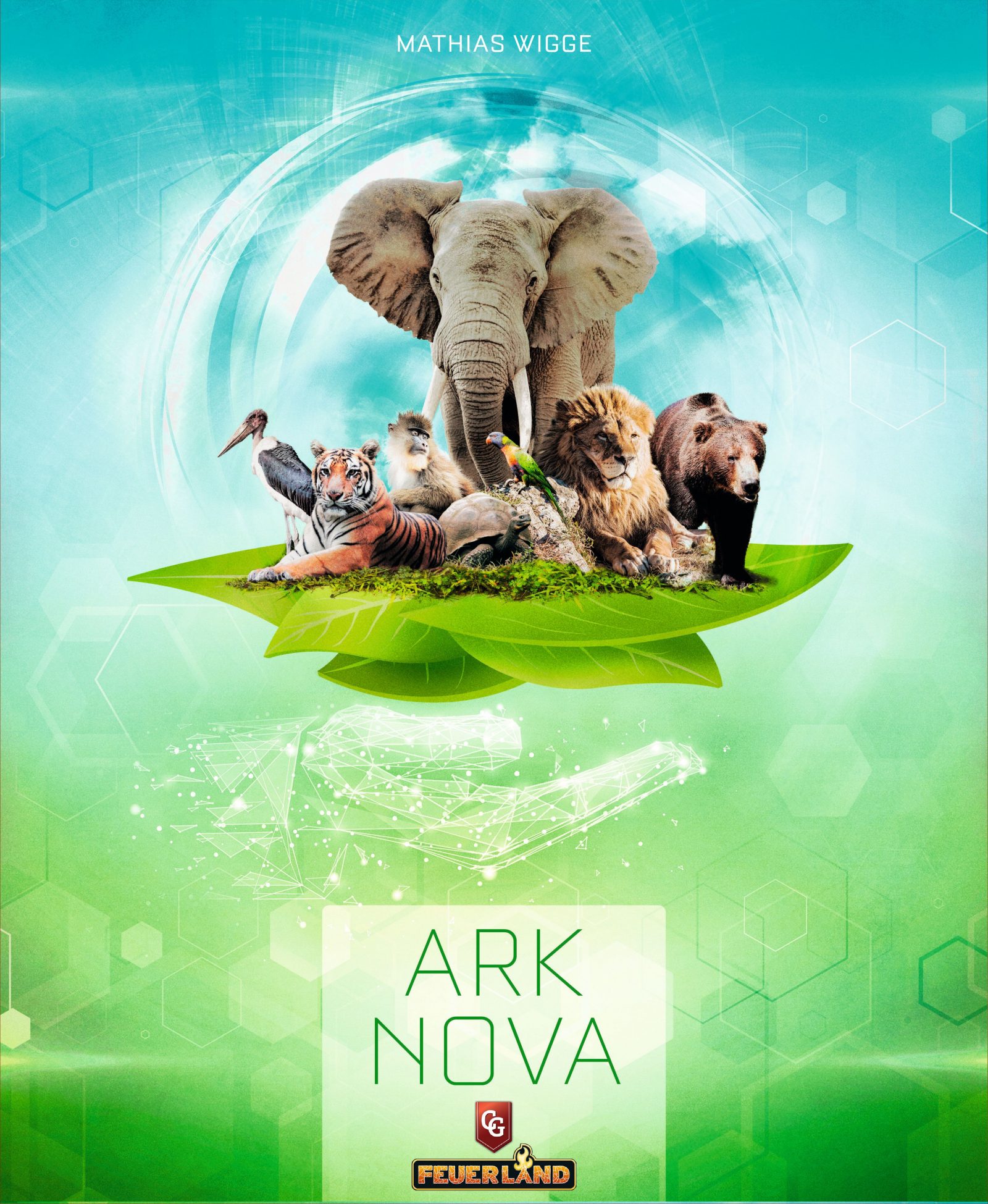
Ark Nova is a beast but a beast worth taming.
First off, let me address the Terraforming Mars comparison. Ark Nova has a lot of cards with a lot of symbols. The cards help determine the path you’re going to take to build your zoo. That’s about where the comparisons end. I’ve also heard people say, “oh, the action selection is like Civilization”, but I’m getting ahead of myself. Let’s start at the beginning.
Setup
There is quite a bit of setup, including each player board, the centreboard, the Association board as well as the enclosures, & other bits & pieces. Figure about 10 minutes to set it up, if you’re doing it alone.
Each player starts with 8 cards & 2 end game objectives (of which they’ll get to score one). Of the 8 cards, each player will discard down to 4. A bit of advice…even if you have cards that seem to synergize well together if they have requirements that you won’t be able to fulfill until later in the game, there’s no point in keeping them. You should start with at least a few cards that you’ll be able to play within the first few rounds.
The Actions & Gameplay
Each player has 5 action cards they will be using over the course of the game. Animals, Build, Cards, Sponsors & Association. I’ll go over each action card briefly in a moment but first, let me explain how the strength of the card is determined.
On the bottom of each player board, are numbers 1-5 from left to right. Each card is placed under a number (at the start of the game, Animals are placed in the #1 spot with the other four cards randomly placed). The higher the number, the more powerful the card action (in the #1 slot, Animals can’t play any animals into the zoo, however in the #5 spot, you can play 2).
As the action cards are selected, you pull them down to signify taking the action, complete the action, then move the card to the #1 slot, shifting all of the other cards to the right, thus making each other card stronger.
Now, the actions themselves.
Animals: Play animals from your hand into your zoo, placing them in an “already built” enclosure of the required size and paying the cost, noting any requirements needed. This brings me to…
Building: Build 1 enclosure up to the size of the strength (a 1, 2 or 3 size if the Building card is in the #3 slot), paying the cost of $2 per space (a size 3 would cost $6). Place it in your zoo, adjacent to any other buildings already build (or along the edge, if it’s your first one).
Cards: First off, you’ll “Break 2” (I’ll come back to this), then choose a certain number of cards from the stack & possibly discards some (depending on the strength of the action). If it’s in the #5 slot, you could also “Snap”, which means to take a card from the face up cards on the board).
Sponsors: Play a “Sponsor” card from your hand into your zoo. The strength of the card will determine the sponsor you can play. The top left of each sponsor card will have a strength that must be reached before playing that card. The other option on the Sponsor card is to “Break # for $”. Basically, whatever the strength of the card is, you’ll get that much money.
Lastly, Association: This card directly relates to a separate board, with a number of different actions. Again, depending on the strength of the card, will determine the highest section of the board you can do. #2 Strength – Increase Reputation by 2. #3 Strength – Start a partnership with another zoo, in different country (which will reduce the cost of animals from that country). #4 Strength – Gain a partner university (which can increase your Reputation, grant Research or increase your hand limit). #5 Strength – Contribute to a Conservation Project.
I mentioned Reputation, which is one track on the board but there are 2 other tracks that you’ll be maintaining, Conservation Points & Appeal. Appeal typically comes from growing your zoo while conservation mainly comes from conservation projects.
Earlier, I mentioned “Break 2” for the Cards card & “Break” for the Sponsor card. Along the inner part of the board is the “Break” track. The start position of this depends on the player count & will move down a number of spots depending on the number of the “break”. When this marker reaches the end, the player that triggered the “break”, will receive an “X” token (which can be used later to increase the strength of a card). Next, everyone will discard down to 3 cards in hand (5, if you have a partnership with a certain university), certain tokens that may be in play will be discarded, the oldest 2 cards in the center display are discarded and then everyone receives income.
Income can come from a number of places, including your position on the Appeal track, certain Sponsor cards that have been added to your zoo, Kiosks that have been built in your zoo as well as a section that may have been unlocked by contributing to conservation projects.
You will continue choosing actions until someone’s markers on the conservation track and the appeal track cross. You’ll continue until everyone has had an equal number of turns and the game ends. End game points will come from End Game (Final Scoring) cards & certain animals/sponsor cards that have end game sections.
Overall Impression
To say this game is amazing is an understatement. I know, everyone has heard the hype but let me tell you, it lives up to it. The theme is great & although you don’t really “feel” like you’re building a zoo, it’s so fun when you add each animal to your zoo. The sponsors help to flesh out the life of the zoo & when you’re all done, you can look it over & declare, “this is my zoo & these are my animals”.
Now, I’m not gonna say it’s not without its faults but they are far and few. The game does run long, about an hour per player (I’ve played it twice solo, once 3 player, and once 4 player). I also just got done running demos of it at Dice Tower West. Although it’s fairly long, I’ve enjoyed each play of it very much.
The other issue is yes, there are a lot of icons but the player aid that is included is very good. The rulebook is great as well (there is an FAQ, that you can download on BGG that is probably a must-have. It answers a few questions not addressed in the rules).
Although they say each of the 250+ cards is unique, they are only unique in their artwork. The different abilities show up across many cards (but there are still a bunch of different abilities). Speaking of which, they are thematic in that the abilities make sense with the animal or the sponsor that is triggering it. Once you’ve seen many of the icons/abilities, they make sense and you won’t have to refer to the book or aid much at all. After a few rounds, the game flows very smoothly.
Overall, I rate this a 10. It’s easily in my Top 5 of all time. I highly recommend checking it out.
You can find Capstone Games online at capstone-games.com or on Facebook at facebook.com/capstonegames.
