
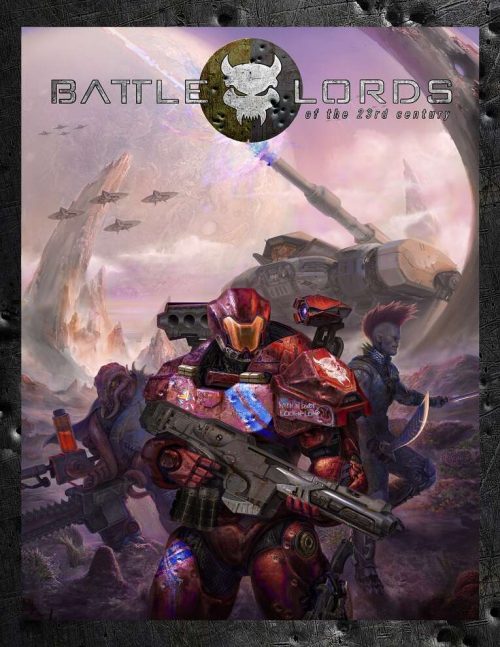
Let’s address the elephant before he even wanders into the room. I really wanted to love Battlelords of the 23rd Century. The theme is right up my alley. In general, I’m infinitely more of a sci-fi fan than I am a fantasy fan. If I stop and think about it, that carries through into gaming as well, most of my favourite TTRPGs lean more into sci-fi than fantasy. Although saying that is really distilling things down to a very strict axis between sci-fi and fantasy, rather than the beautiful spectrum that is our hobby. Sadly, the mechanics of the game aren’t for me. Don’t get me wrong, they are very good. But I think I’ve been spoiled by too many (big air quotes there) games with lighter rules. I still want to talk about this rulebook in general, and focus on some of the cool stuff in it, because I do believe it does what it sets out to do. There is a strong market for this game, I’m just not it.
Battlelords of the 23rd Century isn’t some flash-in-the-pan new game, the current (Revised or Kickstarter) edition is the 7th edition of the game since its initial release in 1990. It was created by military veteran Lawrence R. Sims, and to a large extent reflects the dark and unglamorous life of a soldier. It’s not some grand space opera setting, but a military setting in space. Think Battlestar Galactica or maybe Babylon Five as compared to early Star Trek: The Next Generation, then add more grit.
One of the most obvious things that make the Battlelords core rulebook stand out is its size. Clocking in at nearly 550 pages it is a hefty tome, which has both pros and cons. The book includes nearly everything you could want in a core book and at least one or two supplemental books, but that also means it has everything whether you want it or not.
The book starts out with a brief three-page overview of the game and universe, followed by a four-page timeline leading up to the current time in the Battlords universe.
Part of the reason that timeline is so large is that it delves into fourteen playable species and several non-playable Hostile Alien Lifeforms (HALs). That’s right, fourteen playable species are covered in impressive detail in the second chapter. I loved the detail and consistency of the descriptions, each one running 3-5 pages. The one thing I didn’t like (and it’s just a personal preference here) is that for all the consistency of information, the entries start exactly where the last one ends off, usually in the middle of a column in the middle of a page. There are exactly zero times I wouldn’t rather have a few extra pages, or a little less of whatever makes it fit, to have each species start at the top of its own page. This goes for Chapter 12 on HALs as well.
Chapter 3 goes into character generation, offering three different methods for generating a character’s vital statistics. A Give & Take method (start with a generic balance, then increase stat A and decrease stat B), a Best of Ten method (roll 10 times, and drop the bottom two results), and a Point-Based method (buying points to assign for each stat). I’ll skip the rest of the process other than to say there are a lot of tables and a lot of abbreviations for things (many of which are not defined before they are mentioned in a table.)
Chapter 4 covers Skills and Statistics, which is almost always a longer section of any RPG book, so no hate there. In fact, I very much appreciate how thorough the table of contents is for chapters like this one.
Chapter 5 goes into the Combat Rules. Like so much of this game, I personally think these are needlessly bloated. It takes most of a page just to go over Initiative. Whenever you hit someone in combat, you have to roll to determine specifically where you hit them, but you might also be able Bump your hit to another body part (or even intentionally miss). Armour is similarly assigned to specific body parts. On the one hand, I understand and appreciate the sort of realism this adds to the game. On the other hand, that level of detail is a huge part of why I didn’t enjoy the game.
Chapters 6 through 8 detail Armour, Weapons, and Equipment & Cybernetics. Chapters 9 and 10 are Vehicles and Spacecraft. Chapter 11 is Matrices, or how mental energy (a Matrix ability) is used by some species. Chapter 12 covers HALs in what I actually expected to be a much longer chapter.
Chapter 13 looks at the Battlelords universe. As you can probably tell, there is a lot going on in this universe. This chapter needed to cover how The Alliance of all those playable species operates. Politics, Corporations and commerce, Military and Law Enforcement, and more. The tone of this chapter is consistent with the rest of the book, treating it almost like a data dump more than flavourful world-building, which is unfortunate. This was the chapter I wanted to really shine and make me forget about the other things I didn’t like.
Chapter 14 is your chapter all about acting as the Game Master. It has all the usual things in it. Things like helpful hints and advice on running different styles of Battlelords campaigns, as well as a few “exotic” situations that most players will never need to know about… Until it’s too late, of course. But I also think one of the most important details about the game lands itself here. They come up in other places, but right at the start of this chapter are some of the recurring themes in the game. There is so much more than just life In The Trenches. Overcoming Racism and Stereotypes is very specifically called out with a large and uniquely formatted chart showing the different species’ general disposition to one another. Runaway Capitalism and Inequality of Income are laced throughout just about everything. Finally, the theme of Dark Humour is the one thing that I just didn’t feel very much in the book’s writing. There are definitely a few moments here and there, but it’s something that is integral to the feel of the game and if the GM running the game doesn’t have that personal sense of humour, there aren’t very many great examples to guide them.
Rounding out the book is a three-act introductory scenario called Thunderbirds and Energy Weapons. I won’t spoil the adventure, but I will bring up how the adversaries are handled. Certainly not all, but I would argue most, written adventures include some sort of abbreviated stat block within encounters, hopefully with a reference point to more information. Not in Battlelords. Here each specific or generic-type antagonist has a full-page standardized character sheet, and if it’s a newly encountered species, it has a similarly formatted full page on that species. For the sort of adventures I like to run, this isn’t a bad thing. In fact, I love it for how I do things. I don’t love the very stark design choice, but that’s okay. What does annoy me is that the species format is both less visually appealing than the same HAL entries earlier in the book but also does a way better job of formating than those earlier entries, having a decisive format where the HAL and Player entries have the same information starting and ending wherever on the page was convenient.
The 6th Edition remains available for sale, including a ton of sourcebooks. I don’t know (and I wish I did) how different the two editions are or if they are at all compatible. With the previous version in such supply for such a long time (There were almost 20 years between core rulebook releases) I would have liked a paragraph touching on this in the introduction.
As crunchy as this game is, there are actually “Extra Crunch” rules peppered in where applicable, and that astounds me. I know there is a sizable demographic of players that thrive on such mechanical minutia for whom the crunch is part of the appeal of playing a game. That’s not me. I wish it was me because this setting has so much awesome to offer, but it’s not me. There are not a ton of games on the market that tackle grimy militaristic sci-fi. There are similarly a decreasing number of roleplaying games that still successfully maintain this level of intricacy in the rules. If that’s the sort of game you enjoy, I have no doubt that Battlelords of the 23rd Century is going to be a game you’ll love.
One last note: as I was gathering the URLs below, I saw that a version of the Battlelords setting has successfully Kickstarted using the Savage Worlds rule system. Now I’m curious how much those very different mechanics might impact my opinion of the game since it’s the mechanics I don’t like, not the setting itself.
23rd Century Productions can be found online at 23rdcentury.net or on Facebook at facebook.com/battlelords.

TheRatHole.ca does not accept payments for our reviews but may have received a promotional copy of this product for review.