

[Editor’s note: The following preview is based on a complete, but not finalized, product; in advance of a crowdfunding campaign. -dc]
Blinks. Such a simple name for a game system that packs a punch. Move38 is one of those very VERY few companies that successfully manages to blend technology and tabletop in a way that truly shines. –No wait, check that– in a way that truly glows. (Much better.)
Almost exactly four years ago, Move38 launched their first Kickstarter campaign for Blinks. So close that the marketing guy in me wishes they had waited a week to launch the new campaign, but that’s a note for another time. The reason I know this, is because went back to re-read what I said in the CrowdFUNding Spotlight I wrote about that campaign.
As a starting point, here’s what I said about the game system back then:
Blinks is a fascinating new game system from Move 38 that blends the hands-on play of tabletop games, with high tech innovation and real-time, video-game-like, responsiveness.
Each Blink is a standalone hexagonal mini-computer and game-cartridge, that stores one specific game, and is capable of temporarily transferring that game’s programming to any other Blinks magnetically connected to it. When you’re finished playing a specific game, just activate a different Blink to play the game stored on that one instead.
Simple right? Blinks have been so successful that it has taken way too long for me to get my hot little hands on any, so when the opportunity to preview two of the Party Pack games debuting (TODAY) in a new Kickstarter, I was ecstatic. So without further adieu, let’s take a look at Tangle and Mimic.
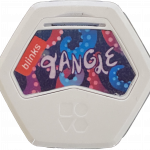
TANGLE
Fast, furious, and fun. That’s the best way to describe Tangle, and for me to put the words “fast” and “fun” in the same sentence says a lot because I rarely consider fast to be fun.
One of the reasons I actually enjoy this speed game is that it is short. A single round lasts between 17 & 23 seconds. I don’t know if that variance is based on player count, game mode, or to randomly keep players on their toes. I’m not sure I care when we are looking at under five seconds. After all, it’s a tabletop game, not an Olympic sport. My point is that it’s short and it’s done. If you’re playing with more than two players you can decide to play as a single round, one-and-done, or as an elimination game with the bottom player each round being dropped. But I’m getting ahead of myself here, let’s look at how it plays.
Once you’ve taught the other Blinks the game, you’ll set them up in a sturdy grouping, and I do mean sturdy. It doesn’t have to be uniform, but you really can’t have any Blinks able to be knocked off the edge of the cluster. Pick a completely surrounded Blink to be the control button and select your Game Mode and Player Count. The default Game Mode is that every player has a unique colour/pattern combination, but for 4 & 6 players it can be set to allow each player to pick a colour (regardless of pattern) or a pattern (regardless of colour).
When you start the game, all the Blinks go dark for three seconds before lighting up with a random pattern. Players then click every Blink with their chosen colour/pattern, turning it to another player’s colour/pattern. The other players are doing the same, clicking their Blink to that of another player, probably yours. When the time runs out, all the Blinks go dark for another three seconds before displaying the final state of the game. The player with the least of their colour/pattern showing is the winner. If you are playing elimination style, the player with the most of their colour/pattern showing is eliminated.
The biggest downside to the elimination format is that the player selection “screen” doesn’t allow players to select a specific colour. There will ALWAYS be a yellow and green player, the third colour will ALWAYS be blue, and so on. So in an elimination game, the odds are that in every round at least one player will have to choose a new colour. Now, there’s nothing specifically wrong with that. However, I’d like to see the rules reflect that each elimination round players MUST choose a different colour/pattern. Alternately, change the selection “screen” to allow players to select their colours with a click on that option, rather than clicking the control Blink to increase the player count one at a time, in sequence.
I also don’t expect to ever play with the overlapping player goals. I don’t feel there is enough definition in many of the patterns for it to be anything but frustrating, but I’ll talk more about that when I discuss Mimic, below.
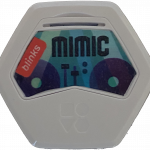
MIMIC
This will be short, and it’s not implausible that I’ll revisit Mimic down the road. Mimic is a game that can be played solo, with as few as 3 Blinks, or more players with more blinks, in any number of configurations.
Before I say anything more, I feel it’s important I bring up two very important points. The first is to remind people that what I played is a finished, but not necessarily finalized game. The rules are in no way the final draft or formatted in a particularly functional way and at the time I am writing this, there is no how-to-play video available. The second is to point out what I said at the beginning of my look at Tangle: I rarely find “fast” to be “fun”. This game was destined to never be my favourite, so please take what I am about to say with a whole shaker of salt and a spoonful of sugar.
Each Blink has six sections, each with a little LED light. When playing Mimic, you’ll take actions based on what those lights show. If it is showing yellow on alternating halves, you’ll turn it around 180º. If the lights are making a crawling magenta circle, you’ll rotate the blink along the edge of what it’s connected to, left or right as shown. If the lights are flashing blue you’ll click it either twice or three times depending on the pattern showing.
So, I played Mimic solo and very much got the feeling I was missing something. I had a couple of much smarter-than-I friends try it both solo and multi-player. We all felt like we missed something.
I think the first thing this may need is a formatted rulebook and a how-to-play video, both of which will occur later. Yay. The other thing I wish this game had was a speed/level selection. They have that sort of thing in other games, and it would make this WAY easier to learn, and being able to set a speed for each player (a’la Rock Band, which might admittedly be harder to do in the current game format) would make it easier to play Mimic with less experienced players.
The last thing I’d like to see is more clarity. There are physical limitations to how an individual Blink lights up. The same design features that give them the ability to light up more or less evenly, can also make the times when a distinct pattern is shown, less clear. I also mentioned this at the end of my look at Tangle, above. For the record, dimming the lights will improve the enjoyment and feel of any and all Blinks games. But isn’t always an option. Little adjustments like not having the actions flash, or having a stationary magenta light, with a second light circling (instead of the multi-light crawl it is now) would make a giant difference in any lighting.
Do I think I’m being needlessly harsh on Mimic? No, but I’m completely open to revisiting the final product. Do I think anything critical I have said about either game is enough of a reason not to back the upcoming Party Pack release on Kickstarter? Hell no! I’ve gotten to try 2/5 games from it, and even if you don’t like one of the games, the Blink is coded onto is still usable. I really do want to want to scrutinize more Blinks games, and I’m debating about what that might look like for TheRatHole.ca going forward.
Check back this Wednesday for our CrowdFUNding Spotlight on the full campaign. But in the meantime, you can back the Blinks Game System & New Party Expansion on Kickstarter until March 23, 2022 and find Move38 online at move38.com or on Facebook at facebook.com/move38inc.

TheRatHole.ca does not accept payments for our reviews but may have received a promotional copy of this product for review.
BONUS: I did a brief unboxing on The Legend of the Traveling TARDIS and followed up with a mini-demo the following week. Here are the highlights of those two shows: