
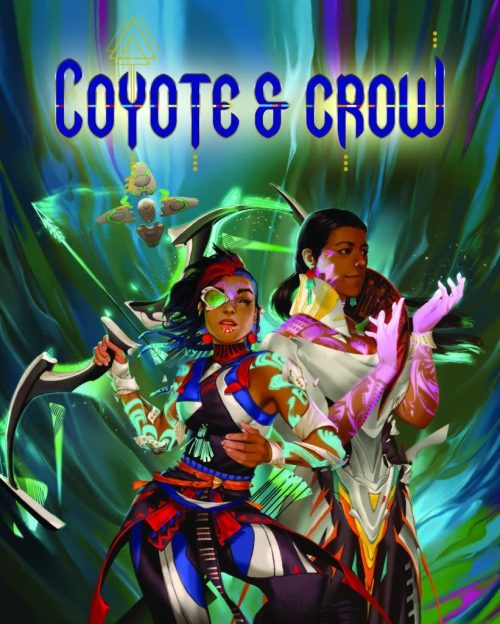
I can’t even say I’m “late to the party” with this review of Coyote & Crow. More accurately, I’ve shown up after the house the party was at has been torn down and turned into a gas station/convenience store. But this game by Connor Alexander is so good, I couldn’t not talk about it. So if you read a bunch of stuff you already know about the game, consider it a pleasant revisit. If you’ve somehow not looked at Coyote & Crow yet, maybe this will finally nudge you toward your Friendly Local Game Store.
Indigenous-created TTRPG Coyote & Crow is an intriguing and optimistic look into an alternate history where European colonialism never happened. Characters inhabit the territory of Makasing, encompassing our history’s North America. The society of Makasing recreated itself after the Awsi, or Darkest Night, in which a meteor struck Earth, bringing with it catastrophic climactic turmoil. Thanks to a mysterious force called Adanadi, Indigenous Americans survived the harsh, long winters which came after, eventually thriving. During this period Indigenous Americans grew into a society which wove spirituality, tradition, and science into a fantastical whole, presenting a wondrous and hopeful setting supported by fun and evocative game mechanics.
Coyote & Crow’s worldbuilding section gives prospective game masters, or Story Guides, a broad canvas on which to create, but looks deeply at the city of Cahokia, central to trade and culture amidst Makasing’s five collective nations. I could go on and on about the evocative details presented among compelling settings and locations. The game’s currency, Nizi, being a corn-based synthetic material instead of the usual run of shiny metals is particularly ingenious. While a dive into the lore isn’t always necessary for players, I think both Story Guides and Players benefit from reading this section and do themselves a service by reading it ahead of play.
On to mechanics and…look, I love a d12. I think it’s a shame it’s been relegated to propping up fantasy barbarians while the d20 gets all the glory. So I was excited to discover not only is the d12 a mainstay of Coyote & Crow’s mechanics, but the game uses d12 dice pools! I love a dice pool mechanic but often d6 dice pool systems still feel too close to binary for me. The use of d12s seems to smooth that out, making for a broader range of options and ultimately more conducive to storytelling.
The support for storytelling within the mechanics can be seen in other aspects as well. During character creation players are given five points to spend on Gifts, fluid, story-focused character benefits like resources, contacts, or wealth. These are broadly ranked from Level 1 to Level 3, indicating their relative advantage to the character. Level 1 could represent a small favour owed the character by an acquaintance with an important job, while Level 3 may mean the character has access to an ongoing resource such as family wealth or an information network. White these Gifts can be earned (and lost) through play, the initial points spend is a way for the player to build a clear connection to the setting and drive the story they wish to tell.
Linked to Gifts are Burdens, which rank similarly from Level 1 to Level 3. Burdens affect the story in the same way as Gifts, but develop some negative aspects of the character’s story. Balancing this, however, they give the character points to spend on further Gifts. And if there are spare points left over after choosing Gifts and Burdens they can be used on a character’s abilities.
While a number of games pare down the range of character abilities, Coyote & Crow features a suite of nine major character abilities: strength, intelligence, spirit, agility, perception, charisma, endurance, wisdom, and will. Each can range from 1 to 5, and players will use an initial point buy system to develop these abilities for their character. There is a similar process for choosing skills, but with a variation I would like to see in other games: specializing in a particular weapon, vehicle, or lore within a general skill costs fewer points than general skill ranks. I love this, especially in groups where there might be overlap in general skills; players can define a specific role for their character even if they share an ability with another. Supporting all this is a focus on character backstory, which helps tie character growth to achieving short and long-term goals rather than simply awarding a bundle of points.
This all combines to create a similar feel to one of my other favourite games, Cypher System, and for much the same reason. While the process of character creation can be as granular as the player may want, it’s all still in the service of telling the story of that character, as opposed to simply calculating a list of mechanical bonuses.
And this initial crunchiness in mechanics supports wonderfully rules-light storytelling. Distances, for instance, are broadly defined as “short, medium, and long” instead of being strictly numerically defined. Even game rounds are of variable length depending on the narrative. The combination of the two, initial crunchiness and in-game narrative focus, creates a game in which players can explore the world and its encounters in a way that leaves them able to flavour the world and their reactions to it in a satisfying way. I think the blend is also going to appeal to players who love digging in under the hood with games like Cypher System, and those who prefer a more narratively focused system like Powered by the Apocalypse, both at the same time.
The book itself is beautiful and well designed, not something always achieved in our hobby. The layout is easy to read and the instructions are helpful without being dry, with helpful examples supporting the rules throughout. I appreciated the inclusion of instructions for both Indigenous players and non-Indigenous players; Indigenous players are encouraged to draw on their own heritage for their characters, as much as they feel comfortable. Non-Indigenous players are advised on ways to lean into the game’s message of cultural celebration and respect without appropriating real-world Indigenous cultures or traditions. Both are treated as important approaches to play.
It’s rare at this point in the TTRPG hobby’s development to find a game which takes some of the best elements of current game design and combines them so flawlessly with a truly wondrous and unique campaign setting. Often I read a new game and I can decide right away if I want to GM the game or play it. Coyote & Crow is that rare game where I’m torn; I know I’m only going to experience the game for the first time once and I can’t decide if I want to come to it first as a player or as a Story Guide. But if you haven’t yet, however you come to it, know that you are about to immerse yourself in a game and a world built generously to tell wonderful, uplifting stories.
If you want a more detailed look at aspects of the game, Coyote & Crow Games has a YouTube channel where they have explained parts of the game in more detail. If this review was not finally convincing, I hope those videos will be. Coyote & Crow is a game you will be sad not to have on your shelf, and a game you will regret never bringing to the table.
You can find Coyote & Crow Gamesw online at coyoteandcrow.net or on Facebook at facebook.com/CoyoteAndCrowGames.
