
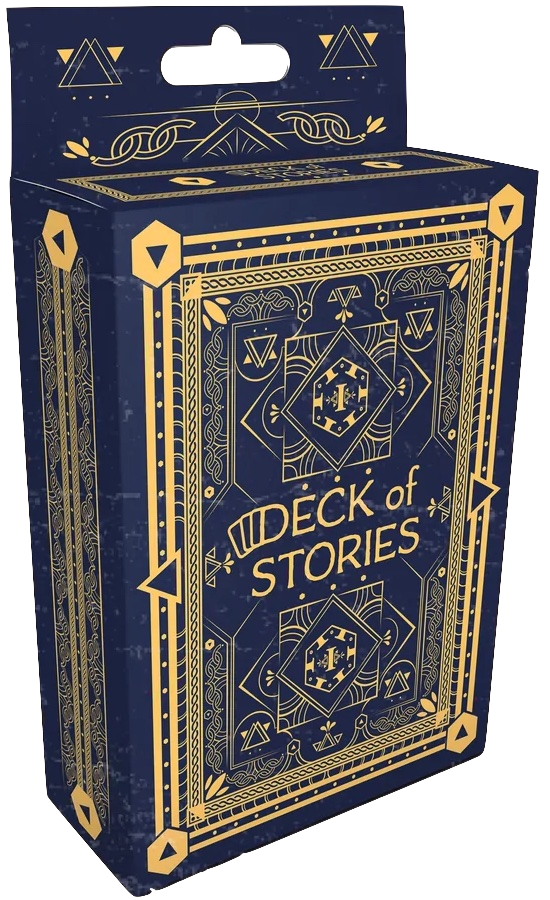
Deck of Stories 1
And now for something completely different: a man with a tape recorder up his… wait… that’s been done and no one knows what a “tape recorder” is anymore.
So instead I’m going to use the Deck of Stories ORC system to plot out a short adventure/scene idea. The setting, genre, and game won’t matter.
After a long journey, your group arrives at a dark fortress. You can see the detail and majesty this place must have once had. But now it’s showing signs of age and neglect. As you approach the gates a small window opens and you think you see a guard shrouded in shadows.
You are informed that you may not enter without facing a challenge, and if you turn to leave you will be shot in the back. The gates open and the monstrous guard informs you that you must each face a trial by individual combat. Any who survive may enter and be accepted as members of the Serpent Guild. You realize they think you have come to join their band of brigands, rather than random passers-by.
A second horror steps out and speaks (if you can call those noises “speech”) and suddenly you feel strange, like part of your very should has left your body. Your shadows shimmer on the wall next to you and seem to step away from you and then step away from the wall as fully separate beings. You draw your weapons and they do the same as if they were still just shadows.
Just like that, a story has begun with the drawing of only three cards.
Each card in the Deck of Stories has three main elements. The top of each has some combination of the letters O R C. The letters showing indicate where in the action the story prompt on that card (that’s the second element) may fit best. O- Opening Action, the opening… to the action… R- Rising Action, an unexpected plot twist. C- Climactic Action, a final confrontation or event that could help close out the story. The last element is labelled “Next Steps” which asks a few questions to help guide you to the next part of the story.
So in my case, I started with card #49(OR) “YOU ARRIVE AT THE DWARVEN FORTRESS. MONSTERS NOW POSSESS IT.”
Only using the O, I dropped the dwarf thing, not specifically wanting a fantasy setting for something this short. Then I five a quick description of how the players got there (presumably from a previous adventure or scene), and a flavourful but vague description of the fortress.
The next card was #50(R) “A CHAMPION EMERGES FROM THE FRONT LINES. THEY DEMAND ONE-ON-ONE COMBAT.” I had a concept in mind but then ended up combining it with my third card #22(C) “SHADOWS PLAY ON THE WALL, THEN COME TO LIFE.”
I revealed that the occupants were “monstrous,” bringing that forward from the first card, and gave a reason for the one-on-one combat while expanding a plot that I was probably building elsewhere in the adventure or campaign. I also gave a hint to what these new creatures might be which could lead to the players coming up with unexpected means of dealing with them.
I didn’t directly use any of the Next Steps, but I already hinted at the same thought process as the last question “How do you destroy a shadow?”
That was a fast and dirty scene, but you could use the same process for an entire adventure, or even a whole campaign. If you can’t work with a drawn card, toss it and draw again. The point is to inspire creativity, not pen you into something you don’t want. Similarly, the ORC system isn’t written in blood. There are cards with just one letter or any combination of the three, but that doesn’t mean you must use it like that.
Card #25 is labelled as RC, recommending it as something towards the middle or end, but “A VAMPIRE WANTS YOU TO STEAL A RIVAL’S COFFIN.” could be a perfect starting point. But if you had started with #7 “EVERY NIGHT, ANIMAL ATTACKS OCCUR OUTSIDE THE CITY. THE VICTIMS ARE FOUND DRAINED.” Which is technically labelled with C, it would make more sense as a middle or end point.
I’m not a great GM, it’s just not my jam. To be honest, I don’t even think I’m a terribly good writer. (Thanks for keeping TheRatHole.ca afloat, so I can pretend to convince myself otherwise.) So it’s always interesting to see what neat tools I can find to get my creative brain juices flowing. 1985 Games has a few similar products that we’ll be looking at more in the future, and I’m hoping to pull out a few different creative angles for your enjoyment.
You can find 1985 Games at 1985games.com or on Facebook at facebook.com/1985Games.

TheRatHole.ca does not accept payments for our reviews but may have received a promotional copy of this product for review.