
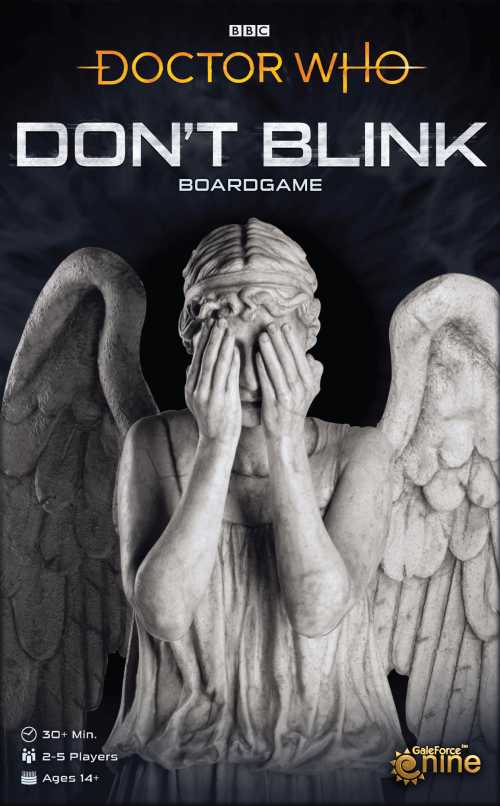
Let’s start this off with the important part of a review: I want to play Don’t Blink a little more to be sure, but it may well be one of my top three favourite Doctor Who games. Now that you’ve got my opinion I hope you’ll keep reading to the end.
Doctor Who: Don’t Blink is an asymmetrical tactical game, in which one player controls eight Weeping Angels, and the other players take the roles of the Doctor (Matt Smith’s 11th Doctor, specifically) and three of his companions (Amy, Rory, and Clara). The story so far, is that the TARDIS has crashed on a spaceship full of Weeping Angels. The Doctor and his Companions must survive long enough to retrieve four components to repair the TARDIS and escape.
The Angels’ player starts the round by secretly selecting up to four Angels to activate that round. Then the Heroes may move up to six spaces, ending their movement facing any direction they choose (this is important) and select either a “Blink” or “Don’t Blink” card. The other Heros are allowed to know each other’s cards but they should remain hidden from the Angels’ player.
The four chosen Angels are revealed and that player has four Action Points to spend however they see fit. The most common actions are moving up to nine spaces and capturing an adjacent Hero that can’t see them. Weeping Angels are FAST, they say Don’t Blink for a reason. As long as they don’t cross into the Line of Sight of a Hero or another Angel they could potentially move up to 36 spaces, using all four Action Points and the board is only 18×18 spaces across, with walls and other obstacles along the way. If an Angel is seen they must pause their action, that Hero must reveal if they chose a Blink or Don’t Blink card. If they Blinked the Angel is not seen and may continue their action(s) and the Blink Card is returned to the Player’s collective hand. If they Didn’t Blink, the Angel is seen and is frozen with any incomplete part of the action forfeited, but that Don’t Blink card is permanently removed from the game, creating a sort of ticking clock for the Heroes.
Managing your Line of Sight is probably the most important part of this game. A Hero can see one space to their left and right, and all spaces in their current room in front of them. The cardboard standees have the character image on one side, and a silhouette of them on the back, to clearly differentiate which direction they are facing. They can only see through a doorway if they are adjacent to that door, and can only see the space immediately on the other side of the door. Heros can also drag Angels during their movement, and if two Angels that were selected for that turn start in the same room and are in a straight line from each other they are both frozen and can’t take actions that round.
Those are the basic rules, leaving out some of the nuances. The rulebook isn’t as long as it looks, as it has lots of example graphics. But it’s also slightly unclear on a number of the rules. For example, we played that if an Angel starts in Line of Sight of a Hero, that Hero immediately reveals their Blink/Don’t Blink card. In that situation, the Angel player must spend an action point and attempt an action before the card is revealed. That makes life MUCH harder on the Heros. Similarly, we assumed that Angels used similar Line of Site rules, meaning they could see each other in adjacent doorway spaces (nope, same room only) and if they moved into a straight line with another active Angle they were both frozen (also nope, only if they start that way). That oops made life much easier on the Heroes, and to be perfectly honest they need all the help they can get. The game is intentionally weighted in favour of the Angels, and that isn’t a “bad” thing, per se. The Angels won every game we played but had we not misunderstood that revealing your Don’t Blink card rule it probably would have been much closer, at least. Both sides of the game pose a very different puzzle to solve, and I personally like that.
OK, here’s where the eyes of any non-Whovians reading this might start glazing over a bit. The nerdy stuff comparing this to the show’s canon.
This game is NOT based on the episode titled “Blink.” It is more similar to the “Time of the Angels,” but it’s still a completely original story. The one big thing that every fan I’ve met has asked is “Why Amy, Rory, and Clara?” It’s a valid question since technically Clara never met Amy and Rory and certainly never travelled with them. Although there will always be some grey in that, as the Ponds did interact with an “echo” or “splinter” of Clara, named Oswin Oswald, and whether Clara’s TARDIS, in the form of an old American Diner, is or is not the same diner from an earlier episode with the Ponds. (Clara’s Impossible Girl storyline covers multiple seasons and Doctors, and is a topic for a different day and a different article.) As for specifically why Clara and not River, who is much more closely connected to Amy and Rory, the only theory I’ve seen is that using Alex Kingston’s likeness would have cost more, but who really knows. It’s equally worth mentioning that these three are also packaged together in an expansion to another of Gale Force Nine’s games, Doctor Who: Time of the Daleks… WITH River Song.
All in all, the rulebook is far from perfect, and the nerdy details are a bit debatable, but the game is still has a good level of challenge for both sides of the table and is a ton of fun. The lack of both canon and continuity means that Gale Force Nine could very easily release small expansions or promo characters with new Special Don’t Blink cards (something I skipped over for brevity) and I hope they do exactly that.
This sentence makes 1001 words.
Lynnvander Studios developed Don’t Blink and can be found at lynnvander.rocks. (Now THAT is a URL I can get behind. I wonder if I should look at TheRatHole.rocks or something…) They are on Facebook at facebook.com/LynnvanderStudios.
Gale Force Nine can be found at www.gf9.com or on Facebook at facebook.com/GaleForceNine.

TheRatHole.ca does not accept payments for our reviews but may have received a promotional copy of this product for review.
The Legend of the Traveling TARDIS