
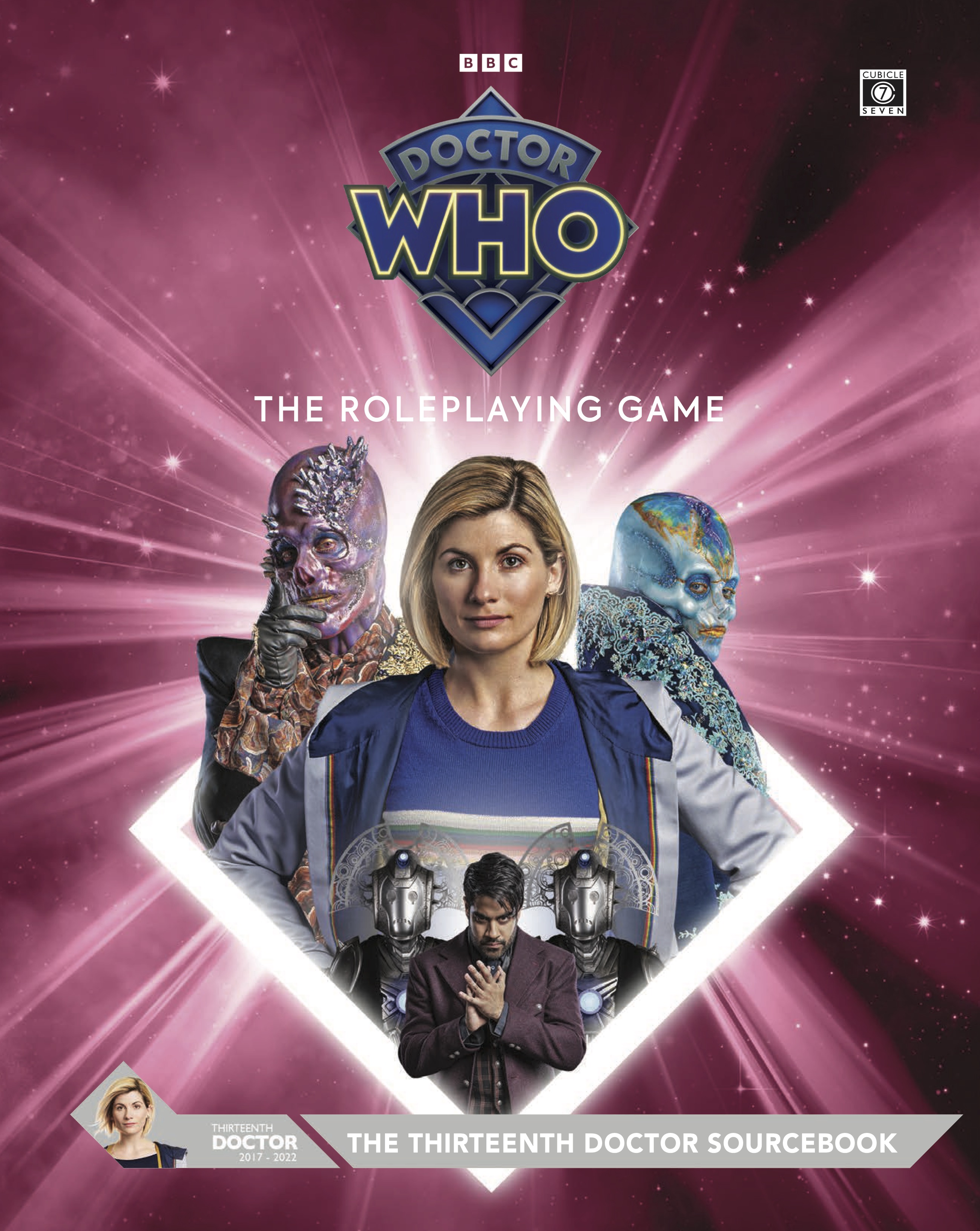
In Canada, Jody Whitaker’s adventures as the Thirteenth Doctor are oddly hard to watch online. The rest of NuWho is readily available, but not Thirteen. I suspect it has to do with previous licensing agreements, but I have no concrete proof of that. Honestly, it’s one of the things I love about Disney+ taking over the streaming for the current seasons. Eventually, I hope the rest of the modern era, Thirteen included, will move there as well. Maybe even the classics. But for now, it’s challenging enough that I haven’t rewatched her seasons since her regeneration.
Lucky 13 ushered in a new and much-maligned era for Doctor Who. A new Doctor, sure, but also a new showrunner (Chris Chibnall) and a new composer (Segun Akinola) gave the series an entirely new feel. There was a great deal of anticipation, given Chibnall being a self-admitted fan of the show, and his great results working with David Tennant and Jodi Whittaker on Broadchurch. In fact, 10 and 13 have a great deal of mannerisms in common. Unfortunately, most people agree this era was a disappointment, at best.
As I rewatch the era, as part of my research for this review, my opinion has been reinforced in some ways and softened in others. Chris Chibnall made the very specific choice in Series 11 to not include any classic adversaries and I appreciate that. His goal was to continue moving the series forward, while still showing reverence to the past. Yes, this resulted in some of the worst episodes of the modern era, but overall it wasn’t as bad as I remember. Tzim-Sha had the potential to be a great villain from a potentially modern-classic species. Then his helmet came off to reveal… teeth. Why in the name of the Doctor does this guy have teeth embedded in his face… WHY? It destroyed the character and long term story arc of the species. But —BUT— this is Doctor Who The Roleplaying Game! Where the television show missed the mark (or worse) can be the best setup for a game.
As always, the Thirteenth Doctor Sourcebook not only gives a chance to play through the actual episodes but also to rewrite them or to use them as the setup for entirely new adventures. Why do the Stenza hunt humans and why the %@#$ do they collect teeth? Orphan 55 need not be the end of a “vacation” story, but rather the start of one. Maybe a disguised Hyph3n worked in one of the other hotels mentioned in Arachnids in the UK. Maybe the GM will tell us that Hyph3n is, as I suspect, a Mog. Half man, half dog: Mog. Like John Candy in Spaceballs. A GM will need to do that though, because even being the best part of that episode Hyph3n barely gets a mention. Boo.
That’s one of the few complaints I have about this book, mostly in comparison to past Doctor sourcebooks. There are disappointingly few stat blocks for the side characters. In the Tenth Doctor Sourcebook, for example, the lunatic architect of the Globe Theatre in The Shakespeare Code has a stat block, despite being a fair minor story element. Whereas in Spyfall we don’t get stats for vital characters like Ada Lovelace, Charles Babbage, Noor Inayat Khan, or even C. Despite getting a proper entry for The Master earlier in the book, I could even make an argument to include stats for his cover persona of O, to better utilize the character. (Not unlike how they handled stats for Ruth and the Fugitive Doctor. Okay, those are mostly human characters. But beyond Hyph3n, Orphan 55 has a whole host of unique characters that go stat-less. (Unusually, we do get a bulleted list of those NPCs, so it’s not like they thought they weren’t important.)
Another complaint is that references to other pages and previous sourcebooks are no longer included. To use the Tenth Doctor Sourcebook and The Shakespeare Code again, references to Charles Dickens and the TARDIS previously being pierced by an arrow in The Timeless Child and Robot of Sherwood are all cited. (in the Ninth, First, and Twelfth Doctor Sourcebooks respectively.) A mention of The Wasp and the Unicorn, later in David Tenant’s run, has the page number noted. Those little details are part of why I’ve always said these sourcebooks could easily be considered as an encyclopedic reference document.
Now, I should point out that those First Edition sourcebooks are technically out of print, and some are fairly difficult for newer players to obtain physical copies of. They have been effectively replaced by the two 60 Years of Adventures books. Nevertheless, those sourcebooks are available digitally and are an invaluable resource for any Doctor Who RPG player or any Whovian in general. It’s also worth noting that references to previous adventures are often referred to alongside the relevant incarnation of the Doctor, but not always. It is an interesting editorial direction to take: often assuming a reader/player can identify the timing of an episode by context while also trying to point out opportunities for new players to learn more about some plot element such as the history of the Daleks.
It is with profound sadness that I declare the Thirteenth Doctor Sourcebook as the weakest of all of the Doctor books. It’s the same sadness I feel knowing that despite so much potential, the Thirteenth Doctor’s era of the television series will always be considered among the weakest episodes in the over 60-year history of the show. I was hoping for the same sort of insight I’ve found in previous sourcebooks and was left wanting more. That said, even in saying this was the weakest, it is still better than most sourcebooks for most games. I suspect my issues come with the attempt to streamline the Second Edition of the game. If you’ll excuse the wildly out of date saying, in streamlining the book, Cubicle 7 seems to have left much of what made these books so impressive on the cutting room floor.
Please don’t take my criticism to mean the book isn’t still good. There are still moments that remind us that the web of the Doctor’s lives are more closely connected than we always see on screen. For example, it is pointed out that in Nicola Tesla’s Night of Terror, the signal that the Skithra intercepted likely was sent sometime after the Empress of Mars episode, suggesting that the scavenger-like Skithra may well have been searching Mars for abandoned Ice Warrior technology.
I hope that when David Tennant eventually returns in the Fourteenth Doctor sourcebook, some of what made his Tenth Doctor sourcebook so excellent will return as well. In the same way his return to screen recaptured what made his first run so great.
You can find Cubicle 7 online at www.cubicle7games.com or on Facebook at facebook.com/Cubicle7Entertainment.
The official Doctor Who homepage is www.doctorwho.tv and the official Facebook Page is facebook.com/DoctorWho.

TheRatHole.ca does not accept payments for our reviews but may have received a promotional copy of this product for review.