
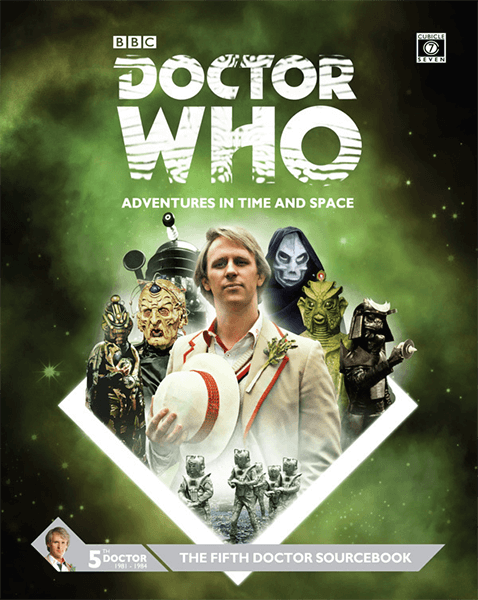
I mentioned this in my Sixth Doctor review, and I feel it’s even more important to bring up here as well. Several months back Celestial Toyroom published an article I wrote, titled Classic Who is Best Backwards. (issue 526) in this article, I talk about how I’m working my way backwards through the Classic Doctors, as I write these sourcebook reviews. With the Fifth Doctor, I am experiencing something that is evidently rather unique. I really like Peter Davidson’s Doctor.
Davidson often gets a mediocre rating by fans, simply because of now basically traditional “not my Doctor” effect. In North America, Tom Baker was the Doctor. Period. He is also one of the longest serving Doctors with 41 stories (172 episodes) over seven years. So this young, babyfaced, upstart was a drastic change for many fans who had simply never experienced a regeneration before. But for me, I was experiencing a kinder and gentler Doctor, after going through Colin Baker’s infamously brazen Sixth Doctor. I was also experiencing a caring but level-headed Doctor after Jodie Whitaker’s sugar rushed Thirteen. To be clear, both Six and Thirteen’s runs were marred by poor writing, and both performances deserve to be respected. Nevertheless, the Fifth Doctor feels like the most traditionally Who Who that I’ve watched in some time. He just feels right to me and apparently that’s unusual.
Five also faced some of the hardest times of the Doctor’s life. His companion, Adric, died in vain. Another companion, Turlough, conspired to kill him. Omega took his face and then forced the Doctor to kill him (himself?) in order to prevent disaster, and that wasn’t the first antagonist this Doctor shot, or encouraged to be shot. He seemed to have a much deeper connection to his past selves, managing to work with his previous hims to survive the perils of the Death Zone. Even his own death and regeneration was tragic.
As for the sourcebook itself, that also has a bit of an unusual feel to it. All of the Sourcebooks that I’ve reviewed to date have had a very encyclopedic feel to them. The Adventures section would present the plot descriptively, even dramaturgically, but largely with minimal guidance on other directions, a GM could take. Instead, they would restrict such advice to the Running the Adventure and/or Further Adventures sections. But for some reason, it isn’t uncommon to see that sort of aside in the Synopsis itself in this volume.
One complaint I frequently have with the Doctor Sourcebooks is that they tend to assume that a person will have them all. So even though Sabalom Glitz (for example) appeared alongside both the Sixth and Seventh Doctor, his stats are only included in the Sixth Doctor Sourcebook. This becomes even more problematic in larger stories with returning characters as in The Five Doctors. This story includes four other doctors, four other companions, and The Master. None of whom have details listed in this book. To make matters even worse, this story replaced the late William Hartnell with Richard Hurndall as a noticeably more spry First Doctor, and a fully adult Susan Foreman. I don’t yet have the First Doctor Sourcebook, so I can only assume that neither iteration of these characters have specific stats there either. The Second Doctor has clearly been Time Scooped from some point in between his trial and subsequent exile and forced-regeneration. (A point in his timeline generally referred to as Season 6B.) Again, I can only assume this visibly older Second Doctor has stats identical to the 14 years younger Patrick Troughton, even if he probably shouldn’t and I also don’t have that Sourcebook. But you can see the problem here. A GM should never have to assume anything as important as these characters. They don’t even give a reference point saying where these stats are hiding, so hopefully you just know your Who.
Don’t get me wrong, this is still a very good Sourcebook to have. There is some great suggestions about using the Black and White Guardians as plot devices, including a lovely new mechanic for Black Guardian Points. The GM can assign these story points for mischief, or a player can just
use them as regular story points, anytime with no questions asked, but The Black Guardian could come to call in his debt using those Points to cause problems for the players. Rather than run that particular risk, players can spend them to purchase disadvantages for their character, which amounts to getting to pick your own poison.
Completionism aside, Cosmic Masque Magazine editor Nick Smith asked me what about these sourcebooks keeps bringing me back to them. I review boardgames in general, and TableTop RolePlaying Games (TTRPGs) specifically, as my regular work. If I decided to never review another Doctor Who Roleplaying Game sourcebook, I would professionally still have a constant stream of games coming across my desk. With so much new material coming out of so many different places, why do I keep going back to review these comparatively older books? The answer isn’t terribly exciting. The answer is that these sourcebooks are exciting. They are well researched and can give you an interesting perspective on each Doctor’s character. I think it was my Twelfth Doctor sourcebook review that I said if someone asked me for reference material to use in writing a biography of a fictional character, these sourcebooks are where I would tell them to start. Even if you don’t play the Doctor Who Role Playing Game, or any TTRPG for that matter, you can pick up one of these books and free read it for fun. You can just ignore what little game mechanics and rules are in them, and just immerse yourself in the world of the Doctor.
This book isn’t the strongest in the set, but it’s still a terrific look at an underrated era of Doctor’s lives.
You can find Cubicle 7 online at www.cubicle7games.com or on Facebook at facebook.com/Cubicle7Entertainment.
The official Doctor Who homepage is www.doctorwho.tv and the official Facebook Page is facebook.com/DoctorWho.

TheRatHole.ca does not accept payments for our reviews but may have received a promotional copy of this product for review.