
So, I’m writing this while still reeling from the depth of Dot and Bubble, which debuted yesterday. The timing of such a layered episode is unfortunate, as I won’t really be able to rewatch it until later tonight. Seeing other people’s reactions and analyses online has just made me more and more excited for that rewatch. But even with only one viewing, I’m willing to say it’s one of the most intricately woven stories we’ve seen in years. Obviously, we aren’t here to talk about that, but I find it helpful to lay out where my mind is while writing a review like this. I will say that as excited as I am to be back writing about Doctors & Daleks again, I can’t help but get even more excited over how it will fit into roleplaying in the Age of the Fifteenth Doctor.
It has been a while since I had the opportunity to talk about Doctors and Daleks. I recommend reading my first review on the Players Guide, but to save you time I’ll summarize what we are working with here. Doctors and Daleks brings the Whoniverse to your gaming table using the popular Fifth Edition rules of Dungeons and Dragons. There is no Core Rulebook, as such, with most of the rules questions directed at the free online System Reference Document (SRD). However, some mechanics have been adapted to better fit the ethos of Doctor Who and those are referenced in the Players Guide and Alien Archive books. For example, Hit Points are instead referred to as Plot Points to better reflect that The Doctor is more likely to talk their way out of a situation than through violence. At the end of the day, an adversary walking away and an adversary lying vanquished is no different to the plot resolution. In essence, most of the changes are contextual rather than mechanical.
I wanted to make that clear because not all games built on 5E rules are entirely compatible with each other. Or, at the very least, are not as accessibly compatible. The now-defunct Stargate SG-1 RPG, for example, has its own Core Rulebook with its own rules built on top of a 5E skeleton but without referencing any 5E rules from outside of the scope of that game. Doctor and Daleks, specifically does not do that. If you wanted to have an adventure on an Air Ship full of Goblins, the online SRD has the stats for these things already. Easy Breezy. Likewise, if you wanted something weird like Colony Sarff in your traditional D&D game, you can do that. You could use the Goa’uld System Lord stats from the previously mentioned SG-1 RPG as a template to build a version of Sutek from Pyramids of Mars. Now, there is another half of this equation that makes Doctors and Daleks unique. It is as inexorably linked to Doctor Who the Roleplaying Game as it is to Dungeons and Dragons. You can, and are encouraged to, use DWRPG books alongside your Doctors & Daleks books. So to fine-tune your newly created Sutek the Destroyer, you could pull out the Fourth Doctor sourcebook for his stats in that system. To expand on that, if you compare Davros’ stats from the Alien Archive and the Goa’uld System Lord stats, then go over to compare Davros and Sutek’s stats in the Fourth Doctor sourcebook, you’ll find that the balance between them is actually very close.
As an aside, that approach mirrors how my brain works when looking at RPGs. In fact, if I were to go any deeper into a Church on Ruby Road or Pyramids of Mars themed adventure I’d probably have books from no less than 3 additional systems out in front of me. One for theme and at least two for creature comparisons and that’s just off the top of my head without counting how many actual books it would end up being.
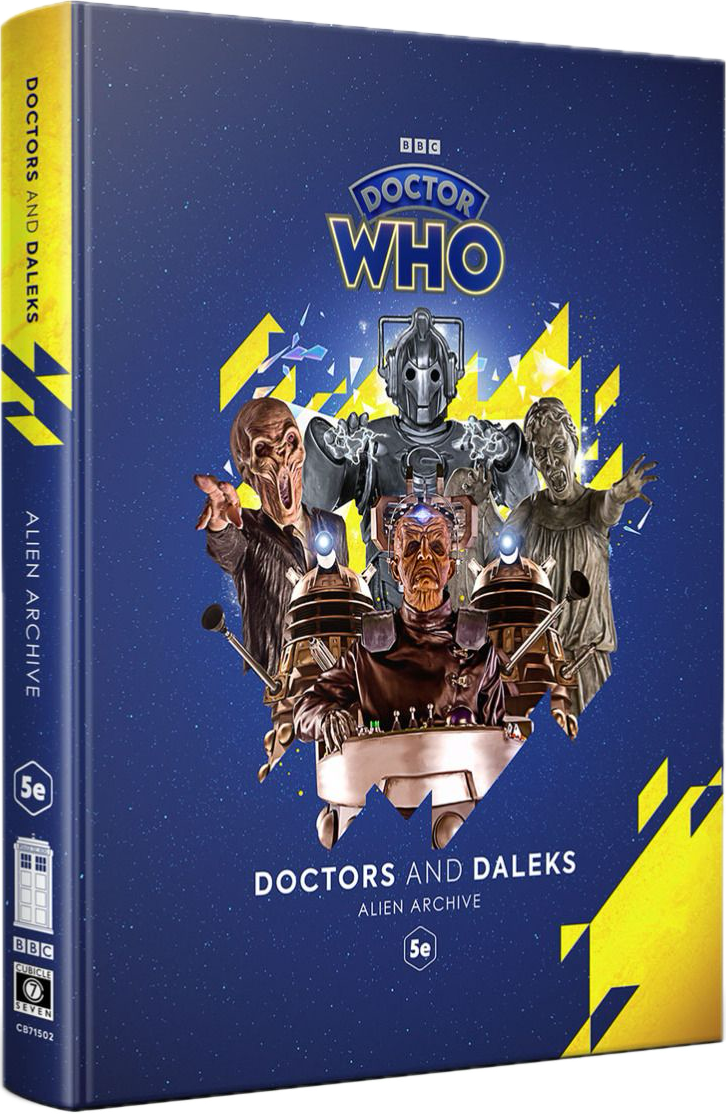
Let’s come back to the Alien Archive book you’re actually here to read about. Much of the content in it has been modelled after the out-of-physical-print 2016 DWRPG sourcebook, ‘All The Strange, Strange Creatures vol. 1‘, with additional content from the years since. The book opens with a short introductory chapter that talks about ways to integrate aliens into your homebrew adventures, how the entries in this book work, and how to bring other 5E content into your games in more detail than I went into, above.
The rest of the book is all about the aliens, and it exemplifies what I love about Cubicle 7. In a lot of creature-focused sourcebooks, you are lucky to get a two-page spread at most, and anything longer is probably just additional stat blocks. In the Alien Archive, there are only a couple of entries that are as short as that. Some of the entries are 10 pages long, and the Daleks along with their Servants and Puppets are over 20 pages. These are mostly detailed entries that include backgrounds, motivations, using that subject in your game, and even adventure ideas for said game. But just because they are extremely detailed, that doesn’t mean they are necessarily complete. I was surprised to see, or rather to not see, that the Weeping Angels entry didn’t discuss connections to Division or mention The Lone Cyberman Ashad in that section. Both of these occurred during the Thirteenth Doctor’s era, and I can only assume this was a decision made knowing that Doctors and Daleks would be released before the Thirteen Doctor sourcebook for DWRPG. (Currently available only as a PDF.) On the one hand, I can understand why that choice might have been made. But I feel like it does a major disservice not only to Thirteen but also to the players and is one of the few major missteps I think I’ve seen from Cubicle 7. To be fair, lest I give the impression that ONLY one era has been omitted, some of these Aliens have appeared again and again over the past 60 years and not every variant could possibly be included. Neither Rusty, a major deviation from the Dalek mould during Twelve’s era, nor the WW2 “Ironside” Daleks from the Eleventh era are mentioned in this book. So it’s not completely fair to to be overly critical about what has been left out. There are no public plans to put out more Doctors and Daleks products after this set, but if an ‘All The Strange, Strange Creatures vol. 2’ ever gets released and there are similar omissions, I might not be as accepting.
All in all, Alien Archive is an incredible product, full stop. If you want to run a Doctors and Daleks game, it’s invaluable. If you’ve ever wanted to cross over a Weeping Angel into a traditional 5E fantasy setting, this is perfect for you. If you’re a new but regular player of Doctor Who The Roleplaying Game it’s still beneficial. If you’re just a Doctor Who fan, get the Doctors and Daleks collectors box set. It’s all three books and a DM screen packaged in a gorgeous TARDIS slipcase.
You can find the publisher, Cubicle 7 Entertainment, online at www.cubicle7games.com or on Facebook at facebook.com/Cubicle7Entertainment.

TheRatHole.ca does not accept payments for our reviews but may have received a promotional copy of this product for review.