
Yes, once again I’m starting this with the same as my openings in the previous Nemesis articles, where I looked at the Dalek, Cybermen, and Master factions in the Doctor Who: Nemesis tabletop game from Gale Force Nine. If you’d like to refresh yourself you can go to TheRatHole.ca/dw-nemesis-1, TheRatHole.ca.ca/dw-nemesis-daleks, TheRatHole.ca.ca/dw-nemesis-cybermen, TheRatHole.ca/dw-nemesis-master respectively.
Just a reminder that I won’t go over the mechanics of the game here. If you decide to simply read on (which you are welcome to do) and feel a bit lost, you know where to look and what to do. But for today, I’m going to be digging into yet another of the Doctor’s various nemeses that are featured in the game.
For those readers who decided not to look back at the earlier reviews, I’ll quickly remind you what the concept of the game is. Each player will take on the persona of one of the Doctor’s classic nemeses: Daleks, Cybermen, Weeping Angels, or The Master. Each nemesis has a unique, double-sided, Control Board with a different “faction” or iteration of their chosen nemesis. Each player also has a unique deck of cards for their chosen nemesis and an additional set of cards added to that for their chosen faction. Further added to their deck are cards representing two randomly selected Doctors (Doctors 1-13 plus the War Doctor). Again, I just copy and pasted the exact same description from the previous issues, as the details still haven’t changed.
Since their first introduction in the Tenth Doctor episode, “Blink”, Weeping Angels have dominated the conversation whenever the topic of the best or scariest villain comes up. In polls, regardless of the question, they often garner more votes than the Master, Daleks, and Cybermen combined. What makes the Angel just so terrifying? They are the thing that goes bump in the night, except they rarely bump anything. When you see them they are statues; quantum locked and turned to stone. But should you turn around… should you look away… should so much as blink… they will advance with lightning speed. When they catch their prey, they will rarely kill them. Rather they send them hurtling back in time so they can feed on the time-potential energy that it creates. Between the terror they instil and their undeniable popularity, it was a given that they would round out the four nemeses in the game.
WEEPING ANGELS Core Deck and Control Board
In the game, the Weeping Angels are the most complex nemesis to play for a few reasons. First of all, they have a special action called Blink. When Blink is triggered (and there are several ways for that to happen) every instance can be triggered on the player’s Control Board, cards in play, and/or cards in their hand. For example, all six of the Characters in the Weeping Angels’ core deck have a Blink effect of moving that Character.
The second big difference is that the Weeping Angels have a unique, optional, combat resolution called Temporal Displacement. Instead of thwarting or capturing a Character they can instead move them to any Location on any player’s Control Board, and gain 1 Power for each of those moved Characters. However, this rule is only actually written in the main rulebook as part of the sections on Resolving Conflict. So even though it’s listed as an Ongoing Ability on the six Angel Character’s cards, the rule is tricky to find. That’s a genuinely big problem in any situation, but it’s even worse since the Weeping Angels are already complicated without adding in that rule. That glaring problem aside, Temporal Displacement feeds (no Angel pun intended) into the overarching theme of the Core deck. The vast majority of the core cards either give a Strength bonus in combat or gain the Player Power tokens, which can also be used to give a bonus in Combat. An interesting feature is that several cards, including both of the core Schemes, ‘Clever Hunters’ ( Nemesis, Instant ; Scheme ) and ‘Decisive Timing’ ( Nemesis, Instant ; Scheme ), give a bigger strength bonus if there’s a lone Angel Character involved in that Conflict. This is extra useful for the ‘Cherubs’ ( Nemesis, Character ; Angel, Minion ) that have a base power of +0, but it’s absolutely crushing when used on the ‘Liberty Angel’ ( Nemesis, Character ; Angel, Minion ) that already has a base power of +4! That’s only partly true. A +7 or +8 ‘Liberty Angel’ will certainly be enough to defeat one or even two Companion Heros, but may not be enough to defeat even a single Doctor Hero. I’ll be going over the Hero cards, and the perceived power imbalance between the Hero and Nemesis Characters, on another day. But for now, know that Companion Heros run +3 to +6 Power and Doctor Heros +7 to +10.
When playing the Weeping Angels (the nemesis) you can choose to play as the Lonely Assassin or as Weeping Angels (the faction, because that’s not going to get confusing at allllll.)
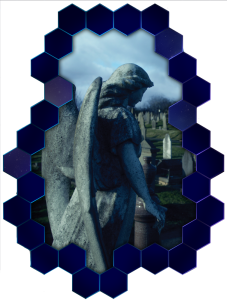
LONELY ASSASSIN faction
“Creatures from another world, only statues when you see them. Lonely Assassins, that’s what they used to be called. No one quite knows where they came from, but they’re as old as the Universe, or very nearly. And they have survived this long because they have the most perfect defence system ever evolved. They are Quantum Locked. They don’t exist when they are being observed. The moment they are seen by any other living creature they freeze into rock. No choice, it’s a fact of their biology. In the sight of any living thing, they literally turn into stone. And you can’t kill a stone. Of course, a stone can’t kill you either, but then you turn your head away. Then you blink. Then, oh yes, it can. That’s why they cover their eyes. They’re not weeping, they can’t risk looking at each other. Their greatest asset is their greatest curse. They can never be seen. Loneliest creatures in the Universe. And I’m sorry. I am very, very sorry. It’s up to you now. Don’t blink. Don’t even blink. Blink and you’re dead. They are fast. Faster than you can believe. Don’t turn your back, don’t look away, and DON’T blink. Good luck.”
That was David Tennant’s first description of the Weeping Angels in the episode Blink. While the moniker Lonely Assasins has persisted, even in that same episode four Angels were working in tandem, and by the end of the Thirteenth Doctor’s era there was a village’s worth of Angels coexisting. But still, the moniker persists.
A bit of an aside here, but the core Weeping Angels’ deck has six Characters, the aforementioned ‘Cherubs’ and ‘Liberty Angel’, along with four identical ‘Weeping Angel’ cards ( Nemesis, Character ; Angel, Minion ). At a glance, it may be a convenient coincidence of the design process, but I like to think it’s a fun little easter egg reference to those first four Angels in Blink.
But anywho, the Locations on the Lonely Assassin’s Control Board are New York: Past, London: Past, New York: Present, and London: Present. It gives a Conflict bonus of +1 Strength if there is only a single Angel Character in the Conflict.
In keeping with the single Angel bonus on the Control Board, the Lonely Assassin faction cards lean into hunting individual prey. ‘Buried in the Snow’ ( Nemesis, Moment ; ) allows the player to search and play a Nemesis Constant or discard their hand to draw three cards. One such Constant is ‘Hunting on Earth’ ( Nemesis, Constant ; Scheme ) which retrieves a Companion Hero Character when played and has an Ongoing effect of gaining 1 Plot for each Conflict where the Angels’ Temporal Displacement rule is used, its Scheme win condition is triggered when 5 Plot have been gained. ‘Seek Prey’ can either Retrieve a Character from the discard pile, then activate Blink, or Initiate a Conflict in a Location with a Hero Character. This is where the Lonely Assassin gets interesting; ‘Human Prey’ ( Hero, Constant ; ) is a Hero card specific to a nemesis deck. It has a Blink action to Retrieve a Nemesis Character, Nemesis Constant, or Nemesis Moment from the discard pile and play it. But during the End Step, the top two cards of that player’s Nemesis Deck are discarded.
As a reminder for those who didn’t go back and re-read the gameplay article, a Moment card is played and put in the discard pile. So the order of operations here could be: If ‘Hunting on Earth’ and any Angel Characters are in play, use ‘Seek Prey’ to initiate a Conflict (using Temporal Displacement to gain Plot) and trigger Blink > use the Blink action on the Angel Characters to move them then the ‘Human Prey’ Blink action to retrieve ‘Seek Prey’ and play it again. This creates a loop which would eventually trigger the ‘Hunting on Earth’ win condition. While that may seem overpowered, remember it requires a minimum of five cards and several turns to set it up. Plenty of time for an opponent to prevent it.
The last faction card is ‘Sally Sparrow’ (Hero, Character ; Companion) who, during the owner’s End Step forces each player to discard 1 Power or card from their hand. Being a Hero card means she could help feed the above ‘Hunting on Earth’ combo, and her ability makes it harder for opponents to help the Heroes win in a conflict to short-circuit the cycle.

WEEPING ANGELS faction
Using Weeping Angels as both the nemesis and faction is ultimately confusing and it really messes with my established format here…
The Locations on the Weeping Angels’ Control Board are Hunting Grounds, a Byzantium Starliner, The Crack, and the Maze of the Dead. It has a Blink action allowing the player to retrieve 1 Paradox Nemesis or to Gain 1 Power. Another thing about the Angels that is a bit confusing to me is how the game refers to certain cards compared to how those same cards are labelled. Whenever I’ve written down a card for the first time I’ve been adding its tags as Tope Line, Top Line ; Bottom Line, Bottom Line so it would look like ‘Lost Time’ (Nemesis, Moment ; Paradox). Now to me, I would refer to a card with specific tags in that same order. But the Weeping Angels Control Board, and several cards including ‘Lost Time’ refer to them as Paradox Nemesis cards. The lack of a consistent internal syntax for this nemesis drives me a bit bonkers, to be perfectly honest.
The Weeping Angels’ Faction Cards include a pair of ‘Unwanted Guests’ (Nemesis, Constant ; Upgrade) that are attached to a Hero Character on their Control Board, then allows the player to Blink. That Hero Character no longer Contests Locations and gains the player 2 Power when the Character is Thwarted or Captured. ‘Spoilers’ (Nemesis, Moment ; Paradox) provides 1 Power for each Paradox Nemesis card in play or your discard pile or allows the player to Retrieve one card and Blink. When played, ‘Lost Time’ allows the Player to Retrieve a Paradox Nemesis or if played using a Blink action, Retrieve and play it. Finally, ‘Temporal Anomalies’ (Nemesis, Constant ; Paradox, Scheme) has an Ongoing effect that gains the player 2 Power each time they play a Paradox Nemesis card and they can discard 3 Power to gain 1 Plot during the End Step. The Scheme win condition is triggered when The Weeping Angels have 4 or more Plot.
Even with the additional Blink and Temporal Displacement rules, the Weeping Angel (faction) is significantly simpler to play compared to the Lonely Assassin. There are a ton of Paradox Nemesis (still hate that syntax) cards in the Core Deck to feed into the ‘Temporal Anomalies’ win condition, and a ton of other cards that gain Power which can be spent to help Capture Doctors and trigger the generic Scheme win condition in all the Core decks or to feed ‘Temporal Anomalies’.
If you had a three new-player game going, I would strenuously encourage you not to use the Weeping Angels nemesis. Figure out the game first or you may not have the greatest first experience. That’s also why I’ve left the Angels for the fourth and final of these more in-depth looks at Doctor Who: Nemesis’ playable choices. Maybe, having read all about the Angels’ strategies, you’ll be ready to step up your game with them.
You can find Gale Force Nine at www.gf9.com or on Facebook at facebook.com/GaleForceNine. You can find more of my Doctor Who gaming reviews at TheRatHole.ca/who. WAIT!!!
You thought I was done, didn’t you? Well surprise, this is the written equivalent of a post-credit scene. I said this was the final look at the playable choices, and that was very careful wording. There’s a major part of the game that is randomized for every player. Remember where I said having Hero cards in a nemesis deck was unusual? That, my friends, is because other than those two cards, The Doctor and his Companions are the Heroes. You can never be sure which Heroes may show up to spoil your evil machinations so those Heroes deserve a spotlight all their own. After all the game is called DOCTOR WHO: Nemesis. So, as always, the Doctor will return…
[Editor’s Note: at the time this goes live we are experiencing some technical difficulties behind the scenes. Our Doctor Who Games landing page is specifically impacted and may not include our most recent Who reviews, including our Nemesis reviews. -dc]

TheRatHole.ca does not accept payments for our reviews but may have received a promotional copy of this product for review.