
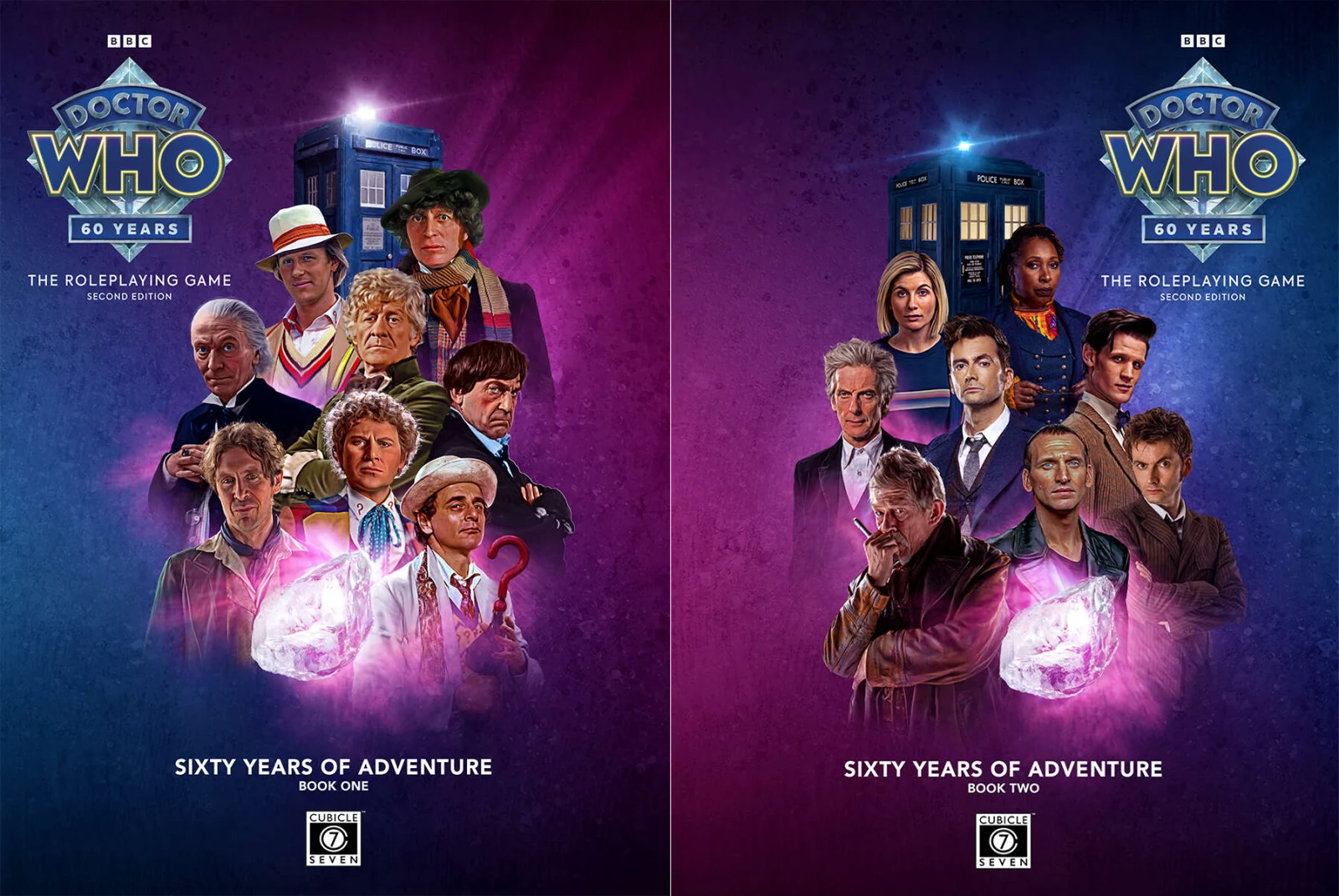
It’s the 60th Anniversary of Doctor Who. SIXTY YEARS. 18 years of the New Who era. New Who can go for a pint almost anywhere in the world. But obviously, I’m not here to talk exclusively about the Doctor’s diamond anniversary (you knew that’s why the “new” logo is a diamond, right?) just like you’re not here to read about it. We are both here to look at how Cubicle 7 and their Doctor Who the Roleplaying Game is marking the occasion.
Let’s have ourselves a bit of a history review, shall we? Let’s go back, waaaaayyyy back, to another time and title. No, not the FASA Doctor Who Roleplaying Game, that’s too far back. Let’s go back to the 50th anniversary when DWRPG was called Doctor Who: Adventures in Time and Space! 10 years ago that was the title of the exact same game we are talking about today. The why and how of the name change is a tale for another day. Now that I’m thinking about it, maybe it’s a story I’ll even try to tell someday. But for now, just know that it used to be Adventures in Time and Space, and many of the original sourcebooks continue to bear that title. Included in that list are the original eleven Doctor sourcebooks.
Released over about a year, each of the sourcebooks focused on a separate and distinct Doctor. I’ve had the pleasure to review most of those Doctor sourcebooks, and I want to stress that across the board they have been an immense pleasure to read. One of the most consistent comments I’ve made about them is that if a student were to come to me with an assignment to write a report on a fictional character, I would give them one of these sourcebooks as reference material for the Doctor. They are incredibly well written, and that is the expectation that I came from when opening the Sixty Years of Adventure books. Obviously, there is no way to fit everything from all the (now thirteen) individual sourcebooks into only two. These are books ABOUT the TARDIS but they are not, in and of themselves, a TARDIS: the books are sadly not bigger on the inside. So while I approached them from a place of awe-filled appreciation for the standalone books, I also approached them with the very realistic understanding that Sixty Years of Adventure would be their own thing.
In the spirit of being all wibbly-wobbly timey-wimey, let us begin at the end with my general impressions of these books. First off, I think splitting them into a “Classic Era” book and a “Revival Era” book was smart and handled extremely well. Many players may only want to deal with one era or the other, plus it provided an excellent opportunity to expand on John Hurt’s War Doctor and Jo Martin’s Fugitive Doctor characters. Some players may bemoan the lack of a “midseason finale” adventure (to use an American television concept) at the end of the first book, but including one after the Fugutive Doctor in the second book means that players who exclusively play the adventures in that era are not being shortchanged by only having seven to choose from. The books are not without faults, most of which really come from missed opportunities more than actual problems. I think the biggest of those missed opportunities takes us all the way back to the First Doctor.
The First Doctor, as we all know, was played by William Hartnell. Although newer fans may know the First Doctor better with the face of David Bradley, who first played William Hartnell (and by extension his Doctor) in the 2013 biographical film: “An Adventure in Space and Time.” Originally airing to celebrate Doctor Who’s 50th anniversary, a re-edited version also aired to celebrate the 60th anniversary for an even newer new audience. Bradley was so good in the part that he canonically returned as the First Doctor opposite both the Twelfth and Thirteenth Doctors. After Hartnell’s death, The First Doctor also appeared in the 20th anniversary special “The Five Doctors”, played by Richard Hurndall, whose casting was supported by Hartnell’s widow and who also died shortly after that special aired. Full disclosure, I have not read the full First Doctor Sourcebook cover-to-cover yet. But I can’t find any mention of The Five Doctors there, which can be forgiven as it is technically a Fifth Doctor story. Hurndall’s First Doctor appears in most of the pictures from that episode in the Fifth Doctor Sourcebook but doesn’t appear in either the First or Fifth Doctor chapters of Sixty Years. David Bradley similarly shows up in the Twelfth Doctor Sourcebook when talking about “Twice Upon A Time” but also not in the Twelfth or Thirteenth Doctor chapters here.
It makes sense that Bradley’s First Doctor doesn’t appear in the original Sourcebook. Much like how these books are not bigger on the inside, the writers are not actual time travellers, and that Sourcebook came out before An Adventure in Space and Time aired. However, we are a full decade since Bradley first stepped out of the TARDIS, and four decades since Hurndall. It is an injustice that neither actor’s portrayal is celebrated alongside their fellow Doctors. Decolourize the pictures so they match, I don’t care. Use footage from An Adventure in Space and Time, again I don’t care. But they should have appeared here in some way or another.
To be perfectly clear, there are a lot of things, a lot of characters, and a lot of actors who deserve better than is possible in a scant 250 pages, but for some reason snubbing David Bradley leaves a bad taste in my mouth. The Eighth Doctor chapter actually manages to have the opposite problem. They only photographically acknowledge his later mini-story. I love that Paul McGann’s brief return, leading into the introduction of the War Doctor, was able to be included in his original Sourcebook. I love that his 20-years-later look is what is most commonly used to represent his Doctor now. But every image in his anniversary chapter comes from the “The Night of the Doctor” mini-episode. Less than 8% of the Eighth Doctor’s screen time is all that gets recognition and that irks me. One photo can make all the difference in the world and there were plenty of photos that could have been replaced with better options.
I don’t want to sound like there’s nothing good in this pair of books. The things that I’m being bothered by aren’t even remotely objective “problems.” They are editorial choices made by the production team that I would have made differently and there are more of them than just what I’ve aired here. But let’s be honest, these may even have been “choices” foisted upon them by some stuffed shirt in the BBC’s licensing department. That’s something that is easy for people to overlook with intellectual property licensing: absolutely everything has to be approved. Every word, every picture, every detail. With that in mind, the team has done a brilliant job distilling down thirteen books to about 13% of the page count. (Before you roll your eyes at me, I’m not intentionally overusing hyperbole. That 8% of eight and 13% of thirteen is pretty well the actual math. Goblin level of coincidence there, I know.)
With that little rant over, let’s look at how the books are organized. The books’ structure is probably best described as “streamlined.” Each of the two books starts with an introduction to the era of the show that it covers, Classic or Revival. From there, each Doctor gets their own chapter. Each chapter is then broken down, starting with a rudimentary overview of the most important details of that incarnation’s time on television. Next, we get a look at that Doctor, their major companions, and then the themes arising from that Doctor’s time (often connecting the television stories to the real world of the day). The most challenging part of the chapter follows: summarizing virtually every televised story in about a paragraph each. Looking back, this comprised 60-80% of each of the individual sourcebooks. Generally speaking, this is a great format, ensuring that all the important points get touched on without extra fluff taking up room better suited for other things. For example, The Eighth Doctor is much shorter, making room for the preliminaries in Book 1, while the second book only has seven Doctors with War Doctor and Fugitive Doctor chapters being long enough to make them feel like proper Doctors (which, of course, they are) but still short enough to help fit in the Appendices at the end. But, as there is some obvious bleedover between categories, there are a few moments of deja vu reading through the chapters that I wish had been handled better.
That also brings up another conversation point. The “Classic Era” of Doctor Who is indisputably Doctors One through Eight. The “Revival Era” is slightly more complex. Production-wise, it starts with the Ninth Doctor in 2005. Whether you put the War Doctor before regenerating into Nine or in the middle of Matt Smith’s Eleventh Doctor when he first appeared, he is clearly part of the Revival. The Fugitive Doctor has not been confirmed on screen as to where she lands, pre-Hartnell or sometime later. Heck, we’ve still never seen the time between Doctors Two and Three, so maybe she fits there. But until that gets sorted out, it makes sense to leave her after Thirteen. But where does that leave the Fourteenth and Fifteenth Doctors? Ncuti Gatwa is easy, his run as Fifteen began after the 60th Anniversary that these books are meant to celebrate. We, the fans, knew that the 60th anniversary specials would be featuring David Tennant’s return, as the Fourteenth Doctor. Knowing that, how do you put out a 60th Anniversary book without him? The answer is you just sort of have to, but also not. The second book closes with an appendix talking about the biology and mythology of Timelord regeneration. It’s in this chapter we get images of Fourteen, and it ends talking about regenerating into familiar faces including a pseudo-cryptic comment not mentioning Ten or Fourteen, like the world didn’t already know that’s a thing. Fourteen also lands front and centre on the cover of Book 2, giving us a nicely balanced eight Doctors on each cover. The two covers actually balance quite nicely all around. The Doctor Who logo is on opposite corners, the Doctors and TARDIS images vaguely mirror each other and the background colours for the two covers are palate swapped. But they are so close to being a proper mirror that it boggles my mind that you can’t put them side-by-side to form a single image. That would have been a delightful nod to the original sourcebooks, which make up an image of a Doctor Who logo across their collected spines.
Right. Back from that little conversational tangent. Across both books, the chapters each close with what I think are the two most valuable things in the collection. Firstly, character stats for the Doctor and their most significant companions, re-written for the Second Edition ruleset. The books point out that there are many character stats missing and point to the First Edition Sourcebooks and the easy conversion guide in the Second Edition Core Rulebook for those. But having every Doctor at your fingertips is super useful. Finally, and this really is the most important part for current players, is an adventure. Each chapter ends with a short adventure loosely designed for that specific Doctor, but completely playable by any and all characters (not just any Doctor or even any Timelord) in any order they wish.
BUT WAIT, THERE’S MORE!
These adventures all tie together into a multi-Doctor campaign, entitled “A Lustre of Starlight,” concluding with a 16th grande finale adventure! If there’s a world where sixteen three-act adventures isn’t value for your money, I don’t want to go there, Doctor. Just take the TARDIS and leave, I’ll stay here. Thank you.
In the spirit of being all wibbly-wobbly timey-wimey, let us end at the beginning where I gave my general impressions of the Sixty Years of Adventure books. I love that there are two books. I love that the War & Fugitive Doctors get treated as real Doctors, rather than guest stars. There is a sixteen-part campaign, that’s worth the price of the books all by itself. All told, there is no reason you shouldn’t pick this pair of books up. Are they as good as the original encyclopedic set of sourcebooks? No, but that would be nearly impossible. They are great for what they are and excusable for what they aren’t.
You can find Cubicle 7 online at www.cubicle7games.com or on Facebook at facebook.com/Cubicle7Entertainment.
The official Doctor Who homepage is www.doctorwho.tv and the official Facebook Page is facebook.com/DoctorWho.

TheRatHole.ca does not accept payments for our reviews but may have received a promotional copy of this product for review.