
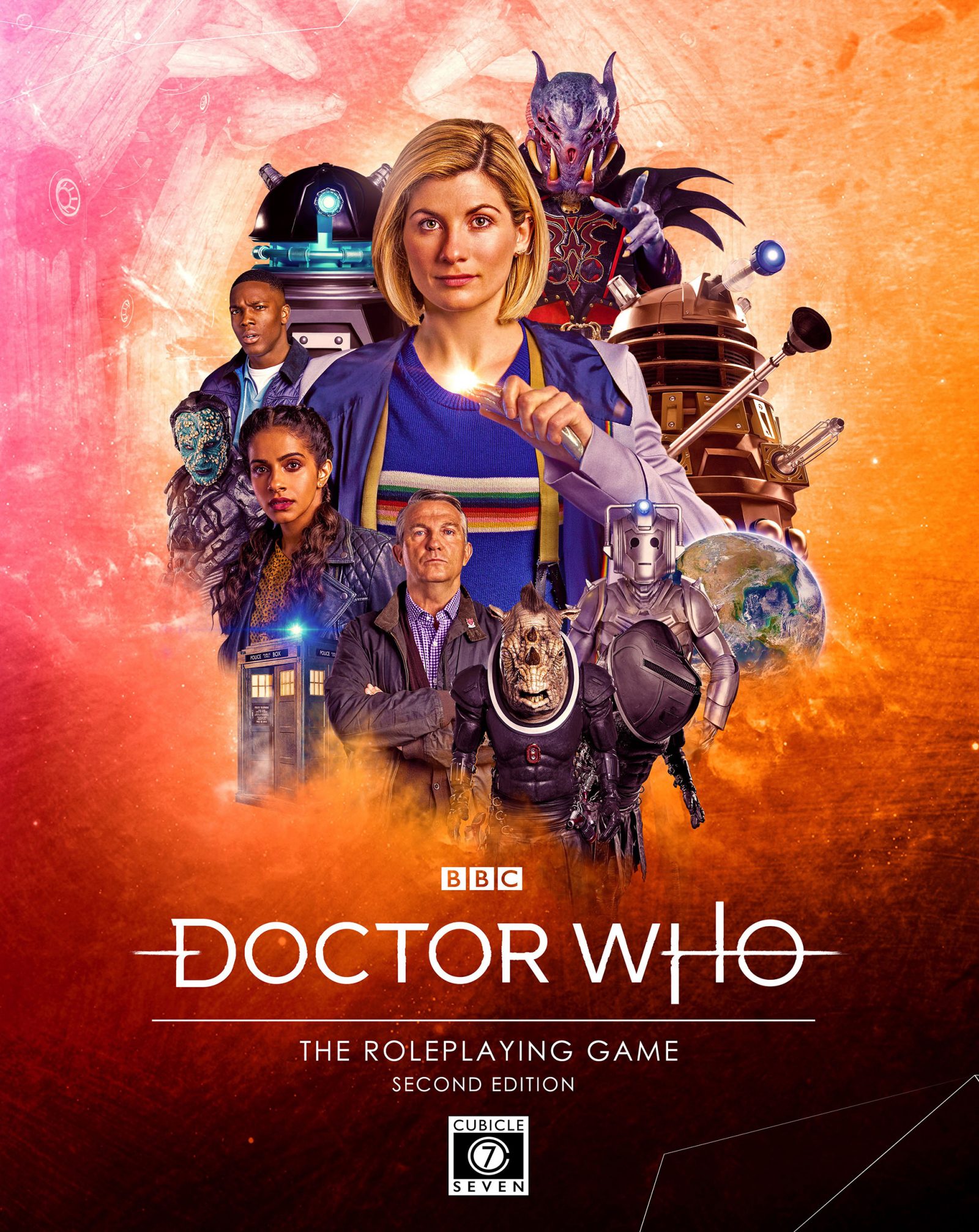
The era of the Thirteenth Doctor is over. Series 13 gave us the six part story arc “Flux” (which I naturally spell “Fluxx” in my head every time) and three specials, concluding with The Power of the Doctor airing days after the centenary anniversary of the BBC. While I am writing this beforehand, by the time you are reading it, Jody Whitaker will have taken her last bow and Ncuti Gatwa will be redecorating the TARDIS. In a few months, Whovians will be celebrating the 60th of the franchise, and what better way for gamers to celebrate than with a Second Edition of the Doctor Who: The Role Playing Game.
For the 50th Anniversary, the First Edition of Doctor Who The Roleplaying Game (DWTRPG) got 11 separate Doctor sourcebooks over the course of the year. If you ever see me on a live stream you’ll notice that as I add each of those books to my collection, the spines collectively form an image of the logo used for the game at the time. I’ve received no indication that something similar has been planned for the 60th, but I’m sure there will be some surprises coming out of the Cubicle 7 offices in 2023. But we are getting a new core rulebook, featuring a Jody Whitaker look and focus. That particular design element of the game is one of the few things about this game I’m not a fan of. There were four editions of the first edition core rulebook. The final edition giving focus to the 12th Doctor, but since the book came out early in Capaldi’s run it is missing a ton of information and images that simply didn’t exist while it was being written. It can be argued that no other Doctor has had as unsettled a character arc as Twelve, and that made things feel even more incomplete after the fact. Now, they of course released a full sourcebook on the Capaldi era, but that doesn’t change how the core book felt. Thankfully Whitaker’s run was, if little else, consistent with her character. So when Cubicle 7 made the decision to move to a second edition, I was afraid they would miss the opportunity to move away from the constant need to refresh the core book. Thankfully it was an opportunity they chose to take to a certain extent, although I suspect we will still get new editions of the Core Rulebook as we see new Doctors. Just because I don’t love the approach they’ve chosen with that, however, doesn’t mean I don’t love the overall graphic design and updated rules.
One important thing to note is that unlike many game’s Second Editions (and third, and third point five, and whatever else editions) this is mostly still the same Vortex System that powered the original game, it’s just more streamlined. The biggest change is the removal of Traits, with many of the character driven parts of them rolled into the new Concept, Focus, and Distinction mechanisms and any mechanical bonuses or penalties that might pop up being applied by giving characters a more general Advantage or Disadvantage in situations. But beyond that, most of the changes are actually pretty minuscule which is a credit to the original design.
When you are designing a new Character the first thing to determine is the Concept you want to develop. Are you a warrior? Are you an artist? Are you a doctor? Are you The Doctor? Your Concept is who you are and what you do in the world. After determining your Concept you’ll come up with a Focus that informs the why and how of your Concept’s who and what. After that, you’ll start filling in the details, starting by assigning 18 points among your six Attributes: Awareness, Coordination, Ingenuity, Presence, Resolve, and Strength. Next, you also have 18 Skill points to assign among 12 possible skills. These skills are kept intentionally broad while leaving room to add Specializations in areas that a character is exceptionally skilled at. Finally, you check if any of the previous steps changes your starting Story Points and add in any Finishing Touches like a background story.
If you’re in a hurry or just want a place to start from, there are a bunch of side boxes with some example scores for all of this throughout the chapter, or you could just download or photocopy the previously generated character sheets for the Doctor and her fam.
As for playing the game, the third chapter has you covered. There are more rules, obviously, but the Basic Rule for any action that has a chance of failure is ATTRIBUTE + SKILL + TWO SIX-SIDED DICE = RESULT (While trying to match or beat the Difficulty of the task set by the Game Master.) If you roll two sixes, you almost always succeed. If you roll two ones you almost always fail. But it’s not just a binary pass/fail system. There are levels of success that work a bit like that improv game, “Yes, and…” by often taking the yes or no and adding something good or bad on top of it. The levels of success are Brilliant (Yes, and… something else good happens), Success (Yes), Barely (Yes, but… it didn’t go as planned somehow), Almost (No, but… it could have gone worse), Failure (No), Disastrous (No, and… now things are worse). You can also spend Story Points to adjust the level of success or failure that you rolled if you need a bit of a boost, or straight up bend the laws of the universe.
Another important set of rules (in any game) covers how conflict is handled. Specifically of interest here is the initiative order the characters act in. Many games are all about hacking and slashing as a solution. But while Malcolm may solve his problems with a chainsaw, and Malcolm may never have the same problem twice, Malcolm is probably not playing as The Doctor. The order of initiative is not determined by dice, but by the actions you intend to take: Talkers, Movers, Doers, and lastly Fighters, with the GM determining where in the sequence NPCs act. This method of figuring out initiative is so perfectly in line with the values of The Doctor that it was imported into Doctors & Daleks, Cubicle 7’s other Doctor Who RPG that otherwise uses traditional Dungeons & Dragons Fifth Edition rules. Social and mental conflicts are every bit as important, if not more, than the physical ones, but regardless of the type, they are all handled in much the same way. By using different Attributes to make the checks and when you take fail or take damage you don’t lose abstract hit points, but rather you lose points from a relevant Attribute. This loss is often temporary but can result in longer term conditions being applied to your character until whatever it is can be fixed or healed.
Of course, it wouldn’t be Doctor Who if you couldn’t just jump into a TARDIS and explore all of time and space. Unless you happen to be Jon Pertwee, whose Who got the short end of the BBC budget stick but at least got a fun car instead. The TARDIS is more than just a vehicle or gadget in the game. The TARDIS, or more accurately any TARDIS, is treated more like a character. In fact, one is created almost exactly like a character including the same Attributes, Story Points, etc. Another change that seems to have flown under a lot of people’s radars in conversations comparing the First and Second Editions is that your TARDIS is treated even more like a character now than it already was. Previously, a TARDIS’s stats included the Attributes of a Character and the Armour, Hit Capacity, and Speed stats of a vehicle. Those vehicle stats have been removed entirely in the Second Edition with the TARDIS treated entirely as you would a Character. I’m curious to see how this change will impact how The Doctor’s TARDIS will be presented in future sourcebooks. Until now, the TARDIS has been given a full page with an NPC-style stat block. The last version of the First edition core rulebook also had a full page on the Twelfth Doctor’s TARDIS. Thirteen’s TARDIS is presented as a sidebar example, barely more than a quarter page long. I’m going to chalk it up to stripping out much of the specific Doctor specificity in the book and that her eventual sourcebook will include something more substantial.
The fifth chapter is all about being the Gamemaster or (in what may be the best toss-away reference in the whole book) Gamemissy. Doctor Who The Roleplaying Game can very much be a challenging game to run. With 60 years of source material across every imaginable medium, there is an overwhelming amount to draw from. Thus far every Doctor-specific sourcebook has walked through each televised story as if it were being played as a game, and published adventures have a more generalized format than I am personally comfortable running. I’m extraordinarily excited to dig into the new multipart adventure Secrets of Scaravore since it will be released for both DWTRPG and Doctors & Daleks and I want to see how each system handles it. But I digress. Cubicle 7 is great at encouraging new Gamemasters or Gamemissys. (They only use that latter term one time, but I’m running with it from now on.) This chapter is great, but for anyone wanting to run a game I can’t recommend the first edition Game Master’s Companion sourcebook enough.
The sixth chapter is framed as a history of the universe, but it also functions as an introduction to dozens of NPCs and antagonists for your adventure. It’s a terrific way to cover two massive info dumps at the same time, and I love it. But it’s a hard chapter to summarize without just doubling the length of this review. Speaking of the length of things, I found it interesting that the Second Edition core book is a few pages longer than the last First Edition book, despite being organized with fewer chapters and having removed the sample adventure. There is a sample adventure available as a separate PDF download, The Einstein Engine, that clocks in at about the same length as the Stormrise adventure that was part of the last core book. So you don’t have to lose out on that completely.
Finally, there is the Appendix, fittingly titled “Remember All The People You Used To Be”, that walks through converting Characters from your First Edition game to Second Edition rules, along with pregenerated character sheets for the Thirteenth Doctor and her companions Yaz, Graham, and Ryan. I’m not sure how they will handle this in the print edition, but I recently received an email notification that the PDF version, via DriveThruRPG, had been updated with a character sheet for Dan, who joined Team TARDIS during the Flux storyline and after this book went to print.
I love just about everything about the First Edition of Doctor Who The Roleplaying Game. That said, I can’t believe how just a few small tweaks were able to so drastically improve it. The removal of Traits is probably the best thing they could have done, as they were so arbitrary as to be functionally meaningless. I’m excited to see how these changes adjust the format and presentation of future sourcebooks, as well as how the releases for Doctors & Daleks will further complement this game the way DWTRPG is complementing it. I’m also a bit interested to see how fast the logo gets changed out for the new one. It’s entirely likely that this book and the Twelfth Doctor sourcebook may be the only two that were forced to use the Thirteen era logo. I know that is just how licensing works with the BBC, but I hate it so so so much.
You can find Cubicle 7 online at www.cubicle7games.com or on Facebook at facebook.com/Cubicle7Entertainment.
The official Doctor Who homepage is www.doctorwho.tv and the official Facebook Page is facebook.com/DoctorWho.

TheRatHole.ca does not accept payments for our reviews but may have received a promotional copy of this product for review.