
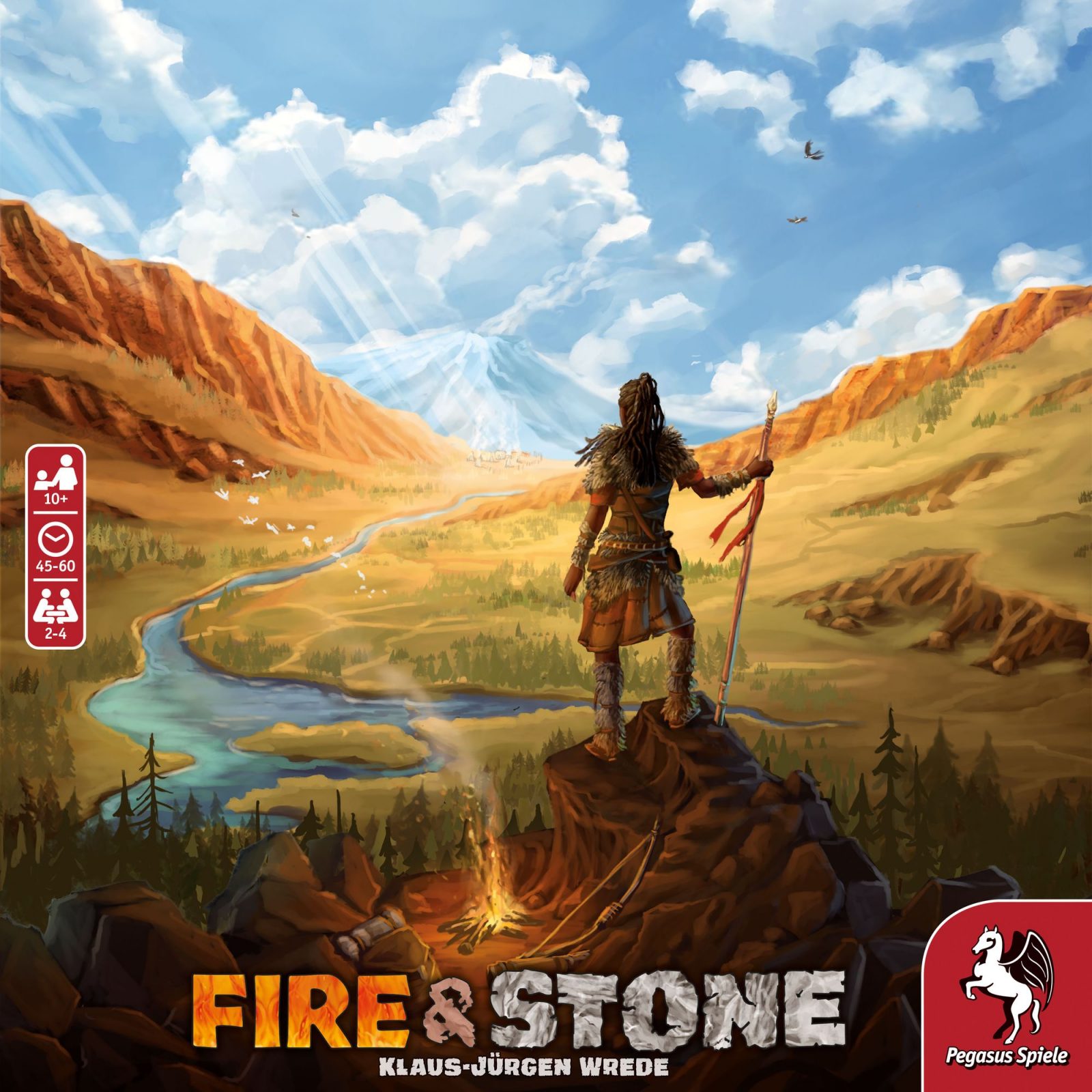
Wasn’t sure what to expect when I cracked open the latest game from designer Klaus-Jurgen Wrede and Pegasus Spiele. I read that this was the same designer as Carcassonne but to be honest, I’ve never actually played that (I know, it’s a classic). So, I came into this with an open mind and few expectations.
SETUP
The game set up is simple yet a bit tedious. There are 3 sections of the map board that each contain a bunch of smaller sections. Each major section, I-II-III, have a handful of chits that get shuffled up and distributed most of the smaller sections (some already have a “fire” shown on them. These don’t get a chit). On the front of these chits, there may be 1 of 4 different foods, a fire, a forest, a hut, or an immediate bonus. After laying out the chits, you take a pile of “animal” chits, shuffle them up & make stacks of 3 to place in their spots at the bottom of the board. Each player chooses a color of their choice, puts one meeple on the starting location of the map, one on the score track & one on the “hut” track (which will be unlocked later). Depending on the number of players, you may start with 1 or 2 of the food tokens on your board. Lastly, you’ll randomly choose a “cave” card to place face down on its spot on the board, randomly give out end game objective cards & in the “advanced” game, each person starts with a special ability. There will also be a stack of cards that contain each of these abilities that you can obtain throughout the game. There will always be 3 of these faceup to choose from.
GAMEPLAY/OVERVIEW
On your turn, you MUST move 1-2 spaces and then you may perform an Action. Actions are
- Discover a facedown token (which may lead to an additional action)
- Take a faceup token
- If the space is devoid of a token (& is not a fire spot), take a food marker (if you have space). Tokens & markers are different. The tokens are cardboard chits with images where the food markers are wood pillars that sit atop your “food bags”, another “resource”).
When you discover a facedown token, it could be several different things (as mentioned above). If it’s a Food Token, you can take it and place it on your player board. Your board has space to hold 2 food tokens. As you gather more food tokens, you can place them on your board if they are the same as the one below it (an apple can only be placed above another apple and so on). Once you’ve placed your second & third food token, you’ll get a chance to choose either a special ability card from the 3 faceup cards or a point card which will cover the ability of a previously chosen card. After the 3rd food token on the same line, discard all those to start a new line of tokens.
Speaking of the special ability cards, they range in ability such as being able to move 1-3 spaces, instead of 1-2, being able to move along ship routes instead of being landlocked, building huts cheaper, getting extra food, etc.
Another facedown token could be a forest. When this is discovered, you’ll take the next stack of “animal” tokens, choose one to place on your board in a space reserved for these, & place the rest facedown on the forest section. Next time someone comes to this section, they can take any animals that are left and choose one. If they’re all gone, you get nothing (not even a food marker). These “animals” will have either food markers, food bags or both. You keep these until you discover or move to a fire token/space. There you can “cook” the animals & take the rewards (if you don’t have room for the food markers, you lose them). You can cook as many tokens as you’d like.
If you discover a “hut” token, you move the token to the hut track along the top. Certain spots on this track will unlock new areas on the map or a 2nd meeple for all the players. Next, you’ll build one of your huts at no cost. Later, if any player moves to this section, they can build a hut of their own for the cost of 1 food marker per hut already built (so the 2nd hut would cost 1, 3rd will cost 2 & so on). This is the main reason for food tokens and huts are the main way to score points (1 point per hut at the end of the game plus a point for majority in each section). After building a hut, at any point, you must move you meeple to a fire spot in the same section of the map as you built in (I, II or III).
Lastly, if you discover a fire token, you immediately gain a point on the point track. Then you can cook as many animals as you’d like.
Once someone has unlocked the 2nd meeple, you will do a Move-Action with each of your meeples before moving onto the next player.
You’ll continue to take turns until either the 10th hut token is discovered, or a player has built all their huts. Once this has happened, each other player will get 2 more turns & the player that triggered the end will get one.
At the end, you’ll add up all your points for huts, majority for hut sections, point cards & secret objective cards (which are things like ‘1 point for each majority of huts next to lakes’, or ‘1 point for each majority in Section I’). The player with the most points wins.
THOUGHTS ON THE GAME
The game is a bit simpler than I first thought it’d be when looking at the back of the cover. That’s not a bad thing, per se but I prefer a heavier game experience. I played this at both 3 & 4 players and there wasn’t a whole lot of differences. Other than discovering tiles & building huts, there’s not a lot of interaction. One group I played with was seasoned gamers who after our first game said, “we’ll never play without the initial special ability cards”. They just give you a little boost at the beginning. The other group was more casual gamers. Their comment was, “okay, now that I understand what we’re doing, this will go much quicker”. Each game lasted about 60-90 minutes, with the seasoned gamers being the quicker group.
There’s not a lot of variability other than the tokens being randomly laid out (& even that, there are certain ones for section I, II & III). The game won’t end before discovering section III but even then, it could end quick if someone just continues to discover tokens or drag out if no one is out there flipping over new tokens. The biggest variability are the Cave cards. There is a huge stack of them & you only use 1 per game. This card comes into play when someone (in section II) discovers the cave token. This will give a new rule or something that players can do that changes the basic game. One game, the cave card made it so players could build in the cave area not with food markers but with food bags (which are valuable because you can hold food markers without them). The cave cards are probably my favorite thing about the game but it’s such a small part. I wish there were more of these.
FINAL VERDICT
As I mentioned, I’m not really the target audience for this game but I did enjoy it. It’s not one that I would ask for but if someone wanted to play it, I wouldn’t run away either. It’s quick enough (an hour for me is a fairly quick game) so it’s not taking up the entire game night. I think players that are just getting into gaming or enjoy light games that involve discovery will enjoy this. The rules are very straightforward and easy to understand.
Overall, I would give this a 7 out of 10. Definitely worth a look if you mainly play with younger kids (box says 10+) or non-gamers & want something that’s a little different.
In North America, Pegasus Speile can be found online at pegasusna.com or on Facebook at facebook.com/pegasusspieleNA.
