
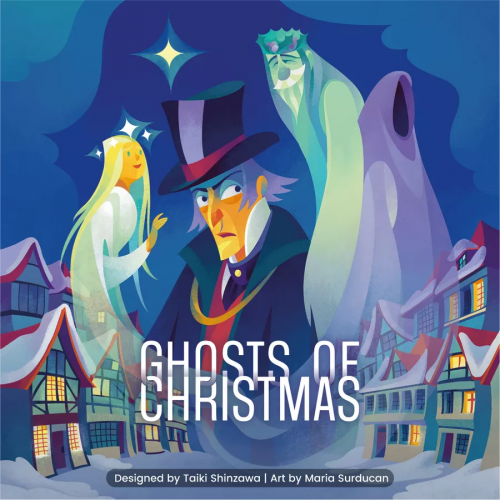
‘Tis the Season and all that jazz. ‘Tis the Season for playing card games with family. Often it’s family that doesn’t play modern games of any sort. Trick-taking games are often as wild as they get. Hopefully, I’m wrong about that on many levels, not the least of which is that Ghosts of Christmas isn’t your grandparent’s trick-taking game. I don’t say that to be disparaging. I even acknowledge that the grandparent trope can be tired and ageist. Heck, I’m old enough that I could be a grandparent. But at the same time, the statement is more true than not in this case. I was having the conversation while playing this and even experienced it while teaching it, that trick-taking games are no longer in vogue. I say that with the full knowledge that the term “in vogue” is also not in vogue and I’m not sorry. I will however refrain from telling you to get off my lawn.
But seriously, fewer and fewer people seem to be playing trick-taking games. I ended up teaching this to someone that didn’t even know what that meant. So with that in mind, and before I turn to ancient dust, let me go through the basics of a trick-taking game, before telling you how Ghosts of Christmas completely messes with the norm.
In a basic trick-taking game the starting player “leads” a card that will determine the suit that every other player must play. If they can’t play the suit that was lead, they can play any card of any suit and automatically lose the trick or a specific suit that is designated as the “trump” suit that automatically wins the trick. The highest card in the correct suit (or the highest trump card) wins the trick and will lead the next trick. This continues until all the cards in the hand have been played.
Most of what few modern trick-taking games exist add some extra twists to that, like extra suits and cards with special abilities. Skull King is a great example of that. But that’s not what sets Ghosts of Christmas so far apart from any other trick-taking game. What sets it apart is that you are playing three, sometimes even four, tricks all at once and what was lead may not end up being what wins the trick.
That sounds weird, right? That’s because it’s weird. I’m going to try to explain it, but honestly, you probably need to just play it through to really understand. But I’ll try.
The game is named after the three Ghosts of Christmas from Charles Dickens’s A Christmas Carol. These three ghosts each represent a separate timeframe: Past, Present, and Future. The players are going to play a card into each of those timeframes, before scoring. There are four suits: Red Hearts, Blue, Green, and Yellow, with Red always acting as the trump suit. The first player leads a card into one of the three eras. They take the cardboard disk for that era and set it to the colour they played as a reminder. The second player may play a card of the same suit into the same era or lead any card into one of the other eras. The next player may play into either of the first two or lead any card into the remaining era. Once all three eras have a suit, play continues like any other trick-taking game, but with three tricks (Past, Present, and Future) happening all at once.
That’s when things get… interesting. Starting in the Past, score that trick based on the card led by the first player as usual. The player who wins the Past trick also takes the first player marker. The Present is then scored not based on whatever colour was actually lead, but whatever colour the new first player played into the Present, which may or may not be the initial lead suit. The winner of the Present then takes the first player marker. The Future is then scored, again, based on whatever the new first player played which may or may not be the suit initially lead. Whoever wins the Future becomes the first player in the next round.
That’s the “TinyTim” version of the rules, aka The easy version. In the full version, players have to bid on how many tricks they think they will win in a hand. After looking at the 12 cards they are dealt, they take 1-3 purple door markers based on how many tricks they feel they can win, when they win a trick they take a wreath marker and place it on the door. If they win exactly the number of wreaths (tricks) as they bid doors, they get two points for each. For more flexibility, they may also take a red door marker. If they win the number of wreaths (tricks) that they bid on, including or without the extra red door, they only get a single point for each.
The problem with Ghosts of Christmas isn’t that it has a steep learning curve, but rather that the moderate learning curve doesn’t kick in until a few rounds in, or even a game or two in, when players start having to play off-suit and also win the prior era’s trick. Until that started happening it was just really challenging for every group I played with to wrap their heads around that the card lead during play may not be the card that determines the winning suit. I’m guessing that you, dear reader, may also be confused. That’s okay, once the odd flow clicks in your head the game goes from average to hella fun with a completely different sort of trick-taking strategy.
If you want a game that is deeper than the more standard kid/family weight holiday game, this is probably a good game for you. I loved it, and it’s already come out more than most Christmas goodness.
The publisher, BoardgameTables.com, has just rebranded to Allplay to better reflect the expanding scope of their business. Things like Ghosts of Christmas. You can find Allplay online at letsallplay.com and at the moment their Facebook remains facebook.com/BoardGameTablesDotCom.

Don’t forget you can read all of our current and past holiday reviews at TheRatHole.ca/Christmas!
To end today’s holiday review I wanted to find something thematic without going to the Muppet Christmas Carol well again. What did I find? Power metal band Majestica doing a whole album of A Christmas Carol. So please let your hair down and enjoy Ghost of Christmas Past.