
So, I had the immense pleasure of spending time with a few amazing friends that I haven’t seen in a pandemic. I’m using pandemic as a measure of time here because the last three years have pretty much just been like that week between Christmas and New Year, where time is made up and the days don’t matter. The biggest difference is that I haven’t spent 3 years full of cheese and tasty baking. But I digress. Scott and Anita are the co-hosts of The Read-Along podcast that I can’t recommend enough. Scott is also a former silver Ennies award winner, so he might know a bit about games. Anita loves games on a different level and the two of them often come off a bit like a very well oiled vaudeville duo, even when they aren’t “on”. They are two of my absolute favourite people. One of the many gems of wisdom that came up was Scott mentioning that every game collection really should have at least one good racing game. *Blink blink* He’s not wrong. I can’t think of a single racing game I’ve ever not enjoyed.
On the video game side of things, games like F-1 Race and Rad Racer for the original 8-bit Nintendo Entertainment System were groundbreaking, and Mario Kart is one of the highest selling series in history. Tabletop dexterity racing games like PitchCar have been around for decades. There have been dozens of card or dice-powered games. Wacky Races based on the Hanna-Barbara cartoon, Snow Tails (and a favourite of mine) is a dog sled racer, even RPGs like the recent Red Shift Rally for Starfinder. There’s just something about the genre. The sport isn’t the thing –I don’t understand the spectator appeal there, to each their own– but rather the play is the thing. The Bard, of course, meant a stage play but in this case it’s the gameplay. Something that holds true across virtually every racing game, is that the biggest determiner in victory is the choices made by the player. There is very little if any, take-that style play in racing games. That’s the appeal, you are in control of your own destiny, un-effected by the actions of others and similarly unable to affect them. In many games, that sort of multiplayer solo play can quickly become dull. But not in racing games.
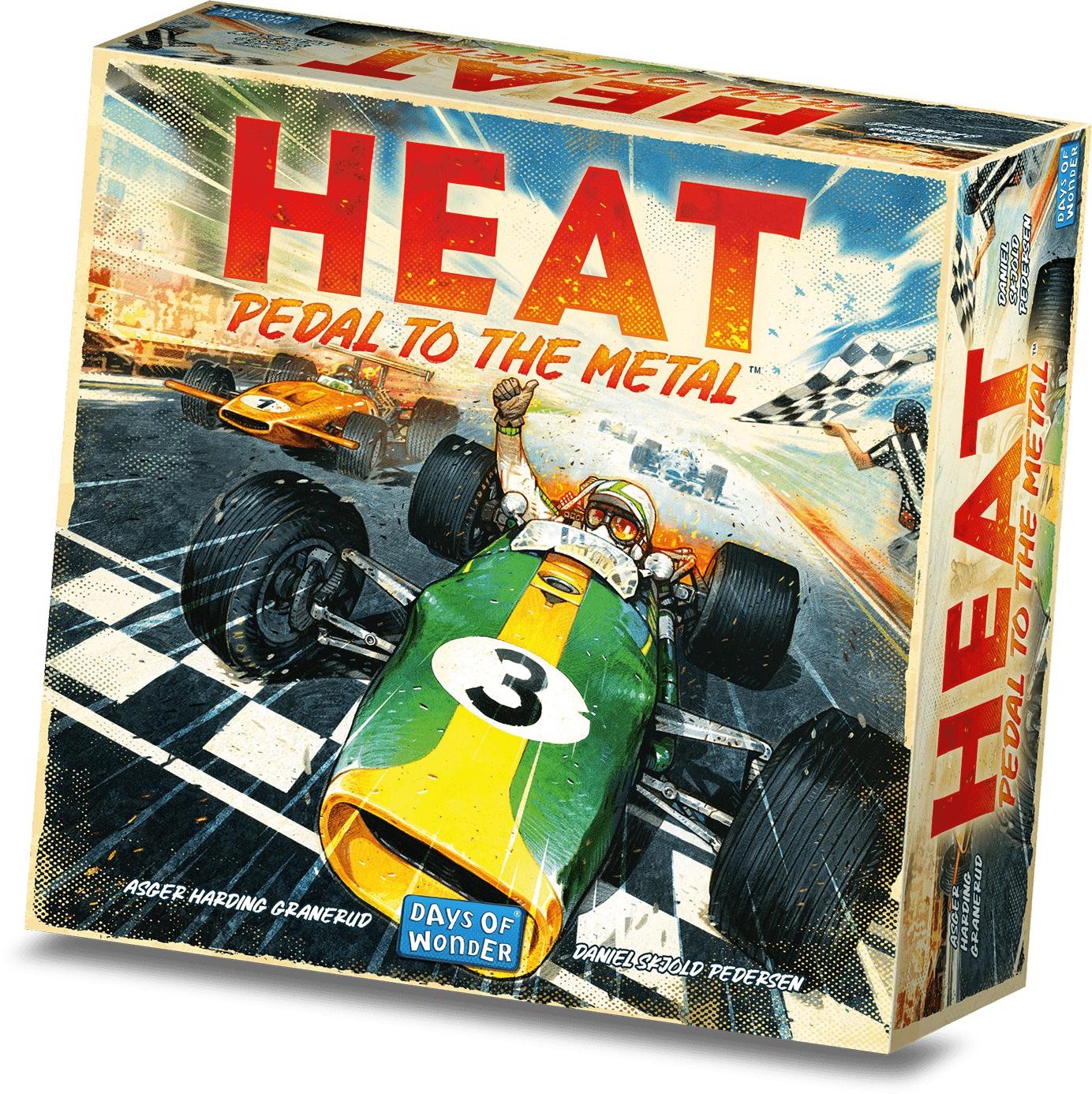
Heat: Pedal to the Metal, from Days of Wonder, is the latest racing game to hit shelves, and I have to say it’s one of the best. I’m sorry for this, but the new hotness is Heat and Heat really is hot. (Okay, I’m not sorry.) As it’s not a game I received for review, I can only base my judgment on the proportionally small amount of the game that we played. I don’t know when I’ll get to play it again, but I’m excited to eventually do so.
The game comes with four different tracks to play (on two double-sided boards), components for up to six players, more components for advanced play, and what looks to be a challenging AI system for solo play or adding extra cars to a multiplayer race. An interesting and exciting side note is that the box insert also has space for at least two more players’ worth of components. I haven’t found any announcement of expansions, but it was clearly on someone’s mind.
The basic mechanic in the game (no car jokes, please) is hand management, and honestly card counting. Each player starts with a deck containing three sets of 1-4 cards, a single 0 and 5 card, three Stress cards, and a single Heat card. They also start with a sidebar of six Heat cards. Heat works as a sort of necessary evil. If you make certain intentional choices or unfortunate miscalculations, your draw deck gains Heat. Examples of this are shifting up or down more than one gear at a time, or speeding through a corner too fast. If you can’t pay Heat, you can’t take that action. If you run out of heat as a result of going around a corner too fast; your car spins out, is returned to before the corner, and start in first gear again on your next turn.
Choosing what cards to play is done simultaneously by all players, placing the same number of cards facedown on the table as the gear you are in. Then, starting with the player currently in first place, cards are revealed and cars are moved on the track. You’ll move the total number of spaces as the numbered speed cards you played. If any of those cards were Stress cards, you flop cards from your deck until revealing a speed card and add that number to your movement total. Maybe flop a 0 and it has no impact or maybe you flop a 5 that sends you spinning out in a vital corner. Players can choose to pay Heat and boost their speed, by flopping cards from their deck just like with stress. The player that started in last place also has Adrenaline which lets them add 1 to their speed and Cool Down by placing a Heat card from their hand back into their engine keeping it out of their discard pile and draw deck. Any card that ends its movement directly behind or beside another card can Slipstream ahead two spaces.
The game ends up surprisingly balanced. I mentioned that race games are all about a player’s choices, and that’s true. But that includes the culmination of all of their choices which means that eventually, every player has roughly the same amount of possible movement in roughly the same amount of time. The number of cards each player has is finite. Every single time that one of us said “well I can’t possibly catch up now” things evened out within a few turns. It’s possible that a catastrophically bad choice could lead to a blowout victory, but that would be the exception, not the rule. As things got heated (sorry, not sorry) I forgot that you can discard speed cards at the end of the round, and that alone might have made the difference between first and my last place by the time the checkered flag came down.
I can’t wait to play this again. Even when your group finishes the four official tracks, either individually or in Championship Season mode, there are already a bunch of fan-made tracks to race on.
You can find Days of Wonder online at www.daysofwonder.com or on Facebook at facebook.com/daysofwonder.