[Thanks to the Compose Dreams Games RPG Marketplace for providing TheRatHole.ca with a review copy of this book.]
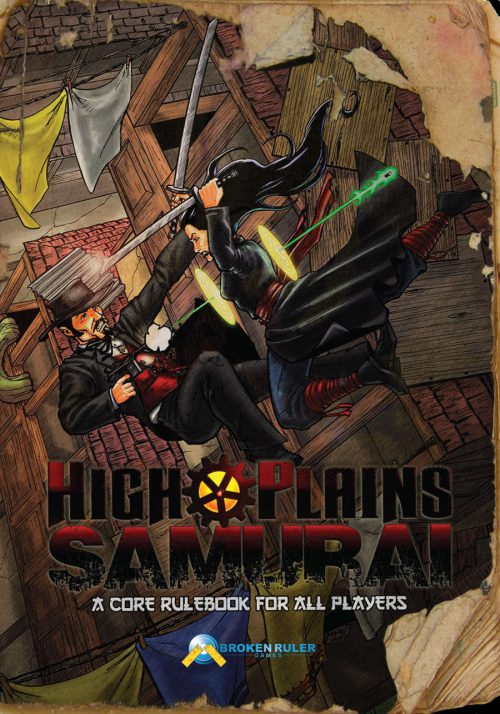
High Plains Samurai is a storytelling role-playing game that takes players on a cinematic adventure through a post-apocalyptic world. The unique setting and mechanics, provide a fast-paced and action-packed gaming experience. Just not necessarily the way you may be used to.
The layout of the High Plains Samurai book is interesting. The softcover edition is largely well organized, but printed in less expensive black & white on standard paper. Nothing fancy or glossy, and that’s ok. I’ve seen comments that the hardcover is printed in colour and looks incredible, but either way, the information is mostly easy for players to navigate and reference information during gameplay. Really, that’s the important thing, right?
The book is split into two “Volumes” with each volume split into “Books” –instead of traditional sections or chapters– which adds to the narrative feeling that the book, and the whole game, is going for. Much of the introductory text is written as if you (the reader) have discovered this tome of knowledge, or perhaps that it has discovered you. This was a great way to immerse you in the world of the One Land right from the start. But I felt like it struggled to maintain that consistent voice, slipping between narration and straight rulebook a bit awkwardly.
The world of the One Land is a blend of Western and Eastern cultures, with some sci-fi and steampunk thrown in for good measure, resulting in a unique post-apocalyptic world. There are five cities, each with its own culture, challenges, and NPCs, making for a diverse experience with every adventure. Surrounding the cities lies The Wastes, a desert filled with every non-urban postapocalyptic trope you can imagine. Between them runs The Salvation, a perpetually travelling train covered in armour and weapons. Unable to take on passengers itself, the train guides and guards private “wagons” that join and leave the caravan as needed. But despite the protection of The Salvation, there is never a guarantee of safety when travelling the Wastes.
I love how different and distinct each of the cities has been designed, but I really didn’t like how they were presented. There is a sidebar on page 14 with a super fast description of each. Then starting on page 23 there is a single-page description of each city in the context of character creation and choosing your Lead Character’s homeland. Then on page 80, there are another 4-5 page descriptions of each, meant for Directors (the GM). Having that sort of separation shouldn’t be a problem and isn’t even all that different for many games. But the execution feels off to me. I think that feeling mostly comes from the book’s struggle to find that consistent voice I mentioned. I suspect that the hardcover version may be visually formatted in a way that avoids that issue a bit better, but I can obviously only guess. Otherwise, the world-building is excellent, with detailed descriptions of the different cities, plus various factions and characters that could be encountered. The lore runs surprisingly deep given the smaller page count, with plenty of opportunities for players to create their own narratives within the One Land, and plenty of opportunities for both combat and non-combat encounters.
One of the standout features of High Plains Samurai is the use of cinematic techniques to enhance gameplay. The game encourages players to think about their actions like scenes in a movie, with the traditional gamemaster acting as the Director and the players the Writers. In building the collaborative story, Writers use Descriptions to resolve their actions, including required or limited Details to move the story along. There are no outright failures here, instead of determining success dice are rolled to add complications to the scene. It’s never really about winning or losing, it’s about telling the most entertaining (and somewhat coherent) story.
To be perfectly honest, I don’t love the storytelling mechanics. No. That’s not quite accurate. I don’t love the storytelling focus. I really think that my dislike simply comes down to how I process information. It does what it sets out to do, and honestly, it does it really really well. I just feel like less outgoing players who prefer to chuck dice at things may find the pure storytelling a bit overwhelming. However, for those who enjoy telling a fast-paced action movie-style story, High Plains Samurai is an excellent choice.
Overall, this is a unique RPG, with its clever mechanics and grungily detailed setting, High Plains Samurai may be just what someone looking for a fresh gaming experience is looking for. While not for everyone, it will give hours of adventure and excitement to those players that it connects with. For the people who connect with the setting but not the mechanics –and I suspect that will be more than a few people, since the setting is the real star– there is more than enough here to be worth picking up to port into a …diceier… system. I can think of a few that are thematically perfect right away.
You can find Broken Ruler Games online at brokenrulergames.net.
[Thanks to the Compose Dreams Games RPG Marketplace for providing TheRatHole.ca with a review copy of this book.]

TheRatHole.ca does not accept payments for our reviews but may have received a promotional copy of this product for review.