
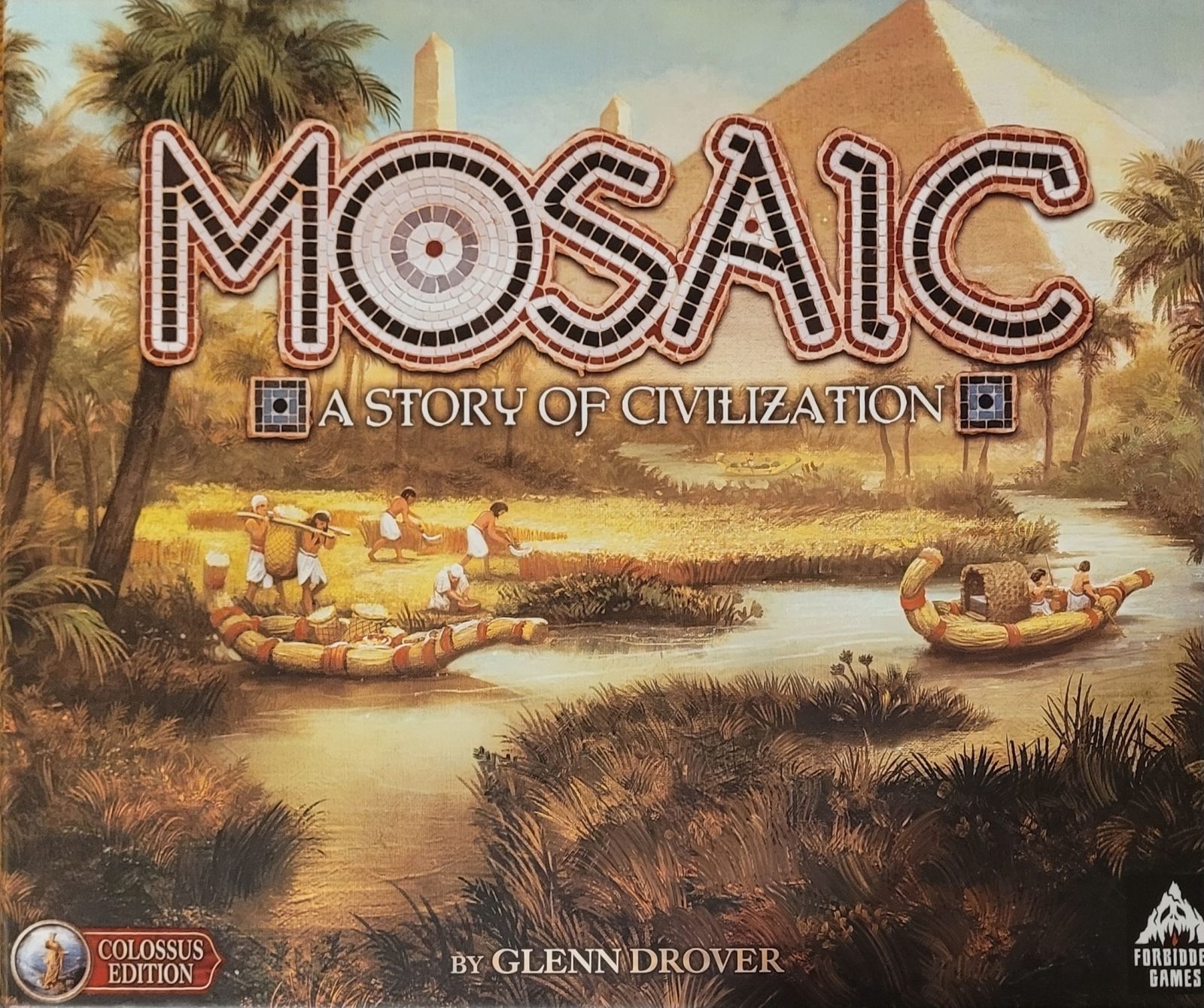
Mosaic is the new hotness right now, and right from the start, I want to say that it deserves to be. Unfortunately, that also means I’m stuck between wanting to play it a bunch more “before writing about it” and being a slave to the modern media cycle. Well, you’re reading this, so I think you can tell which I chose. If nothing else, I likely won’t have another opportunity to see the owner and play for a month or two, meaning this review would have to drop in the new year.
So let’s start with the fact that this was the Colossus Edition, with upgraded everything. The box is MASSIVE. I looked up the size and its Dimensions are 16.50 x 13.50 x 6.75 inches and weighing 15.20 pounds! I honestly don’t know how much of this was Kickstarter exclusive (or how “exclusive” they really are) but it has metal coins, wooden tokens, and plastic minis for almost every map component. Off the top of my head, the only other possible upgrade that could realistically be done would be the already-heavy-gauge cardboard Trade Good and Cache Tokens.
Mosaic is an eloquently executed civilization building game for up to 6 players. Most Civ games that I’ve played do tend to be table hogs, and this is no different, with the upgraded components also adding to that size. We played with four players on a kitchen table and had two side tables as well. Big. We watched a roughly 30 minute setup and how-to-play video and felt pretty confident we were ready to go. The initial setup was a bit cumbersome, as we were pausing the video, setting up that element, and starting the video again. I’m not sure I’d want to set it up from memory next time, but I think by the third time it would be a fast-ish and easy setup for being as large as it is.
Going in, we were told that the box says a two hour playing time and that all accounts peg it at… a two hour playing time. Take out the time spent on the video, and without watching the clock we finished off in – you guessed it – about two hours. Now for some players, two hours is an impossibly long game time, but this game moved along incredibly fast for us. Almost too fast, to be honest. I’ll come back to the specifics of taking actions in a moment, but some of the action choices have no impact on other players, nor can they be impacted by other players, so planning ahead is easy and it can be similarly easy to step away from the table to grab a snack or bio-break and ask another player to relay the chosen action on your behalf. It wasn’t uncommon for one of us to complete our action while the previous player was still finalizing the details of their own turn.
Let’s back up. Mosaic is an action selection game. That means on your turn, you will perform one of seven actions:
- Learn a New Technology
- Build a New City Town, Project.
- Build a Wonder
- Recruit or Move Military Units
- Grow your Population
- Produce Key Currencies (Food, Stone, or Ideas))
- Raise Money with Tariffs or Taxes
For the majority of the game, the bulk of these actions involve selecting a card that gives the best economy of action, but if the appropriate cards are no longer available that action can still be taken for a higher cost. The biggest exception to that is actions that have a unique outcome, like building a specific Wonder or being the first to guide your civilization into a specific Golden Age, as a separate free action. As you create the unique Mosaic of your civilization, Empire Scoring cards are revealed which eventually trigger the end game.
Action Selection games often don’t have a great deal of player interaction, and Mosaic does fall into that category. The place you would most expect conflict would be in the Military. But even with that, the extent is some cards allow you to place your own military pieces and remove some of an opponent’s; but there are no battle mechanics per se. I do want to clarify, however, that I was a player only, in someone else’s game. I thought saw a note somewhere about there being unique military rules for each player, so there may be additional rules to address this. But in the most basic rules, we played with, military units were simply another factor in determining territory control during scoring. In other games, this sort of conjoined solo play could be considered a major flaw, but gameplay moves swiftly enough that it’s not a factor. In a four-player game, you have enough time to figure out your turn, and the only slowdown is if the player right before you takes a card that you wanted and you didn’t already have a plan b. “Analysis paralysis” has the potential to slow down any game, at the best of times. I’ve certainly experienced it, in other games, with this same group of players. However, I don’t recall the game stalling for more than a minute or two later in the game as choices became more impactful.
I mentioned that we played the heavily upgraded Colossus Edition. So I feel I should make an educated guess as to how that may have coloured my experience and, subsequently, this review. I will always prefer the tactile feel of wood tokens and metal coins, but other than that I’m not sure most of the upgraded components add much to the experience. It does make scoring a bit easier since the 3D components are a single colour (unless you paint them) rather than a 2D tile with art and a coloured border. Nevertheless, flat tiles will always take up way less table space than minis. I don’t mean that to sound at all negative, and just mention it to alleviate the idea that the basic game is at all inferior than with upgrades.
It’s rare that I get the opportunity to play many games again after I’ve reviewed them. Call it an occupational hazard. But Mosaic is definitely something I want to play again, maybe with a higher player count.
You can find Forbidden Games online at forbiddengames.net or on Facebook at facebook.com/forbiddengames.