
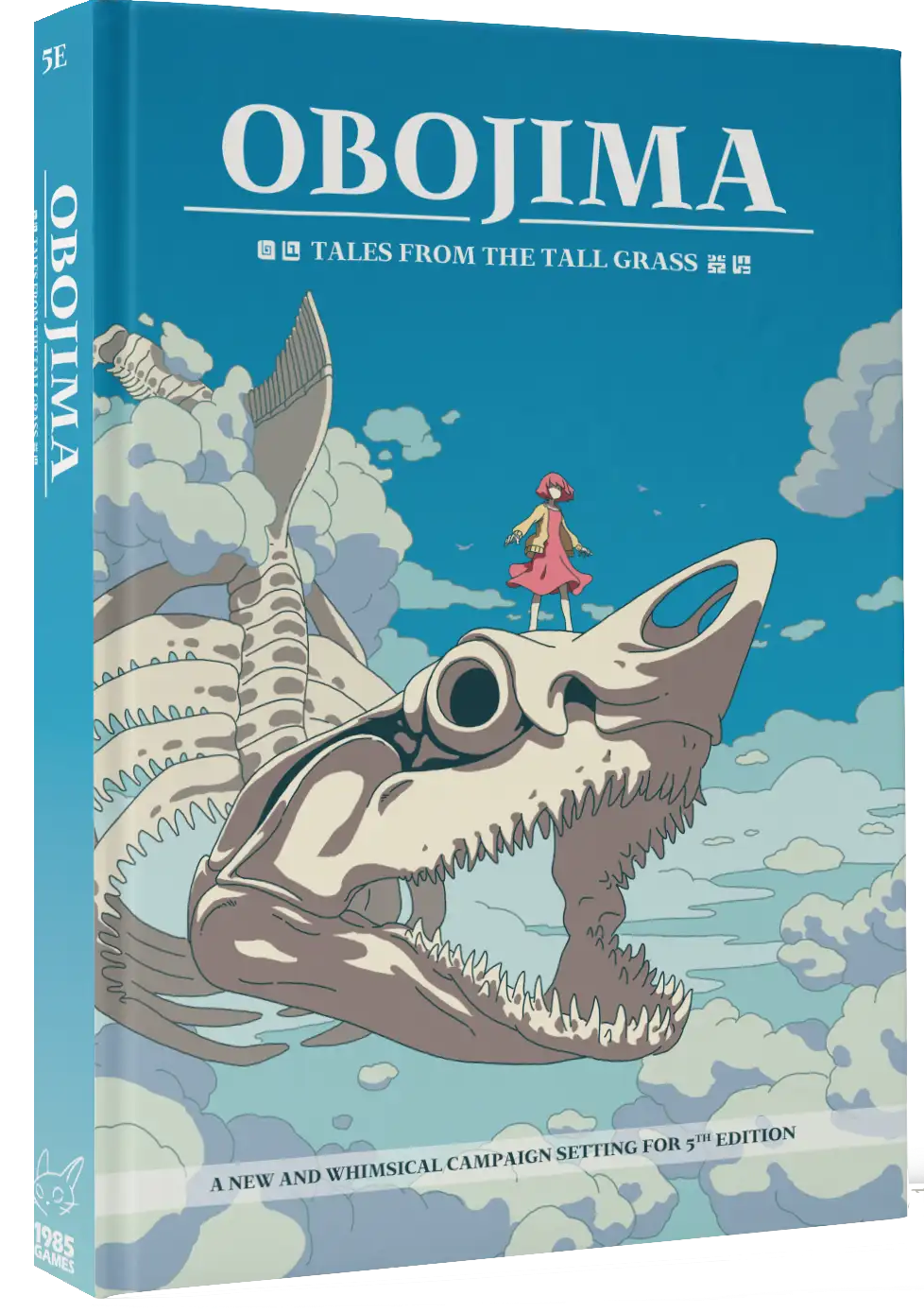
Have you ever wanted to play a game of D&D in a world of wonder? A game less about kobolds and orcs, and more about telling a fantastic story? You know, the sort of story you get in a Studio Ghibli film? That’s what you get in the world of Obojima, from 1985 Games. A game filled with light-hearted laughter and simple joys mixed with whatever fantastic story may be occurring.
As many of you know, I don’t play D&D. I obviously have played (I think you’d be hard pressed to find an RPG player that hasn’t), but it’s not my preferred game. But I do love free reading RPG books. The nice thing about books that present a new setting is that they don’t really need to be played in the system they were written for. It’s easier, but rarely are they rooted so deeply in the system that they can’t be adapted. So with that in mind, I opened the wondrous world of Obojima.
Obojima is an island. A large island, but an island nevertheless. What that means is that the world of Obojima is prime for smaller, more contained adventures. But that being said, there is a ton of placed to explore on and around the island to never feel restricted by that containment. The game thrives on presenting magic in the mundane, making even the small things seem large. A tea house. A restaurant. A 1980s convenience store. A pop machine. A cassette tape….wait, what? In the same way that the futuristic world of Star Wars takes place “a long time ago,” the fantastic island of Obojima seems to be in an alternate future. Artifacts from “the first age” are rare, but not uncommon. These bits of analog and early digital technology are magically powered and found across the island.
All of this is explained in the opening chapters of the book. First, we get a look at the world Obojima exists in, then an overview of the island in general. Then comes the biggest, and as far as i’m concerned, best, part of the book. We dial in on specific locations on the island. Initially, looking at a given region, then villages, and even individual businesses and guilds. Each subsection breaks down the lore of the location for a page or two. Then, NPCs and the major factions (introduced earlier in the book) working in that area.
What I love about these sections is that in many cases, the NPCs aren’t just standalone people. They have interconnected relationships with other NPCs in other areas of the island. For example, the Mariners Guild is run by Captain Clintock, who spends as much of his time as possible at sea. He has two daughters, living at different lodges at opposite ends of the island. Chisuay’s Teahouse and Hakumon’s Ramen Shop are run by two estranged brothers. Chisuay lives his life primarily in the form of a human. Hakumon has taken his own path, living in his Oni form. Few even know these two culinary masters are connected, and their history could be an adventure hook for a GM to build a story around. Individually, the brothers could be at the centre of similar cozy adventures, looking for ingredients or judging a cooking contest. The Clintocks open the door to wild adventures at sea, battling the Lionfish King in the Shallows. Every area, be it a town or the remains of a first age Goodie Mart, has adventures of scales in every section. Then, if players somehow run out of adventures in the Physical Realm, they might be able to find their way onto the Wandering Line and take a train ride into the Spirit Realm that overlaps the island.
This brings us to a major difference between playing standard Dungeons & Dragons and playing in the world of Obojima. There are only two planes of existence in Obojima: the Physical Realm and the Spirit Realm. One of the things that this means is that spells like Plane Shift break the immersion of the game and are intended to be omitted from the game. Similarly, there are dozens of new spells to bring players further into this world. That’s followed by an even larger section of brewing potions. Combat potions, utility potions, and even whimsical potions all take the spotlight. The list of regional ingredients range from sheep dragon wool to bottle caps to a vinyl record. Every ingredient has a picture and a description of what it is and where to find it.
Of course, no TTRPG world would be complete without a section of Companions and Creatures. Many of the companions in Obojima are spirits. So, naturally, there are stats for multiple spirit types. My favourite is the animated object spirit. There are such objects presented, including a pocket video game system! The creatures include common interactions like a postal knight, or a harpie, to various unique dragons. There are some specific entries like the Lionfish King or the Three Great Beasts of Obojima.
The one thing I skipped over is the player options. Humans, Elves, Dara, and Nakudama are all introduced during all of the world-building, but more details are given. Also included are some contexts in which players might find existing D&D ancestries might come to the island. There are also alternate takes on the classic archetypes with subclasses such as Path of the Belly Brewer (barbarian), Sheep Dragon Shepard (monk), and The Spirit Fused (fighter).
The book closes with three short adventures, intended to take players up to level 5.
Obojima is something special. It takes a lot to get me interested in a D&D product, but I’m glad I cracked this book open. It truly does feel like the Studio Ghibli films and Legend of Zelda games which inspired it. I absolutely adore most of the art. The world somehow manages to feel both cozy and dangerous all at the same time, which is a difficult line to balance. I absolutely love it.
Once you try Obojima, you may find yourself hooked on its unique way of storytelling, so I have good news. There is more Obojima coming to Kickstarter a few short days after this review goes live. You can order the main book and the (hopefully first of many) sourcebook, Tales From Yatamon.
You can find Obojima online at obojima.com or on Facebook at facebook.com/1985Games.