
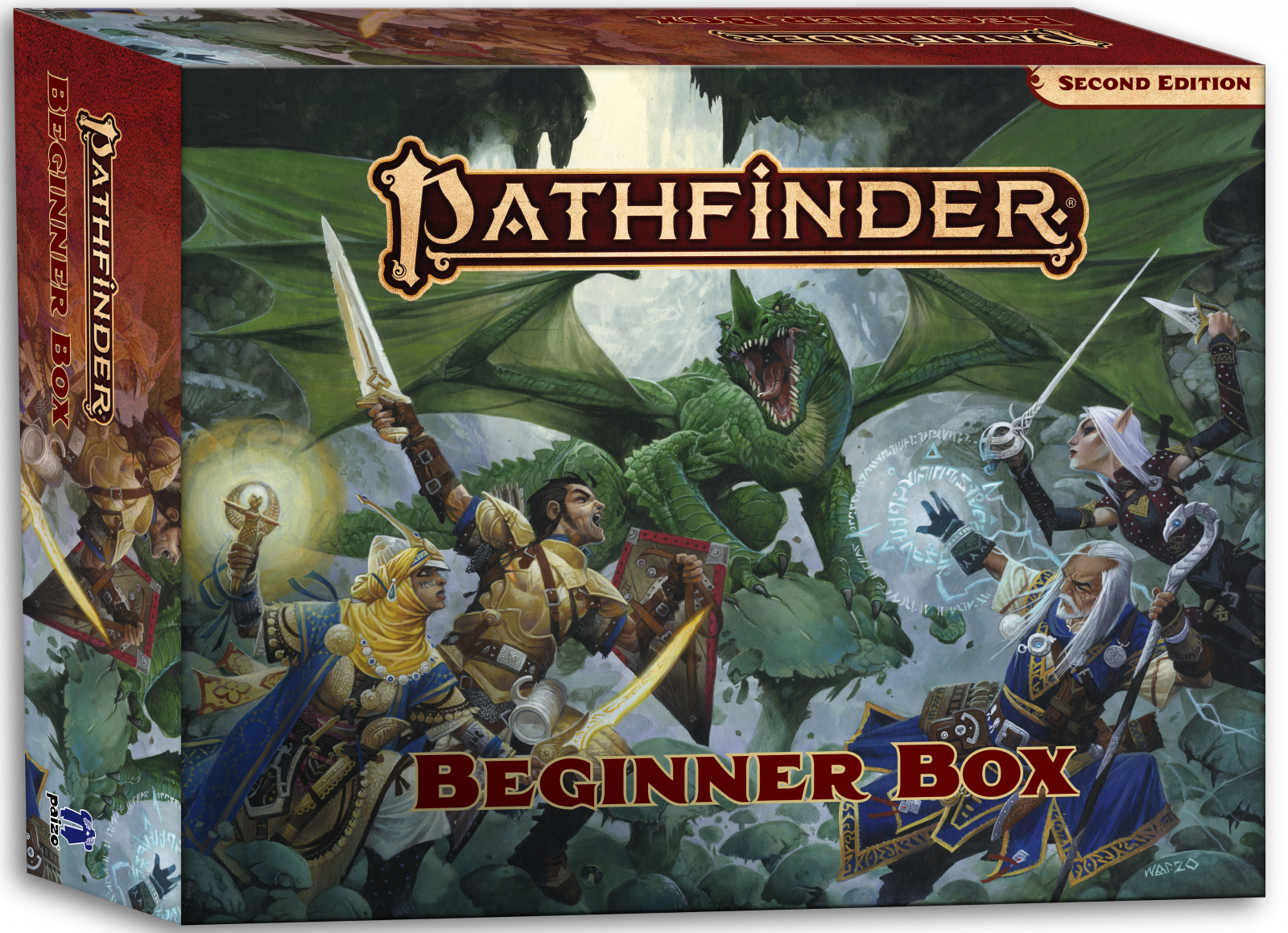
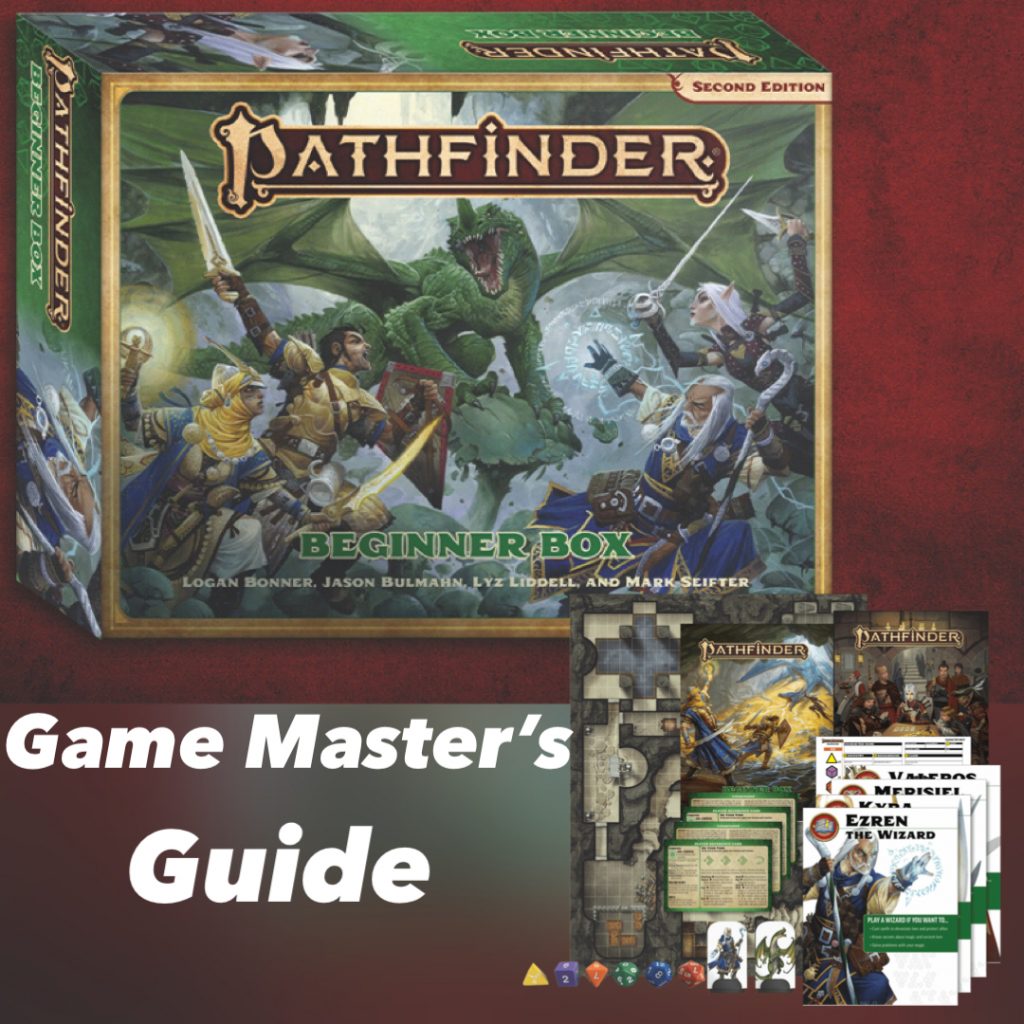
This review is the second in the beginner box, and since we started with the Player’s Handbook, it only made sense to move on to the Game Master’s Guide. In this book, the term Game Master and the shorthand ‘GM’ are used interchangeably, so I likely will do the same.
Much like the Players Handbook, this book opens with an adventure. I will not go into the adventure too much, but I will say that the way they formatted it is terribly satisfying. It starts with the most basic of concepts- having the players introduce themselves to one another. I don’t know how many times I’ve had games where the introductions are jilted and awkward, so it’s nice to get that out of the way.
It then introduces the combat format, with something as simple as could be, with a simple creature. The adventure does get more challenging later on, sure, but not yet. No need to boil the frog all at once, after all.
The next part is simply exploring a space. In this section, things like perception checks were explained, as well as simple saves like crafting, and learned skills like avoiding monsters.
There is no need to go into much more depth over the next few pages. There is only one part I would say is worth looking into. Midway in this sample adventure, there is a basic puzzle. I say basic, as I am sure the authors here thought it would be simple, but I have been in a few too many games where the phrase ‘simple’ was not, well, simple. I saw a meme online that GMs should search for puzzles for toddlers if they want to find challenges for their players and, well, this puzzle is not that. I am sure it will be a good time for a more organized party; I just have never been in one of those.
The sample adventure begins on your good old fashioned looting. Who doesn’t love that?
Now we are onto the actual creation of adventures. Much like the Player’s Handbook, this book defines terms we will need later on with a glossary box as the term appears. The terms are not repeated in the back of the book, which would have been nice, but nobody’s perfect.
I get the impression that some prior experience with storytelling or writing would be beneficial, if not entirely critical to be able to become a GM based solely on this book. The next section has a single paragraph or 2 for each component of building an adventure. Sure, I know that these sorts of things take time to learn and develop, but I am not sure if I, as an individual, would feel prepared enough off of this alone to run a campaign, or even a one shot, just off of this, but it is a start. Further reading definitely required, but it is a start.
One thing that they did make fairly clear in this book is how the experience points are supposed to work. I know that more often than not, experienced Game Masters tend to go off of encounters and adventures as opposed to combat for their experience points, but the combat based format is good for those just starting out. I will give them credit for doing a good job there.
This book then goes into difficulties for players. It does not give the clearest descriptions of the various levels, but it does provide examples of each. From there, it is not too difficult to extrapolate.
The next section, which I found alarmingly short, is building maps. I counted, and there is a mere two and a half pages dedicated to what, in my mind, is a major aspect of building an adventure. After all, if you think about it, we spend an incredible amount of time in this game exploring the dungeons and worlds around us- I mean- our characters. Sure, much of the map is meant to be open to whatever one thinks of, but some guidance would be nice too.
I have a few issues with the bits on roleplay, but I highly suspect those are more of a personal preference issue than anything actually being wrong with the book. Collectively, roleplaying and story do not have more than 300 words. On top of it, the book seems to be drawing readers more towards combat encounters. I believe I have said as much in my previous reviews, but I simply am not the combat type. How a GM actually makes it work, though, will be up to them.
A little later, though, after the rewards section (Which was brief and a lot of numbers so I didn’t read super in depth) we get back to some more roleplay style information. It is not quite role play, but it will do. The next section is on environments that players can work through, followed by a section on various hazards. Now, this section I think was well done. It is a good blend of how the numbers would work out, mixed with more sensory descriptions. Yes, I am quite pleased with this part.
Up next is yet another couple of sections I found a little tricky to get through simply because of numbers, yet found incredibly valuable, was the items section, followed by the creatures section. These sections are, of course, not exhaustive by any means, but in my opinion, it is more than enough to fill up a basic adventure.
This book ends with another adventure. What better way to bookend this?
So, what are my final impressions on this book? It is far from enough to actually get started as a GM, but I think it is a solid place to get started. After all, that is what this whole box is about, right? It is a place to get started. All in all, it is a relatively short read, and I think it can give a taste for anyone on the fence if they want to try being a GM or not.
You can find Pathfinder Second Edition, and all things Paizo, online at paizo.com or on Facebook at facebook.com/paizo.

Bailey is a vintage- loving author who likes to joke that she has an 80 000 year old soul, as her Twitch followers can attest. She spent much of her preteen and teenage years playing Descent, Shadowrun, Pathfinder, or whatever other tabletop RPG the GM found that week. She later turned that creative energy into writing, and now has multiple books published. Despite focusing on her novels, she can never quite resist the call of a new character or plot idea. You can find her on Facebook, Twitch, Patreon, and buy her books on Amazon.ca.