
Hi, my name is Debra, and I love dice. I love pretty dice, shiny dice, and gimmicky dice. I buy polyhedral dice sets, even though I don’t even play most of the games that require them. I carry dice around in my pockets for emergency decision-making. But even I haven’t ever seen anything quite like the PolyHero class-specific dice sets. So far, they have created sets for Cleric, Rogue, Warrior, and Wizard in a variety of colours. But it isn’t the colours that make them cool, but the shapes. Roll D6? Who wants to roll a cube when you can throw down a mace, or a fireball? Make it fun; make it immersive.
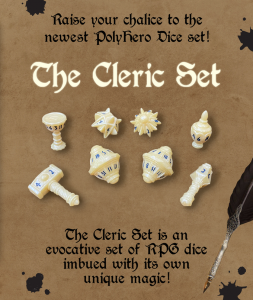
I was given a set of Cleric Dice and Wizard Dice to play with, but I’m going to review them separately. My Cleric set is in Celestial Ivory, but it is also available in Radiant Rose (pink), Spirited Steel (silver), Sunstorm (orange), Verdant Viridian (green), and Vile Violet (purple). The 8-piece set consists of a D4 Hammer, a D6 Mace, two D10 “Holy Symbols” (the sun-like Celestial and spiky Infernal), a D8 Potion Bottle, a D12 Chalice and two D20 Censers. Even better, the 2 D10 are numbered 0 to 9 and are set up to be used easily as percentile dice. Not only are they different shapes, the Infernal die has a dot under each number that you can decide to be the tens or ones digit. Speaking of dots, the unique shapes of all of these dice ensure that the number is always read face up, meaning that there is no need to differentiate between the 6 and 9. Unfortunately, I don’t know enough about D&D and the Cleric class to know if the theming is specific or general. For example, I don’t know if the mace and warhammer are more likely to be used for damage rolls, or if the potion bottle and chalice are more likely to be used for spells.
I confess, I don’t play D&D, and it didn’t seem worth the effort to organize a one-shot campaign. So I had to get very creative in terms of ways to test my dice. The first was a superhero-themed solo RPG game, which was fun but only needed D6 and D20 rolls, and only had half of its rule book. Next, I found a System Agnostic gamemaster resource called The Hyper Halfling’s Book of Lists, with pages and pages of charts. I spent a while rolling up a bunch of random items from assorted Lists. Finally I gave in and just brute-forced my way through some randomization tests. I rolled each die type 160 times to see if the results were anywhere close to a balanced distribution. There was no particular reason why I chose 160; it was just ten times the number of lines in my notebook. But after I finished all of these, I had a pretty good idea of what I was working with.
My first thought, beyond the initial “these are so cool!”, is that this might be the first dice I’ve seen that actually have a learning curve. What I mean is, the first time you roll these, you may not instantly be able to read the results. It takes a bit of practice to figure out what you are seeing. In some cases, you may even need to decide how you will read the die before you roll it. For example, the D4 Warhammer works on something of a teeter totter effect, meaning that you need to decide if you will read the number that is “up” or the one that is “down”. I also noticed that, for some of the dice in this set, it is actually possible for a roll to “fail”, not giving a number at all. Although it didn’t happen very often (4 times or fewer out of 160 rolls), the D4 WarHammer, D8 Potion Bottle and D12 Chalice all occasionally landed with a “blank” side facing up.
One of the things that I like about dice is the brief sense of anticipation in the time between when the dice leave your hand, and when they stop rolling on the table. That period of anticipation heightens the sense that you are putting your fate in the hands of chance. While some of the dice in this set do have a satisfying roll to them, others tend to just “plop” down on the table. On the other hand, once a roll is cast, the dice should stay where they are. Most of the dice in this set did pass the Table Bump Test, but the D20 shape did move again in response to even a small jiggle. Depending on your TTRPG playing style, this could be a non-issue, mildly annoying, or a major issue.
If you are a veteran gamer looking for a conversation starter or a way to connect better to your chosen character class, then you are really going to enjoy PolyHero. On the other hand, if you are a TTRPG beginner, still learning which dice to roll and why, these might not be the best choice.
If you enjoy bringing a little extra flavour to the game table, you can find PolyHero Dice online at polyhero.com or on Facebook at Facebook.com/polyhero.
