
I’m sure this may shock some people reading this, but I’m a nerd. Yup. There, I said it. I’m a nerdy little goblin, and like many others of my kind, I love me some shiny math rocks. I’m also the sort of person that will go out and buy new dice for a new campaign. I have a growing collection of dice just for Christmas games. (I really need to find a set of Christmas-y Fate Dice). Half-sized dice for a halfling. That sort of thing. Since I often find myself playing a Rogue or similar class in many games, the opportunity to try out the PolyHero Rogue Dice, for an Accessories And… review, was too much to pass up.
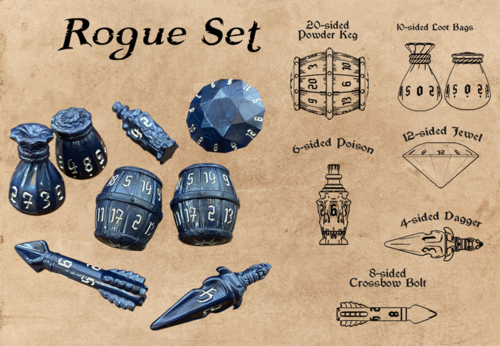
A starting point, I suppose, would be explaining the concept in general. I’m going to assume that we all know what your standard polyhedral dice used for many RPGs are like. PolyHero dice use those same values but use them to create uniquely dice that are themed to character types. Not themed strictly in colour like many “theme” dice, but themed in terms of the actual shapes.
The D4 is meant to be a dagger, but the blade has been (for lack of a better term) bloated out along the fuller of the blade to create a long pyramid shape for the numbers.
The D6 is an ornate bottle. The veins down the side of the bottle and the clawed base create very distinct sides for the bottle to stop on but also manage to not feel angular.
The D8 is an arrow. At one end there is a four-edged arrowhead and the other has a set of four fletchings. The protrusions on either side are offset from one another giving a good base to land on with more rollability than if they lined up. It also allows the numbers to be written on the smaller cylindrical shaft.
There are two D10 designs. Both are largely cylindrical with the first being a money pouch and the second, a pot. Where the opening of the pouch would be the “material” is gathered in a way to create a functional design to help the die stop more readily. The pot has a slightly more angular design, akin to the D6 bottle design. The bottom of both designs is rounded to reduce the chances of landing on that side, but I did have the pot specifically land on it several times.
The D12 is a gemstone. While extremely fitting for the Rogue theme, it doesn’t fit well with all colour schemes. In this case, I have a textured brown set that is not particularly gem-like. It is worth noting that you can purchase certain designs as individual dice, including this gemstone D12 in several more appropriate colours that are perfect for GMs to let players roll for treasure with. The numbers are placed along the edge of the gem, and I actually think this one could stand to be more angular because of that. The shape and inherent weighting of the design make it unlikely for it to turtle and land completely upsidedown, but far from impossible. Of all the designs I rolled more unusable results on this die than any other.
Finally, the D20 is a barrel. This is both my favourite and least favourite design. The physical design is very evocative and rolls best out of the whole set. Despite having the largest and least rounded non-numbered sides, it almost never landed on its end. In the surprisingly rare case where it does, there is a starburst design etched and inked like the numerals that just screams to be house-ruled as a critical success. The only issue is that a player and GM shoulkd agree on how to read the results. Picture a barrel in your head, the wooden staves contain the numbers, and the single hoop around the outside is raised enough to tilt the die one way or the other. Since the numbers are necessarily in a straight line a choice needs to be made whether the number tilted up or tilted down should be read. On a standard D10 or D8 (the closest traditional shapes) it is very obvious that you would read the number facing up, but the distinction is less obvious here, to the point that it feels more natural to read the bottom number.
I know more than a few players that can’t stand the slightest irregularity in their dice. These dice are not for them, and might even make them unimpressed-Marge-Simpson scowl just watching them roll. But personally, I love them overall. The design of the D4 and D8 make them roll like a standard D4, and by that I mean they don’t really roll so much as they land. The D6 isn’t as bad for that but also doesn’t have a big roll in it. Honestly, if you are playing in a limited space, this can actually be a strength not a weakness of the designs.
I mentioned earlier that some of the PolyHero designs are also sold separately. This includes the Wizard’s D20 Orb. The orb features a round… well… orb, surrounded by a sort of cage that creates a more standard D20 shape. Because the numbered faces are inset from the outer cage. It also lacks that oh-so-satisfying rolling factor. But again, sometimes less rolling is honestly better. There is a good chance I’ll be at least testing this design for use on camera, specifically because of the limited rolling.
If you enjoy bringing a little extra flavour to the game table, you can find PolyHero Dice online at polyhero.com or on Facebook at Facebook.com/polyhero.

TheRatHole.ca does not accept payments for our reviews but may have received a promotional copy of this product for review.