
Welcome back to the weird and wonderful world of Gimmick Dice. This time, we are looking at PolyHero’s Wizard set, plus two bonus dice (a new type of D20 and a D2). I was able to consult with an expert in TTRPGs in general and D&D in particular. When I told him that we had a new set of dice to test he said “New colours?” and I replied, “no, new shapes”. His first gut reaction on seeing them, from the point of view of someone who has both been a player and a DM, was “They’re cool, but I’m not sure I would allow them for gameplay.” His biggest concern was that these non-standard dice might not roll reliably, and also that figuring out which shape corresponds to which dice might slow down the game, or cause confusion.
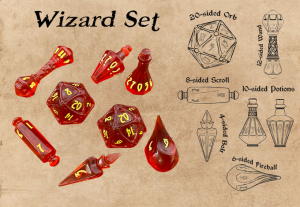
The Wizard Set, like the Cleric Set, consists of a variety of object shapes thematic to the character class. In this case, two “orbs” for D20, a D12 “wand” (which is basically two D6 held together by a bar), two “potion jars” for D10 (which together can be used for percentile), a D8 “scroll”, a D6 “fireball’ and finally a D4 “dart”. There are also two bonus dice, an alternative D20 shaped like a wizard hat and a D2 “spellbook”. I frequently had to consult my “cheat sheet” to determine which shape did what, which was somewhat annoying.
I was able to play a short one person “one shot” scene in D&D 5e, in which I was able to test out most, but not all of the dice types. I did notice that the D6 fireball did seem to roll low while determining stats, but it’s hard to tell for sure in only a couple dozen rolls. D20 is obviously the most commonly used die in D&D, and I didn’t really have many issues with the Orb shape, which is almost identical to the standard shape, albeit bigger. The Wizard Hat D20 lands firmly in the “fun but impractical” category. It is intended to twist like a top, and if you give it just the right spin, you can be waiting a long, long time for it to actually stop moving. Once it does stop, the intention is to read the number that is flat on the table But the sheer number of very small wedges means that it is easy for two people sitting at different spots on the table to argue over the roll result. Unless you look at it from exactly the right angle, you have to think about what you are seeing. The D2 Book is fun to look at, but again, is it really any better than just grabbing a coin from your pocket? I will say that the Dart shape of the D4 was easier to read than the Cleric Set’s D4 Hammer. Nor did any of the dice have the problem of “blank side up” rolls that plagued the Cleric set.
The general opinion from both the DM and I, is that these dice are fun to have around, and are definitely a conversation starter. But there are a lot of issues that stop it from being a “go-to” dice set for a long, ongoing campaign. The shapes aren’t recognizable at a glance, the results aren’t always easy to read, and once again, they just don’t “feel right” in the hand. Maybe I’m just a traditionalist, but I WANTED to like this dice set more than I did.
If you enjoy bringing a little extra flavour to the game table, you can find PolyHero Dice online at polyhero.com or on Facebook at Facebook.com/polyhero.
