
Welcome to the first interview of 2024! I hope you’ll join me for many more of these, we have a whole host coming your way.
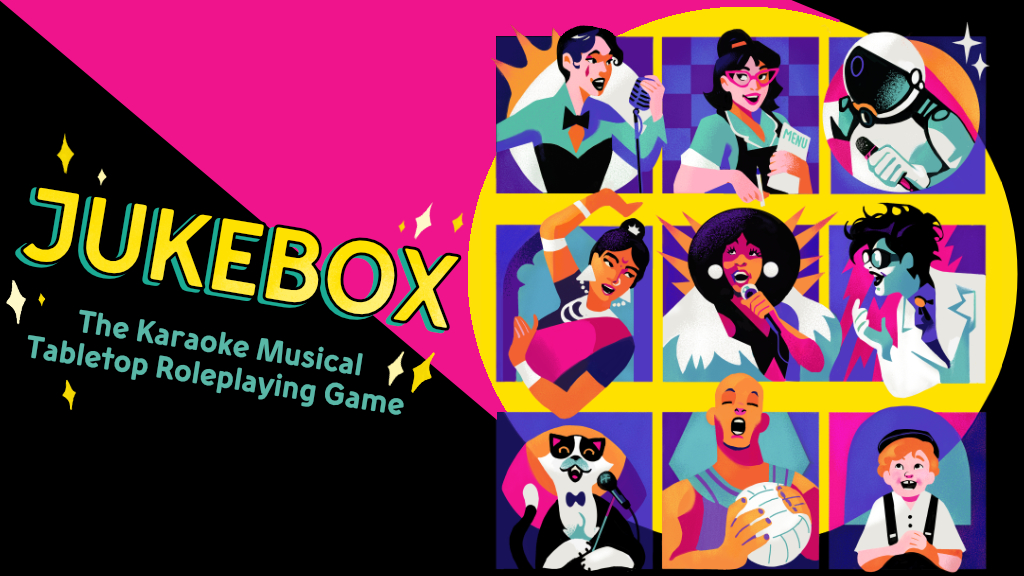
The TTRPG hobby is awash with games to suit almost any theme or genre. Fantasy, of course. Sci-fi, naturally. Horror? You bet, a raft of them. Broadway Musical? Before you say no, read on. I was lucky enough to get some time from Lyla Fujiwara, creator of Jukebox: The Karaoke Musical TTRPG, to talk about her game and the TTRPG space in general.
***
Brent: Thank you for taking the time to talk with me, Lyla. For our readers not yet familiar with your work, please tell me a bit about yourself.
Lyla: Hi! My name is Lyla (she/her) and I’m a game designer and project lead writing in from Somerville, MA. Most related to the conversation today, I’m the designer of Jukebox: The Karaoke Musical TTRPG (funding on Kickstarter now!) which is a Dicebreaker pick for one of the best upcoming TTRPGs of 2024. Besides Jukebox, I’m the Project Lead for the Stormlight Archive TTRPG and have written for Gamehole Con, Bob World Builder, and Jeff Stevens Games. I’m a 2023 Storytelling Collective Creative Laureate and 2023 Big Bad Con POC scholar. In addition to my creative work, I’m the author of Project Management for TTRPGs, a newsletter series about project management and leadership for newcomers in the TTRPG space.
B: What drew you into tabletop roleplaying games? What was your “hero (or villain, we don’t judge) origin story” in the hobby?
Lyla: I’ve been playing D&D since my mom bought me the 3rd edition books in middle school. This was at least a decade before Critical Role and Stranger Things, so D&D was still a pretty niche, back of the local game store type of hobby. I taught all my artsy anime friends to play in highschool, became our defacto DM, and have been bringing new folks into TTRPGs ever since.
I’ve always been more interested in the storytelling and character based parts of TTRPGs, as opposed to the more “board-gamey” elements of tactical combat or min-maxing. When I started learning about games with a stronger focus on narrative – PBtA and story games like Fiasco or Dialect – I was hooked.
B: How and when did you shift from player/GM to designing your first game content? Was the shift gradual or did you burn to design something right away?
Lyla: It was slow. While I’ve been creative all my life, the fact that creative work is a reflection of one’s self – more so than producing technical documentation or coding mobile apps – means that doing creative work poorly feels more personal. So I’d run games for friends, design elaborate larp-esq murder mystery parties, or write a low-budget fantasy TV show for my college’s film club, but I didn’t feel confident I could produce work commercially or as a career.
Things changed in 2019 when I attended my first gaming conventions. That’s when I started meeting game designers and noticed two things:
1. Game designers weren’t all narrative design graduates making AAA tabletop ttrpg titles and some of them had pretty similar backgrounds to me.
2. By seeing games in the playtesting phase, I realized that folks’ games required multiple revisions, editing, and weren’t perfect the first time they were written.
I later discovered the Storytelling Collective’s Design Your First Adventure course – a class about writing D&D adventures. Having a clear path and steps to publishing a pdf on DMsGuild removed some more informational and mental barriers about whether I could publish something. I also failed to complete that course two times – partially because I was trying to write Jukebox as a D&D module (Spoiler: it didn’t work).
Even after writing and publishing a D&D module and an early version of Jukebox, I struggled to call myself a game designer. Instead I’d put the qualifier “aspiring game designer”. Getting rid of the “aspiring” qualifier took work and is largely because a few folks who were game designers saw me, advised me and shared their stories of breaking into the industry.
B: You’ve previously written work for D&D 5e, Encounters in the Radiant Citadel and Out of Luck, both on DM’s Guild. What did you find to be some key differences between the experience of writing for an existing game system and creating your own game system?
Lyla: The standard advice is to not write something too ambitious for your first game writing – that includes deciding to make a custom game system. My original plan for Jukebox was to write it as a D&D module. I tried SO HARD to not write my own system, but it just wasn’t working in playtesting. After D&D I tried PbtA and then Fate then back to PbtA. Eventually I realized that all of these systems had extra rules and mechanics that had nothing to do with the experience I wanted for Jukebox. It was all just extra cruft getting in the way and stealing the focus away from singing karaoke and storytelling.
But that’s Jukebox. More generally I think writers benefit from writing for pre-existing systems for the following reasons:
- Faster: It’s faster because you’re not starting from scratch
- Tried and True: You benefit from all the thought and playtesting that went into that system. There are communities of writers who can advise about writing for a system. Take something like PbtA; there’s a ton of support and examples on how to write a PbtA hack. Same goes for D&D.
- Familiar: It asks less from your players; they don’t need to learn a whole new system to play a game if they are already familiar with the system you build on.
- Pre-exisiting Audience: Relatedly, because it asks less from your players, your audience will likely be bigger and a community might already exist to play and buy your game. DMsGuild is a perfect example. They have an audience there, looking to buy and play D&D modules. For my Radiant Citadel tie-in content (which both Encounters and Out of Luck are), there’s an audience of DMs running Radiant Citadel that directly benefit and need the things I wrote. When you make your own game, you need to fully create that audience.
The reasons to write your own game is if you’re doing something truly new that needs it. That’s where I ended up-ish with Jukebox. And I say “ish” because Jukebox is not an entirely new thing: it takes deep inspiration from scene based story games, including Follow and Downfall. What is new is the karaoke mechanic. By building on the ideas and structure I saw in story games, I could focus on really nailing the karaoke singing.
B: Having spent three years in development, Jukebox is obviously a labour of love. You talk extensively about Jukebox’s development on your devlog, but could you touch briefly on the process of refining a game over that period of time? What benefits and challenges did you encounter?
Lyla: As I mentioned above, Jukebox went through a lot of iterations and playtesting. At each step of the way I learned things. When I tested it as a D&D module and then PbtA, it was that mechanics that didn’t serve the musical storytelling experience were led to a worse play experience. I did not need all these combat rules or the vast majority of the “moves” from the PbtA games I tried hacking.
My exploration of Fate and Our Last Best Hope is something that I talk a little more about in the devlog. I took two ideas from this exploration:
- People liked building a character based on songs
- It was fun to write down songs on index cards and dramatically reveal them
My early playtesting made it very clear to me what the design goals were for the game I was making. When something didn’t work, I’d ask myself “Why? Why is this not the thing I want to make? What must be true about this game?”. The design goals explain Jukebox so well that they’re one of the first things on my Kickstarter:
- Singing big, dramatic karaoke songs, and for those songs to be pivotal moments in a musical story.
- Creating a character-driven story where everyone gets complete, meaningful narrative arcs.
- Collaborative storytelling where all players shine, regardless of singing ability or familiarity with roleplaying games.
My last set of playtests was with the story game version of the rules that I published in 2022, and I was ruthless about sticking to those design goals. If a mechanic didn’t serve the design goals, it got cut.
The benefit of all this playtesting and rewriting was now I really know what my game is about and what experience it’s trying to achieve. I know generally how the game plays with different groups of people. When I went through developmental editing, I had a clear vision for what the game was trying to be and where it needed work.
B: Amongst the sci-fi, horror, and fantasy games available, a Broadway Musical TTRPG is definitely an unfilled niche in the hobby. Can you talk about what led you to seeing that need and filling it?
Lyla: In 2019 I walked into a korean karaoke joint in SF with some friends. I’d just been to Big Bad Con and a few similar TTRPG conventions and wondered “could I make a D&D module that could be played in one of these karaoke rooms? It’d be like the musical episode of your D&D campaign.” So that was the idea.
As I began building Jukebox, I looked around to see if anyone had done something similar and was shocked that there aren’t a lot of examples of Broadway musical themed games or games that involved you actually singing in a meaningful way. There were a few posts on r/rpg and r/rpgdesign about musical games, and I took a look at them: My Jam and Ribbon Drive are two I’ve played and own respectively. There were also musical “themed” supplements, but these rarely had you actually singing. There were D&D-inspired musicals. It really felt like the interest and audience was there, but nobody had done the thing I was thinking about. That felt so rare to me that I couldn’t let the idea go.
And then for the next few years I made the game, mildly terrified that some other more well-known publishing house or designer would come up with a very similar concept. And maybe they have – and if so I’d love to know about it! Random shout out to Passion of the Jukebox which came out sometime after Jukebox and looks cool!
B: While the “theatre kid to TTRPG player” pipeline is certainly real, you’ve designed Jukebox as a game where “…everyone gets to be a star, regardless of singing ability.” Can you talk a bit about how the game works for singers and non-singers alike?
Lyla: So PLOT TWIST: I am not a great singer. My wonderful little brother was blessed with perfect pitch and did musicals throughout highschool, but I didn’t even make it as a background dancer on our highschool’s production of West Side Story.
But I love karaoke: especially the kind where you rent a room with your friends, which is more popular in Japan, Korea, etc. That style of karaoke, at least in my experience, is rarely about amazing singing, performing for strangers, or being judged. It’s about having your voice crack on “Don’t Stop Believing” as your best friends in the world shake a tambourine with abandon.
So anyway, I wanted to make a game I would feel comfortable playing and inviting friends to play with me, regardless of singing ability. That, as noted above, became one of my design goals, to design for the “karaoke curious” as well as the hard core karaoke lovers.
As for how this works:
- I made sure you are never judged or get any benefit from being a better singer.
- You have full control over your karaoke songs, so you’ll never be asked to sing something you don’t want to.
- The game asks that players who are not singing pay attention to the song and the singer because the other players get to decide what happens next in the story (based on the song lyrics). This is to combat the phenomenon that happens sometimes with karaoke where a person will sing a song nobody knows and everyone zones out on their phones.
- The game makes it very clear that if someone isn’t comfortable singing alone, you should never force them to, and provides alternatives that I’ve playtested: turning solos into group songs, letting players lip sync, or watching music videos.
- The game starts with a group number so that shy players get a chance to warm up their pipes before, if they want to, singing alone.
B: Despite the obvious benefits to a diversity of lived experience in the design process, we still see many projects excluding traditionally marginalized groups in the TTRPG space. You’ve assembled an excellent team for Jukebox; what advice do you offer to folks starting their own projects on building a richly diverse team?
Lyla: Oh my goodness, I’m so excited you asked this question. I’m going to give a short answer here but it’s something I plan to blog more about because it’s a complicated question. The experiences that inform my thoughts on this are these:
- I’ve worked in tech (which similarly has a diversity problem) and conducted interviews and gave hiring feedback when I worked at Google.
- I was a Big Bad Con PoC scholar and helped with some of the tasks organizing the PoC events in 2023. Ajit George, who founded the BBC PoC program has a great thread on hiring here.
- I have been a beneficiary of “diversity programs” in both of these situations.
For Jukebox, I got my collaborators through a mix of invitation and an application process. For the collaborators I invited, I have the benefit of knowing a lot of diverse designers because my community largely centers around Big Bad Con. That community took a LOT of work to create by the folks organizing the con: including thousands of dollars for a PoC scholarship program that flew out diverse designers and con scholarships for other marginalized identities. If you hire for games, have the funds, and want to meet diverse designers, check out and support Big Bad Con.
For the application process: This was something I tried for the first time with Jukebox, specifically because while I might have a “diverse network” I still suffer from being biased to only invite folks I know about or who are in my social circles. For the application process I did the following:
- Made the application as short and clear as possible: Lengthy applications disadvantage folks who don’t have time to spend three hours writing you a custom cover letter. Originally I was going to ask for a writing sample, but at the wise advice from a friend, I cut that because newbies don’t necessarily have writing samples on hand.
- Be explicit and question your minimum “qualifications”: I explicitly stated you didn’t need to be a well known game designer to apply and that I was looking for new designers. Marginalized creators marginalization means they aren’t socially connected to spaces that will give them opportunities and they can’t follow the “traditional” paths to game design (I say this in quotes because a traditional path is more relevant for tech careers than game design where it seems like folks paths are a bit loosey goosey). The end result is that a talented “marginalized” creator might not have as extensive a portfolio or traditional qualifications. There’s a stat often quoted that “Men apply for a job when they meet only 60% of the qualifications, but women apply only if they meet 100% of them.” So don’t state or imply you want someone to have a certain experience or qualification unless it is critical to the job.
- Opened the application early in PoC and not-NA-focused gaming spaces: The goal of this was to give these folks extra time to apply. I also opened the application early for followers of my blog.
- Avoid bias when assessing: When I did my original read through of applications, I only looked at what the writer pitched for their Jukebox playset and nothing about their name or biographical details. This cut my applicants from 75 to 26. When I then looked at who those 26 designers were, the results were surprising: they were not necessarily the most well-known game designers and influencers.
My final team of Jukebox writers are there because they wrote absolutely killer playset pitches, not because they check a box on a diversity checklist. As someone who has at times felt like I was hired because I check a box on a diversity checklist, that was important to me.
Finally, and this is my own hot take and I’m happy to hear alternative viewpoints: A diverse team should be the norm, not an outlier to be celebrated. That’s why you won’t see “diverse team” on any of the Jukebox advertising or marketing. These are not “the best diverse designers for Jukebox” they are “the best designers for Jukebox”.
B: Your Kickstarter is running and has not only funded, you’ve blown through your current stretch goals as well, congratulations! With a little more than two weeks left in the campaign (at the time this goes up), are there plans to add more goals?
Lyla: Short answer is yes and I’m having a conversation with my artist imminently 👀. We might also have some more playsets in the works.
B: Besides your work on Jukebox, you also write a series of articles on Substack, talking about project management in the TTRPG space. What brought that about? Do you see a need for broader education and transparency around best practices in TTRPG publishing?
Lyla: The short answer is that I ran a TTRPG project and made up most of my processes as I went. That project also went well – we hit 250+ sales in a month and I had the unique experience of being RT’d by Matt Mercer. More importantly, my collaborators gave me a bunch of feedback on how the project went and all said they’d work with me again on an anonymous feedback survey.
Around the same time I was also extraordinarily lucky to be connected to some professional mentorship in the TTRPG space. A lot of what I was learning wasn’t documented anywhere. There are a lot of resources for writing your first adventure alone, but not many for writing with a team.
And finally, I’ve been writing technical videos and tutorials for years. I’m not the best social media-er (it still takes me 10+ minutes to compose a tweet), but I knew I could write how-to articles. So I decided if I was going to have an online presence, I was going to focus on longer form teaching content.
Relatedly, I’m working on a more formal course with the Storytelling Collective about project leadership: Lead Your First Collaborative TTRPG Project
B: As a designer, what other games out there right now excite you? What are you drawn to as a designer and as a player/GM?
Lyla: Here’s a few:
I play-tested Ralp Amico’s The Zone in 2019 at my first Big Bad Con and was absolutely blown out of the park by this Annihilation inspired horror game. It really leans into its “play to lose” tagline. I finally got the box set earlier this year and it is GORGEOUS. It also has the best online implementation I’ve seen of a TTRPG ever (you can tell that Raph is a UX designer).
I backed Guns Blazing by Basheer Ghouse after playing it in 2022 at Big Bad Con. It’s set in a diesel-punk alternative history 1920s where you play soldiers fighting the colonialist powers. The setting was what really got me: Jinn walk the streets and colonialism is presented as a lovecraftian like infection.
Also anything by Thorny Games. Dialect is a classic, but I also deeply enjoyed my play through of Sign, which is a larp about non-verbal communications, misunderstandings, and the history of Nicaraguan Sign Language.
Finally, two of my close co-collaborators have some fantastic solo games if that’s your jam:
- Family Album by Taylor Navarro is a short, deeply personal game about parenthood. In it, you draw from a deck of cards and write about prompts where you imagine family pictures you take of your child (with you always behind the camera, never featured).
- Fetch My Blade by Ethan Yen and Kelly Tran is a Polygon pick for best tabletop RPGs of 2023. In it, you play the dog of a retired sword master who must once again take up the sword to duel a mysterious foe. You are called to “fetch their blade”. The physical zine is laid out so that you ingeniously flip the zine upside down on the return journey of your fetch quest.
B: Obviously your focus is currently on Jukebox. But are there other projects on the horizon you can discuss? What’s next for Jar of Eyes Games?
Lyla: I’ve got three other projects I’m working on:
- I’m doing my first developmental editing stint for Chris Sellers (@hecticelectron). They are working on a queer, romantic, sword and sorcery game called Defy the Gods. Keep your eyes peeled on one (or both) of our socials for the announcement of the quickstart guide.
- As previously mentioned, I’m working on a course on project leadership with the Storytelling Collective: Lead Your First Collaborative TTRPG Project
- And finally I am the Project Lead for the Stormlight Archive TTRPG, which comes to Kickstarter later this year.
B: Lyla, thank you again for talking with me! Where can folks find you if they want to follow what you’re up to?
Lyla: The best place to follow me is my newsletter, The Jar of Eyes Games Gazette. I’m also active on Twitter/X and Bsky. Thank you so much for having me!
***
Jukebox: The Karaoke Musical TTRPG is running on Kickstarter now until February 9th. It’s fully funded so don’t miss out! And make sure to give Lyla a follow above to see what’s coming next!
