

In her relatively short time as a creator, Cassi Mothwin has released an impressive number of TTRPG supplements and games, ranging from cozy to terrifying. I was privileged to talk with Cassi about her work, as well as discuss the TTRPG space in general and gain some insights into what goes on in the life of a solitary creator. What follows is an edited transcript of our talk. Any errors or discrepancies fall on my shoulders as the editor. Enjoy!
***
Brent: Thank you for taking the time to talk with me, Cassi. For our readers not yet familiar with your work, please tell me a bit about yourself.
Cassi Mothwin: I sort of bill myself as a tabletop RPG enthusiast. I have designed a few items and I’ve been recognized in a couple of different ways for my actual plays, for the content I’ve created for my artwork but I hesitate to say I’m a designer. I just sort of still feel like I’m a burgeoning designer I guess. So I still hesitate to take on that label, and then I’m just generally very excited by tabletop RPGs and different systems and other creators. So I don’t want to call myself an influencer, even though many people have told me that I’ve influenced them into buying games, which I’m proud of. But I wouldn’t call myself an influencer as much as I would say I just really love tabletop RPGs and the possibilities that they offer.
Brent: What drew you into tabletop role playing games? What was the first sort of thing that excited you about them.
Cassi: I think storytelling has been in my genes for a long time. I thought, one of the funnest things to do would just be to travel the world and tell stories. And when I found out there was a way to mechanize that in a way where you can do it with friends, and while it’s still sort of looked upon by some circles as a strange activity, it doesn’t feel as strange as saying, I’m gonna travel the world as a bard and sing songs in taverns, right? So, scheduling weekly or bi-monthly events with my pals to tell stories with each other spoke to me on a whole new level when I discovered what it actually was. When I was first introduced to tabletop RPGs, it was through Dungeons and Dragons 3.5 and I was not at that level of interest. So I ended up completely deciding that was not for me immediately.
I’m kind of sad because that was in, I think 2012, and my life would be a lot different if I had started playing Dungeons and Dragons earlier. Because that means I would have discovered indie tabletop games even earlier, but I didn’t discover them until someone taught me fifth edition in 2018. And while I didn’t love D&D, I loved the idea of D&D, I loved at the base of it pretending to be someone with magical powers running around kicking ass. But holistically, I didn’t love all the fiddly bits that went along with that.
I felt like “there’s a lot here that’s cool. But there’s also a lot here that isn’t so rad.” I mean I started with homebrew, fixing what’s broken and learning through trial and error that there are just better systems out there to do what I was hoping to do. I’m still discovering that and that’s what I love is the discovery of all of that.
Brent: How and when did you shift from player/GM to designing your first adventure or game? Was that gradual or did you jump in right away?
Cassi: So I’m still a GM and a player but I would say I’m more of a creator. I think I spend more time working on stuff to add to my stores compared to what I do for the table. And they get it, they get that, “Hey you guys are great but I like having this bigger audience.” And it’s so much more satisfying, when I spend ten hours on something, for a lot of people on Twitter to be like, “that’s really cool!” versus four people, my closest friends to be like, “that was really cool. So want to go get something to eat?”
So anyway, in 2021 I was looking to bring some content to my table, some folk horror content, some people may be familiar with What Crooked Roots, which is my first thing I ever designed and it was designed for D&D 5e. But anyone who reads it is like, okay, we can tell you already didn’t really like 5e because you barely use any 5e mechanics. It’s mostly what I think are really interesting roleplay situations where things are creepy and weird. And I did that because I wanted to bring more creepy and weird things to my table.
And I sort of fell in love with the process of making. I do a lot of my own artwork and I do my own layout and I create my own covers for my games and products. So it was just so satisfying to be able to have a hand in all those aspects. And quite honestly, keeping all of that stuff in-house or just for the group I was running, while it was so much fun to do it for them and it was rewarding, it’s just so much more rewarding when you have that validation from outside of your friend group. And so, What Crooked Roots sort of started the domino effect of me sort of being a jack-of-all-trades when it comes to product creation in the tabletop RPG space.
Brent: Carved by the Garden is your latest solo TTRPG, can you talk about how that developed and what drove your return to folk horror?
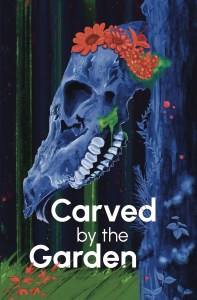
Cassi: So I was always far away from civilization growing up, in the middle of the woods with nothing to do except hang out with me, myself, and my imagination. And there are a lot of sounds in the woods. I don’t know if you knew this, Brent, but if you’re not surrounded by people, you get really concerned about what kind of noises you’re hearing coming from the woods. As a child hearing all these different sort of noises did create a lot of inspiration for creatures and monsters and horrifying things that might dwell within, even though I would quite frequently explore the woods, tell my own stories in the woods; as I said earlier, I’m a big storyteller.
But as I grew older we moved into the city and I have, personally, just a lot of anxiety. I don’t like going into grocery stores. I don’t like talking to people. I just really struggle to meet people and to do public things. I’m a bit of that, like, wild child. And so the city is my folk horror. And I think the best horror is inspired by more real life things than it is monsters.
So I bring a lot of that anxiety into all of my work and I think it’s pretty present in Carved by the Garden. Obviously, a lot of it is extrapolated and imaginative and magical and weird. I don’t just say “you go to the grocery store and things are terrible”, but everything is inspired by those anxieties. “If this person is the worst form of who they are, what could they do to me?”, is sort of what inspires Carved by the Garden except it takes place in the woods.
You play with a standard deck of playing cards, a Jenga tower, a six-sided die, and what I call a pieces of nature which can just be buttons or coins or what have you. It’s just for thematic effect; go get ten leaves or something.
There’s some questions to help guide your creation but you create this character who is drawn into the neighboring woods daily for daily walks. Essentially the reasons for those walks are up to you. There are some ideas provided including: “You’re searching for someone who went missing”, “You’re creating a map”, or “You are studying a newly discovered creature”.
These things draw you into the woods and every day you will encounter very terrible things within. I think one thing that makes it interesting is all of these encounters are during the day because I think that’s when the woods are the most scary. At night everything is sleeping. But during the day when there’s a lot of shadows there, there’s a lot of movement, there’s just a lot of activity in the woods and it’s creepier when you hear something and you look but you can see there’s nothing there. So the whole game takes place during the day with a lot of weirdness.
Brent: What is it about folk horror that makes it an excellent conduit for tabletop games, that draws players into it?
Cassi: That’s such a good question. I don’t think there’s a lot of folk horror tabletop RPG stuff out right now. I’ve done a little bit of research into what is out there. And off the top of my head, I can think of Chris Bissette’s (their company is called Loot the Room) The Parish of Reivdene-Upon-The-Moss which is a folk horror setting hex crawl. And then I think they also have a game called The Hunted, which is a Forged in the Dark system folk horror game. That’s pretty interesting.
But going back to your question, I think, one of the big draws of folk horror is, it’s such a myth-making genre. It’s like you’re sitting around a campfire and telling stories about the shadows in the trees and I think that’s such a natural thing for us to do. I mean, as a child, I used to do that, I wouldn’t even know the genre of story I was telling was a folk horror story, but I have deep memories of sitting around a campfire and telling my friends these weird stories that were happening to campers as they walked into the woods, encountering monsters and creatures and witches and whatnot. And they would do the same thing, but I don’t think any of us knew it was folk horror.
Brent: So Carved by the Garden is solo TTRPG, which is a style of TTRPG that I hadn’t really embraced prior to the pandemic…
Cassi: Same.
Brent: Which is I think the same for a lot of people. What is it about creating a solo TTRPG that you enjoy compared to designing something for, let’s call it a classic tabletop role-playing game?
Cassi: I really like writing prompts for solo games. I think it’s so satisfying to write a really good compelling question and I think that’s one of the things that does set my solo games apart from others.
Let me back up a little bit. So if you’re not familiar with solo TTRPGs I would say there’s a couple of different types under the umbrella term Solo TTRPGs, and the type that I usually write for are journaling games. And so a journaling game is going to give you a prompt. So you have an encounter, and then after that you’ll be asked questions related to the event that happened. I think that my questions are usually pretty compelling, they’re not just yes or no questions and they give you a direction but also give you space to sort of fill in the blanks in a way that might make you uncomfortable. Which is why both of my solo games have been horror themed; I wouldn’t say I enjoy making people uncomfortable but I enjoy making people squirm in a fun way.
Outside of solo TTRPGs I’ve only written What Crooked Roots which is a supplement so it’s not really a group game. But Clean Spirit is the group game that I wrote, it’s GMless and really encourages players to work together and figure out a way to get people to interact with each other. And while that’s a lot different, the core of that game is getting players to ask each other questions. So I think at the end of the day I like solo games because it’s just a lot of questions. It’s a lot of really pointed and sophisticated and, I would dare say, elegant questions that pull from the genre and help players immerse themselves within it.
Brent: Speaking of solo journaling TTRPGs specifically, Carved by the Garden is based on Chris Bissette’s The Wretched.
Cassi: Right.
Brent: And you did a web series of The Wretched, is that correct? Can you talk a little bit about that and sort of what that process was like?
Cassi: So I did do a live stream of The Wretched which is a science fiction solo journaling game. And it’s encouraged that you record your playthrough either with audio or video for that game because you are the last surviving astronaut on a spaceship that is being attacked by a hungry alien. I had been streaming for about three months when I decided that I was going to do this huge, elaborate green screen set up with the jenga tower and all these specific graphics and whatnot for the stream. I think it lasts a total of fifty-five minutes, and I told the story of Gunner Bates, this kind of mousey astronaut who was not the best at her job, but was doing her best, trying to survive an alien attack. It was a really good playthrough. I did a really great job on it. It was accepted to Minnesota Webfest and New Jersey Web Fest, so that’s exciting.
And that was the point I knew I wanted to write a Wretched & Alone game. I just didn’t know what it was going to be yet. And Wretched & Alone games all have similar mechanics, where you are likely to die and there’s only one good ending. With Carved by the Garden there are ten endings, none of them are good, and you’re sort of told that at the beginning.
Brent: I love that.
Cassi: You know things are going to be bad but there are flavors of badness.
Brent: So sort of a follow-up question I guess then are you open to folks doing a recordings of your solo TTRPGs in a similar fashion?
Cassi: Yeah, of course. Yeah, Tangled Blessings and Carved by the Garden, I’ve seen people have done APs of both. The only one I’m hesitant about is The Sticker Game, because that is a solo game that is all audio-based. So if you play it, anybody can just play, they have the game then because it’s mostly the audio. So that one’s a little bit complicated, but everything else is on the table.
Brent: Yeah, that makes sense. Reading through Carved by the Garden you talk about playing with a tumble tower and a deck of cards and things like that. But one of the things I noticed is that you provide a lot of options for how the game can be played. A lot of really good accessibility options around how you can journal, for instance. Likewise, if you didn’t want to use the tumble tower, there are options to replace that in the gameplay. How much does accessibility play into your game designs?
Cassi: So I want to say, before I dive into my manifesto, I’m not an expert. I do all of this in my spare time which I have about six hours a week to devote to all of this, as it’s not my full-time job and I’m also limited by funds. So I can’t run or purchase accessibility programs. All of that said, accessibility is extremely important to me as someone with disabilities. I try to do my best to ensure others can access my work and play it regardless of how they want to engage with it. So if it’s going to be easier, I don’t want to tell someone, “hey you can only play my game if you have a Jenga tower”. If someone can’t afford one, because that can be an accessibility issue, I don’t want them to feel like they have to go and buy a $20 Hasbro wood block situation. Also, to be quite frank, people have cats and children and it’s hard to play a Jenga tower game. The point of Carved by the Garden isn’t to relax, but at the same time, maybe you want to have a relaxed scary situation, and I want to make sure that you can do that.
All of that said, I also do my best to create multiple formats of my work that are easily accessible. Almost all of my products have an EPUB or a Word document that has all of the art stripped out and all of the basic layout stripped out so you can just read it and copy and paste it on whatever program makes it easier for you to read it if you want to. And then I’ve also started creating HTML documents for everything and it’s a lot to manage. But in my research, there’s a big preference towards having a PDF, having an EPUB, and having an HTML document. It’s a lot for one person but that’s why some of my stuff is maybe a little bit more expensive than people expect and it’s because I’m managing all those file types.
Brent: That’s excellent. Yeah, it’s certainly something that I wish a lot of the larger companies would standardize.
Cassi: It blows my mind that it isn’t. I mean I get it among Indies, it’s a lot of work, and I’m blessed in the sense that I have the time and opportunity and quite frankly funds to figure this stuff out. Not every person’s gonna have that ability, but then you’d expect more from the big folks.
But circling back to our discussion on accessibility, my theory is that…well, it’s not a theory, it’s not a revelation, it’s the truth. It’s just not a priority for them [large TTRPG companies], and I think it continues to be up to us to pressure and yell about accessibility being important. But as a small business owner, I understand it’s hard to make that decision. To make things more accessible when you’re already not making a ton of money in the space.
Brent: Talking about the larger gaming industry, are there any games out there right now that you are particularly excited by?
Cassi: Fabula Ultima. I’m so excited about Fabula Ultima and I feel like I’ve been singing the praises of this quick start for the last two weeks. I haven’t had a chance to actually read the full book, even though it’s literally right in front of me. It’s been sitting on my desk for the last few weeks.
Fabula Ultima is a tabletop RPG inspired by J-RPGs such as Final Fantasy, and it uses mechanics directly inspired by the mechanics you’d find in those video games. The art style and the flow of the game, all are reminiscent of Final Fantasy games. So don’t delay checking it out if you’re at all interested in that genre of video game. The quick start is free on DriveThruRPG. The digital version is there as well so you can go check it out whenever you want.
But it is one of the coolest quick starts for a TTRPG I’ve ever had the pleasure of reading, it guides the GM as well as the players through an adventure and it tells the GM when to introduce players to mechanics of Fabula Ultima. And what’s really cool is you choose a specific character to play when you play through the intro adventure. And as you play through the adventure you unlock portions of your character sheet, like a tutorial in Final Fantasy. So it’s really cool how you’ll encounter a challenge that might make your character poisoned. Then you unlock the ability on your character sheet to add in conditions and figure out how to fix those conditions. It’s getting a lot of attention this year. I think because it’s been out for a while but it’s finally in physical form. So it’s getting a lot of attention and it was just nominated for an ENnie, so it’s very cool. The art direction is fantastic. It’s a beautiful game.
Brent: That sounds amazing. You mentioned before you are working on the Kickstarter for Carved by the Garden. Can you talk a little bit about that and maybe tease any stretch goals you might have planned?
Cassi: So it’s starting on Tuesday. I’m really excited about the tiers. You’re gonna have your basic tiers, like digital, and then a physical signed edition. I did a box set for Tangled Blessings and I didn’t want to do a box set for this because of storage issues. I live in a one bedroom apartment so it gets a little crazy around here with all these books.
But I am doing a limited edition tier that will come with three custom wood-burned Jenga blocks and a custom prompt to go with those jenga blocks. And that’ll ship worldwide, outside of countries that have restrictions from the US which probably don’t have access to Kickstarter anyway but it’ll be really neat.
And then also the highest tier, I think it’s going to be $650. I doubt anyone will back it, it’s kind of a joke. But if someone does, that would be amazing and it’s for an entire custom wood-burned Jenga tower. Every side of the blocks will have a custom design. And if that gets backed I’ll be able to buy a professional wood-burning kit so it can look really good.
So we’ll see if someone’s like “No no, I want to custom Jenga tower!”
Brent: I love it. I mean they would treasure that forever, just to have their are their own custom jenga tower. That sounds great. It’s very tempting. Thank you again for talking with me, Cassi. I’ll just finish with where can people find you?
Cassi: Who knows where Twitter will be, even in a week. They can find me reliably at CassiMothwin.com. I try to keep my website updated with my latest releases. And I can also be found on the usuals, the Instagram, Tumblr, I’m even on YouTube and Tiktok and Twitch, if you want to see me be crazy, live.
***
Thank you again to Cassi for talking with me, it was a wonderful conversation. Please check out all of their work and definitely get in on the Carved by the Garden Kickstarter, you don’t want to miss out!
