
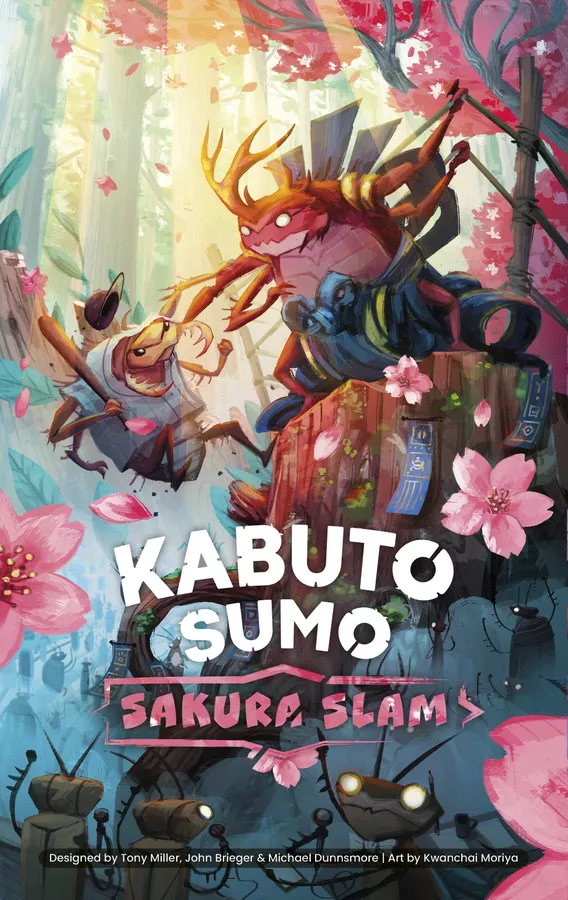
*ding ding ding* WELCOME! TO OUR MAIN EVENT OF… SAKURA… SLAM! The following contest is for one fall and is for the Kabuto Sumo Allplay Championship!
If you’ve ever been a professional wrestling fan, you can hear those words in your head, in the voice of your favourite ring announcer. You can’t help yourself. Some version of it is burned into your brain forever. So, it’s hard not to think about that ring announcer as you start a game of Kabuto Sumo.
Sakura Slam is the latest entry to the Kabuto Sumo games. It adds 8 new wrestlers, fixed corner posts on the main playing board, and a new additional move: the corner slam. Now, I’m not able to tell you how all of those differences impact the previous editions of the game, as this is my first experience with the franchise. I can say that this game may not be fully backwards compatible, but older versions are certainly compatible with this one. I say that because some of the Sakura Slam abilities involve tagging all four corner posts, which isn’t a thing in the previous editions.
Kabuto Sumo is generally classified as a dexterity game, but I don’t really like that description. It’s a physics game like pool without pockets. There are 2-4 wrestlers on the board, each represented by a disk-like (but not fully round) piece. These are surrounded by small, medium, and large disks that fill the entirety of the playing space representing a wrestling ring. Technically speaking it’s a sumo ring, but in Sakura Slam, it’s definitely meant to mirror the “squared circle” of a professional wrestling ring. The point of the game is still, as in sumo, to push your opponent out of the ring. To do this players set a platform against one of the corners of the the ring and push a piece from their supply into the ring. If any disks are pushed out, they are kept by the player. If any of your opponent’s wrestlers are pushed out, you win. If you accidentally push your own wrestler out of the ring, you lose via submission.
The biggest difference in Sakura Slam is the ring posts. When you push from the platform in a new corner, you place a small tag marker on it. When you have “tagged” all four corners (something you are never required to do) you take back your tag markers and push a second piece from the same corner as you take your turn. This is not optional, which is important. If you ever are unable to push a piece from your supply when you need to, you lose.
That covers the basics of the game. But what makes Kabuto Sumo so fascinating is the wrestlers. First off, they are all insects* (*don’t come at me with scientific semantics of the term.) That’s right, did I not mention that you’re a bug wrestler? Well, you are. There are eight wrestlers included in the game, each with unique signature moves and specialty pieces.
Dude… is a Lovebug. His signature pieces are a nested pair that make a Yin-Yang symbol. When both pieces are in the ring and touching, he gains a disk from the supply.
The Great Bugbino is an Antlion. This baseball-themed wrestler starts with a mandible/bat shape signature piece that attaches to one of the ring posts and can be used to knock nearby pieces out of the ring.
The Liquifier is an Assassin Bug. They have a pair of X-shaped signature pieces that allow them to push an additional piece when both signature pieces are in the ring.
APEX is a Goliath Bird Eater Tarantula. His spider-shaped signature piece replaces the normal rounded wrestler piece, and if it is touching another wrestler at the end of APEX’s turn, that player must stack a disk onto one in the ring. This brings them closer to a potential submission loss.
Midas is a Golden Orb Weaver spider. If his web-shaped specialty piece is touching his wrestler piece, he may tag a corner, speeding up future corner slam moves.
Green Destiny is a Longheaded Chinese Grasshopper. She may stack a disc that she knocked out that turn, and when a stack reaches four disks high, she gains her sword-shaped specialty piece and may push an additional piece from any corner. (Unlike a corner slam, which must be made from the same corner.)
Queen Bee is –wait for it– a Honey Bee. Her smaller, bee-shaped specialty pieces can be chained and pushed together.
Morozashi is a Rhinoceros Beetle, or a Kabutomushi. (Which translates to helmet insect.) If he can maneuver his kabuto horn-shaped signature piece in contact with an opponent’s wrestler, he can then stack that wrestler’s piece onto any large or medium disk. This leaves a hole on the board, which may make predicting how the disks will move for the next few turns more difficult, but it can also set an opponent up for a fast knockout loss.
For the record, I left out how players gain their specialty pieces, which is also different for each wrestler. Some of them are connected to tagging the corners (as I mentioned earlier) so they can’t be used in older versions. Six of the eight also have a “Junior League” version on the reverse of their info cards. Junior League rules are a simpler version of the game with wrestlers having different starting supplies, including their specialty pieces but no specialty moves.
Between the physics and the unique wrestlers, you can be assured that no two games will be alike. Its easy gameplay and reasonable footprint on the table make it an easy game to pull out anywhere, anytime. Just as long as you have an even, flat surface. Be it at a picnic table or a pub (maybe while watching wrestling on TV), it’s always the right time for Kabuto Sumo!

TheRatHole.ca does not accept payments for our reviews but may have received a promotional copy of this product for review.