
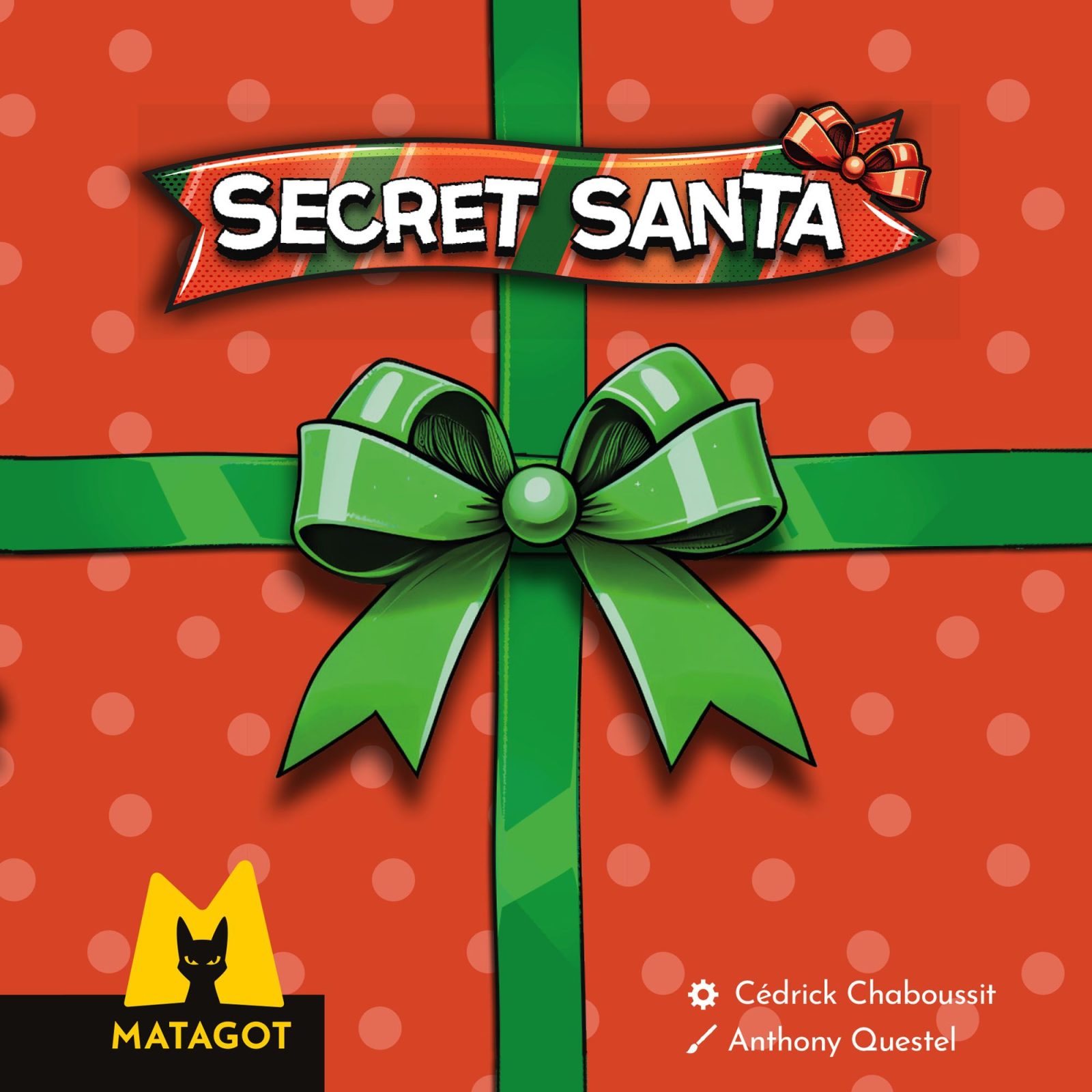
Fun fact: TheRatHole.ca officially opened 7 years ago on American Thanksgiving. (or as we call it in Canada: Thursday.) The first official review was Secret Santa by Osprey Games. So when I had the opportunity to review another Secret Santa (this time from Matagot) I was definitely interested to see how this would go. I wasn’t expecting the same game. Nor was I going to quibble over another game with the same name. The term “Secret Santa” is fairly common, and there are only so many blatantly Christmas names to go around. So what was I expecting? Nothing, I try not to hold any expectations when going into reviewing a game. If anything, I honestly come into most Holiday games with slightly lower expectations than I might with a game less niche.
No. No, I don’t think that’s the right way to put that. “Lower expectations” sounds too derogatory and that’s not what I mean. The holiday season is a time for family, and it’s often a time when family members who are not regular game players can be convinced to play some games. By necessity, many of those games need to be something more straightforward than what might normally be considered a “gateway game” or even a “family game.” That doesn’t mean they are inferior or less fun. But going into such a game expecting a heavier game would be a mistake.
That brings us to today and Secret Santa from the French company, Matagot. I hate to start on a negative note, but my biggest takeaway from this game was a question. How is this a Secret Santa? To me, and I assume most North Americans, a “Secret Santa” is usually a gift exchange in which everyone participating is given the name of another participant and gives that specific person a gift. It is a closed circuit if you will. There are rarely unexpected participants. Now, a similar yet different gift exchange is the “White Elephant” gift exchange. In this tradition, participants each bring a gift, and everyone gets the opportunity to chose (or often steal or trade) a gift. The host might have a handful of extra gifts squirrelled away for unexpected participants. A White Elephant gift exchange has many other names, and I wonder if there is a French tradition that is called a Secret Santa but would be what I would consider a White Elephant style exchange. Because that really is closer to how this game feels.
This Secret Santa is a small-scale set collection game. There are seven Tea Bag cards, each worth 1 Point apiece. There is a single Tea Pot which is also worth 1 Point, but doubles that player’s Tea Bags to 2 Points. There are seven Generic Presents, each worth 2 Points. There are seven Tea Cups whose points are determined by the number of Cups a player has, -2 Points for one all the way up to 14 Points for all seven. (A feat only possible in a two-player game.) There are two additional special cards, the Matamug (the Matagot Mascot Mug-ified) and Choc & Cawa. I have ZERO idea why Choc & Cawa is so named. The “Choc” clearly references the Cacao character on the card, which means “Cawa” must reference the Coffee character, somehow. I can only assume it’s a weird translation thing. The Choc & Cawa card is worth 0 Points on its own, but 3 Points if the player also has the Matamug. The Matamug is worth 2 points, but removes all Tea Cup cards that player owns. Interestingly, that is a better deal than it sounds at first, especially as the player count increases. In a four-player game, each player only gets five cards and unless you have 3 Cups, the Matamug is a better deal. in a three-player game, a player who has the Matamug along with Choc & Cawa would need all four (of six) of their remaining cards to be Tea Cups to have been worth more than those two cards. Upon reading that back, it sounds more complex than it actually is. Sorry. The instructions are actually quite brief and to the point.
The player whose birthday is closest to Christmas begins the first hand. I’m partial to this method, as it almost certainly means I go first. The active player takes a Gift card from another player or from the “unexpected guest” in the centre of the table and places it in front of them. If a player takes a facedown card from the middle the next player must give one of their cards to the unexpected guest face up, to simulate that guest’s turn. This adds a great deal of additional strategy to the game. It takes cards out of circulation to the other players and it can allow the next player to sluff off a card that they think another player might want.
But how do you know what another player might want if cards are taken blind? Well, the backs of the cards are different colours. No set has duplicate colours, with each of the three special cards each being one of the cards in in one of the sets. To remind players of this, the Pink, Purple, and Yellow cards all have a silhouette representing the special card of that colour, while the other colours all look like wrapped Christmas gifts.
I sadly wasn’t able to play this with my younger nibbling, because I think it really would shine there. Playing with adults quickly became a touch dull. There is limited player autonomy, but not so little that an adult couldn’t enjoy playing with kids. It’s not Candyland tedious or anything like that.
The best part of the game is the card art. It feels very much like Cuphead, Inky, and similar pseudo-classic cartoon art. It’s a style that has been growing in popularity in recent years, and I like it. Each card even has a unique character with their own name.
I won’t be seeing my younger family members until Christmas Eve, and I plan to bring this with me when I do. Do I expect it to become a yearly tradition, honestly no but who knows. Do I want to give it the best chance possible to shine? You bet I do.
You can find this, and other Matagot games online at matagot-friends.com or on Facebook at facebook.com/matagot.france

Don’t forget you can read all of our current and past holiday reviews at TheRatHole.ca/Christmas!
Matagot is a French company, so it feels right end this with a French-Canadian song. The Huron Carol is a pre-colonial song, performed here by Adam Ruzzo in(English, French, and Wendat.