
[EDITORS NOTE: If this is your first experience with the Starfinder Roleplaying Game, you may want to consider starting with our previous review of the Core Rulebook. -dc]
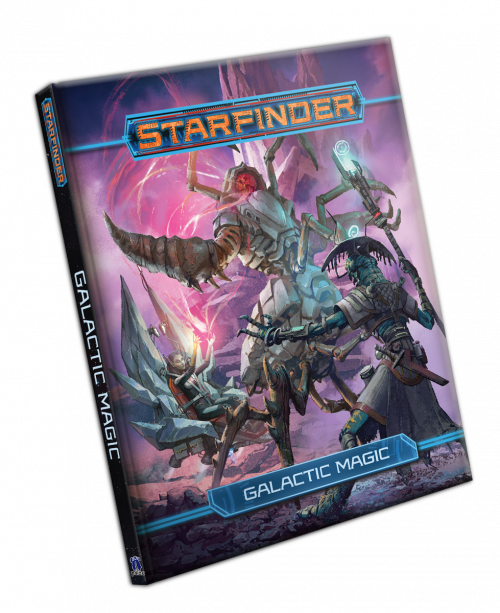
Starfinder. The name basically screams Science Fiction. Aliens, Starships, big guns. If you want magic, go away and play Pathfinder, right? But what if I told you that Science Fantasy is a real thing and that Starfinder is every bit as magical as its traditional Fantasy predecessor. After all, we live in 2023 and still make swords and follow books that are hundreds or thousands of years out of date, why should magic be any different in Pathfinder’s far future? Now, if you’ve come here having already played Starfinder, you already know this. If you’re new here (welcome) then hopefully you’ve looked at my old Starfinder Core Rulebook review and I promise my writing is better now. But again, if you read it, you probably already gathered this. If nothing else, you may have gleaned some of this information from the title of the sourcebook we are looking at: Galactic Magic.
Galactic Magic is meant to explore and expand on magic in the universe of Starfinder, and it’s a big universe. Now, when I say that, you might think this is going to be 150 pages of lists and tables. Thankfully that’s not the case. That exists, Chapter 3 is just that, Spell Lists and Spell Descriptions. I probably won’t even go into much more detail than to point out that this chapter isn’t even the longest chapter in the book. Seeing that is actually when this book started to intrigue me. You see, I don’t play magic users. Like, at all. Decades of playing dozens and dozens of game systems, I can only think of one time I’ve played a magic user; it was in a Free RPG Day game on Kobolds Ate My Baby, and that almost doesn’t count. If I saw this book on the shelf of my Friendly Local Gaming Store, and I wasn’t reviewing it, I might not even take it down to look. I say that as someone who has every other Starfinder sourcebook through Drift Crisis. I’m glad that’s not what happened.
Let me reiterate that, as a separate paragraph for emphasis: As a devout non-Magic User player, I’m excited by what’s in Galactic Magic for all players.
The Soldier Class, for example, gets some fascinating new Fighting Styles. The Spellbrawler can use Arcane Arsenal to conjure an analog weapon, such as a bow and arrows. At higher levels, they can drain away magic and magic-like abilities from their enemies to use for themselves. They also get some cool new gear and gear boosts to use.
The Operative Class, another not particularly magical character class and more my style of play, also gets some interesting new Class Features, Operative Specializations, and Operative Exploits. Spell Thief lets them… steal spells. Well, steal the energy used to cast spells, anyway. The Memory Weaver Specialization lets them twist the memories of people a hacker might twist computer memory.
Of course, all the normal Magic Using Character Classes get access to new stuff, PLUS there’s a new class. The new Precog class twists and turns through the flow of time in a way regular creatures don’t. These characters are slightly more limited in what spells they can use but also have some super creative abilities. Every Precognition has an Anchor that acts like a combat-based character might have a weapon fighting style specialty or a religious/spiritual character might connect to their deity. As their levels increase how many paradoxes they can create, replacing a d20 roll with a known, pre-rolled, result. These paradoxes also can be used up as part of other abilities. Precogs also use Temporal Anomalies to avoid or change all sorts of dangerous situations. Instance Analysis, for example, sort of lets the character peer over the GM’s shoulder at a target’s strengths and weaknesses. Another way to look at it could be seeing that “Pikachu used X attack, it was super effective” screen before actually making the attack. Precogs are a fascinating Class, and I’m legitimately tempted to do a deep dive into it, in the context of something like a Doctor Who for Starfinder homebrew.
The other magically delicious new thing is the Spell School Specialist Archetype. Like all archetypes, this grants alternate class features and abilities. As you would expect from the name, the player chooses a specific school of magic to specialize in, and one of the most basic new abilities is an extra spell slot for that school.
The second chapter is gear, and as I mentioned I’m not really going to talk about that or the next chapter on Spells. Buuuut having mentioned mixing up Doctor Who and Starfinder, there is a Trench Coat of Utility that would be perfect to store some jelly babies.
The longest part of the book is the fourth chapter on Faith. The Core Rulebook covers a broad swath of religions in Starfinder, but it isn’t exhaustive. Faith and Magic are inexorably intertwined in the world, so it makes sense to expand on that in this book. There are 20 full page entries on various important deities, including the most important one at the moment: Triune. Triune was responsible for the signal that gave Drift travel technology to the universe. Now, if you’ve been paying attention the past year or so, Triune is also at the centre of the Drift Crisis event that has been upending the universe. [Editor’s Note: This book predates the Drift Crisis. However, this review was written well before it concludes, despite not being posted until closer to the end. -dc]
There are another 10 half-page entries, including Cavrabon The Hospitable, deity of food, hospitality, and spycraft. If a better combination of patronages exists, I don’t think I want to know. I never mark a deity down, but that may now change. Also included is Cayden Cailean, The Accidental God, an ascended mortal from the Pre-gap time. He had a full two-page spread in Pathfinder: Lost Omens book on Gods and Magic. That book also discusses Calistria, Cayden’s intermittent lover. A potentially interesting plot point for you, No mention of their dalliances are mentioned in Galactic Magic. As the chapter progresses it includes sections on Ancestral Deities (including Calistria), the Elder Mythos, the Fey demigods known as The Eldest, Outsider Deities, and finally concluding with a look at various fringe cults and sects that players may encounter.
The book closes with a chapter entitled The Magical Galaxy. The chapter is all the world-building and lore you could want. Factions, Institutions, and Phenomena that players may cross. The most important and interesting note is a phenomenon called Drift Thinning. Drift Thinning causes issues with Drift travel. When Triunes followers tried to explain it, the Tall-Code responded with “Reported Defect>> Intended Effect==1.” Does that connect to the Drift Crisis? I’ll have to wait and see (although, by the time this goes live, we may all know that answer.)
As someone who rarely plays magic-focused character classes, I appreciate that this book is more than just a glorified spellbook. If it was, I’d probably have ended this some paragraphs back. While this may not be the first resource I’m likely to reach for (based only on my play style) I’m sure this will become very useful, indeed.
You can find Starfinder, and all things Paizo, online at paizo.com or on Facebook at facebook.com/paizo.

TheRatHole.ca does not accept payments for our reviews but may have received a promotional copy of this product for review.