
[EDITORS NOTE: If this is your first experience with the Starfinder Roleplaying Game, you may want to consider starting with our previous review of the Core Rulebook. -dc]
A long time ago, in a galaxy far, far away… there was a war over a star and there were spaceships, weird aliens, cool weapons, some magical mind tricks, and many MANY new planets to explore.
No, we are not talking about the new Ewan MacGregor limited streaming series. But we could be talking about a Starfinder campaign motivated by that classic sci-fi universe that George Lucas created oh so long ago. I mean, it’s no coincidence that Advanced Dungeons & Dragons came out the same year as the first Star Wars movie. Okay, it probably was a coincidence. But over the following 45 years, both of these things have inspired countless games which eventually brings us up to Starfinder and the Galaxy Exploration Manual.
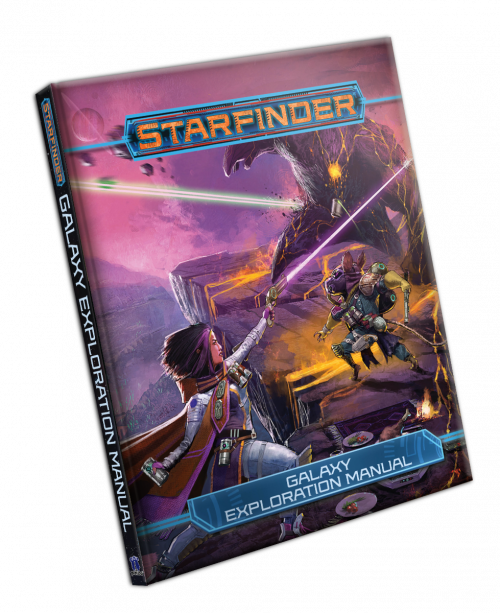
I’m admittedly behind getting to this review, and that’s a major disappointment. I’ve often said that the Alien Archive books (and the equivalent in any TTRPG) are the most important books in Starfinder. I stand by that, but for a GM still trying to gain the confidence to expand their homebrewed universe, the Galaxy Exploration Manual is a VERY close second. In fact, I think an argument could be made for this to take that top spot, not just in Starfinder but for my entire TTRPG library. I can’t think of a single sci-fi themed game where this book couldn’t apply, and with some obvious tweaks in the specifics, it could apply to just about any game that isn’t designed for a very specific location. Even then a GM can draw from the advice on creating a “sandbox” game structure at nearly level.
What is a “sandbox” game, you ask? A sandbox game places the emphasis on free-form gameplay, where the players can ultimately travel anywhere with less regard to linear goals. The term is more common in the video game sphere, and the concept has been around in homebrew campaigns since forever, but it is becoming more and more common in published game material. This is, in part, a response to the notion that published adventures are far too linear and “railroad” players through a plot where they have little or no agency over their character’s story. Just to acknowledge the elephant that just wandered into the game room: yes, Starfinder and Pathfinder are considered among the worst offenders for this. Honestly, I don’t care. That is one of the things I personally love the most about Paizo’s format for adventures; the level of detail they include to make the GM’s job as straightforward as possible. I consider those adventures to be the gold standard I inevitably hold other games against. But not everyone feels that way, which brings us back to the topic here.
The Galaxy Exploration Manual is the antithesis of just about every other Starfinder book. Sourcebooks like Near Space and Pact Worlds are designed to expand the canon universe, as are the Codex of Worlds entries included in every Adventure Path book. Especially in the latter’s case, these new worlds may not appear in a published adventure making them easy to drop into a campaign and use as an anchor to develop a new star system within your sandbox, but they are nevertheless integrated into that “known” universe. This book is designed to help guide you into the unknown universe.
The first chapter focuses on the Player Characters. Obviously, any character can bounce around the universe, but this chapter presents options and ideas that may be better suited for an exploration-based (sandbox) campaign. the section on Character Backgrounds can help both focus and expand on a character’s reason for being where they are. Similarly, the Class Options and Equipment sections present a whole host of new and exciting options particularly appropriate to exploration.
The most important section of this chapter is the Exploration System of optional rules that help codify the process of charting the unknown at any scale. Starting with Galaxy Exploration, then narrowing to [Star]System Exploration. From there it narrows further to Exploration [of a specific planet] From Orbit and finally World Exploration once you’ve landed. This last bit tackles “Hexploration” or the process of exploring a world using a hexagonal grid, with each hex containing a dominant biome. This sort of exploration is sometimes called a “hex-crawl”, adapted from the term “dungeon crawl” as a form of exploration. If you’ve never encountered this before, think of it like playing your TTRPG on a Settlers of Catan map.
The second chapter is entitled Infinite Worlds, and it focuses on building the new worlds that players will explore in five easy steps:
-Choose the type of world this will be. Is it a space station, a gas giant, an earth-like terrestrial body?
-Determine what the Gravity and Atmosphere are like. This may be a minor point, but it’s important enough that there are rules about it all the way back in the Core Rulebook.
-Determine the Biomes on the world. Is it covered mostly in water? Is it a forest moon? This is likely going to be one of the most important parts of the process, impacting almost every facet of your creation.
-What are that planet’s Cultural Attributes? The Biomes make up the world itself and the Cultural Attributes are going to make up the settlements and other inhabitants of that world.
-Then you add in the Finishing Touches like specific locations, notable NPCs, some Adventure Hooks to draw the character’s interest, etc.
It’s worth noting, and the book has this note, that several of these steps can be done using the Deck of Many Worlds, which is exceptionally useful to draw up a very general location that players may notice but not actively interact with. (But take note of it as the GM, because inevitably if you don’t the players will.)
The third chapter is all about designing Sandbox Adventures. This chapter is why I say this might be one of the most important books in my library. There are very few resources out there on how to build, and more importantly how to manage, this sort of campaign. It covers everything you’d want to know, starting from the character’s home base out to infinity and beyond. Including a great section on different subgenres, with suggested media relating to each.
The book then closes out with Toolbox chapter full of tables to quickly roll up anything your players might unexpectedly wander into.
There is one statement, one little sentence, buried in Adventure and Encounter Design section, that sums up this entire book:
“Ultimately, the sandbox is a site, not a story.”
Sometimes a GM focuses so much on the story aspects of their plan, that they get derailed by inquisitive players. (Again, referencing the concept of railroading players through the adventure’s plot.) It’s important to remember that no matter what you are creating, sometimes the story writes itself. Build it, and they will come, if you will. The Galaxy Exploration Manual doesn’t just explore Starfinder, it can open you up to exploring a whole new style of Roleplaying for many players.
You can find Starfinder, and all things Paizo, online at paizo.com or on Facebook at facebook.com/paizo.

TheRatHole.ca does not accept payments for our reviews but may have received a promotional copy of this product for review.