
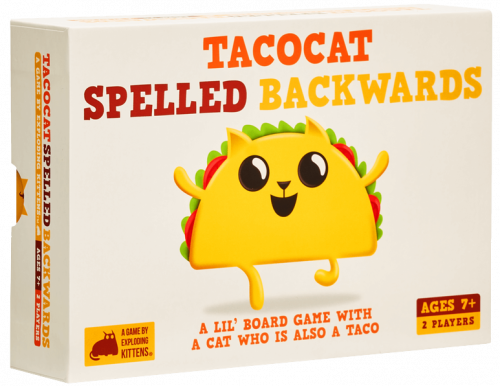
We’ve officially crossed over from the “overpriced flowers” February to the “discount chocolate” March. But it’s still Two Player month in The Rat Hole, and I’ve got another offering from Exploding Kittens. What does gaming and dating have in common? Both share the risk of getting something that isn’t quite what you expected. That’s right, I got Catfished by a game. Specifically, I got Tacocat-fished.
Based on the name alone, you would think that Tacocat Spelled Backwards would be a word game. Apparently, a lot of people had that problem, because when you flip over the box, it says, quite clearly “this is not a spelling game, but try spelling my name backwards”. Okay, so it’s not a spelling game. Maybe it’s a word-play game? Who can think of the cleverest palindrome? Nope. Tacocat Spelled Backwards is… well, there’s no other way of saying it. It’s a “high-card wins” playing card game, with a gimmick attached. In fact, I was amused thinking that there would be one member of the game development team who had the job of just researching palindromes. Other people would be testing game rules or designing artwork, but this person would just be in charge of a running gag.
The game consists of a scoreboard (which is also the game box), a “Tacocat” score marker, 7 colourful tiles, and a single deck of 38 cards. The cards are numbered from 1-12, each with a cute illustration demonstrating a corresponding palindrome. Some of the palindromes are simple, like “Star Rats”, “Evil Olive” or the titular “Tacocat”. Others can be quite a mouthful, like “Was it a car or a cat I saw?” or “May a moody baby doom a yam”. Some of my favourite word/art combinations were “Too Hot to Hoot”, showing an exhausted desert owl; “Ma has a Ham”, showing a woman walking her pink piggy; and the one that made me laugh the most, “UFO Tofu”, showing a flying saucer dropping grey cubes.
Although this seems like it should be a simple game, the rules are more complex than you would expect. So much so that even experienced Rat Hole staff members didn’t catch one of the rules. As I mentioned before, Exploding Kitten rules sheets include a large message that says “Don’t read these rules! Reading is the worst way to learn how to play a game. Instead, go online and watch our video”. I admit that I didn’t look at the video until just before writing this review, after playing multiple games. That’s when I discovered the rule that I had missed in the written instructions.
When you unfold the box, the first thing you see is a score track. At each end are the goal points, “Yay” and “Wow”. In between are 7 slots, one for each of the letters of the word “Tacocat”. To win the game, you have to move the Tacocat token from the center slot to your goal. To do that, you have to win rounds of the card game. Each time Tacocat moves, the slot where it used to be gets filled with one of the tiles. When a slot is filled, you can’t move to that slot, and so you move to the next open slot instead. This means that the more rounds you play, the bigger advantage you get for winning a round. Each slot has a number and an arrow. The number is the number of cards each player gets for that round. The arrow points to one player or the other, and gives that player an advantage that I will discuss later.
Next, let’s talk about the card game itself. In the opening round, both players get 7 cards; but as the rounds progress, you may get as many as 9 cards, or as few as 4. Each turn in the game has an Attacker and a Defender. The goal of the Attacker is to play a high card; the Defender then must match or beat the attacker’s number. If they cannot, they have to give up, or “Sacrifice” the lowest card in your hand. Not “a lower card”, specifically the lowest; no bluffing, no cheating. This is because, at the end of the round, the winner is the player whose final card is the lowest. To determine who attacks first, you “Duel”. Both players lay a card face down and reveal it at the same time. The highest card wins, BUT both cards are discarded; if a Duel ends in a tie, you each put down another card. After the first turn, the winner of each turn is the one who attacks next.
Now we can talk about those arrows and numbers. After the first round, each slot will have an arrow pointing to one of the players. After the cards are dealt, but before the round begins, the player to whom the arrow points has the option to discard and replace as many, or as few, cards as they wish. But, if they do, the opponent can exchange up to that many cards as well. Whenever a round ends in a tie, the winner is the player with the arrow pointed at them. The numbers determine how many cards are dealt in that round: 7,6, 9 or 4. This means the game plays faster the more rounds you play.
Even after that long explanation, we can’t ignore the fact that this is a very simple game. There isn’t much room for strategy, tactics or bluffing. You play your one card, and you either win or lose. The box recommends ages seven and up, and this would be a good game to teach basic numbers, but even young children might get bored after a few games. This is the kind of game that our hypothetical romantic couple might play while waiting for their reserved table, or waiting for their food to arrive. It wouldn’t be the primary entertainment of the night.
Finally, I’m going to mention something that I don’t talk about often: price. I paid $20 Canadian for this game. Twenty dollars for a deck of cards, a few colourful pieces of cardboard, and a box. The only really innovative part of the whole design is that fold open box. But is an origami box worth twenty bucks? Personally, I would have been more comfortable paying between $10 and $15. But I’m the first to admit that I don’t know much about the business and economics of game design. Your mileage may vary.
You can find all the Exploding Kittens online at explodingkittens.com or on Facebook at facebook.com/explodingkittens.
