
Spill
The date was April 20, 2010. The place was the Macondo Prospect in the Gulf of Mexico. At approximately 7:45 pm CDT, the unthinkable happened, the Deepwater Horizon drilling rig exploded in a fireball that could be seen 64 km away, killing 11 and injuring 17 workers of the 150-person crew. Two days later, the still flaming hulk off of the semi-submersible mobile rig sank. Terrifyingly, that’s the feel good part of the story. This was the start of the largest marine oil spill in history. It would take months to stem the flow of oil into the Gulf of Mexico, years of cleanup, and decades of testing and environmental rehabilitation still to come. The impact of the BP Oil Spill can neither be overstated nor downplayed. It’s hard to claim that the positive changes that came afterwords come even close to balancing the scales.
It is said that those who fail to learn from history are doomed to repeat it. While sweeping legal and regulatory reforms may reduce the likely hood of another Deepwater Horizon disaster, and while technological advancements may further reduce the potential devastation, the best way to not repeat history will always be to not only learn from history but to learn about it. That doesn’t just mean sitting in a classroom, it can be fictional accounts, music, or even respectful parody. It can also mean playing board games.
The Spill isn’t the first environmentally-themed game, it’s not even the first marine ecology-themed game we’ve reviewed at TheRatHole.ca. (Nor will it be the last.) However, The Spill stands tall as one of the best. When I say that, I don’t just mean as an educational tool, or just based on the theme. It’s a great game on almost every level. It is best described as a “reverse tower defence” game. The tower defence genre doesn’t have to involve an actual tower. One of the more popular app-based games is Plants vs Zombies. Ordinarily you, the player or players, have a single point that you are trying to keep from being overrun by the oncoming hordes of <insert thematic hordes>. Sometimes from a single direction or sometimes from a full 360º around you.
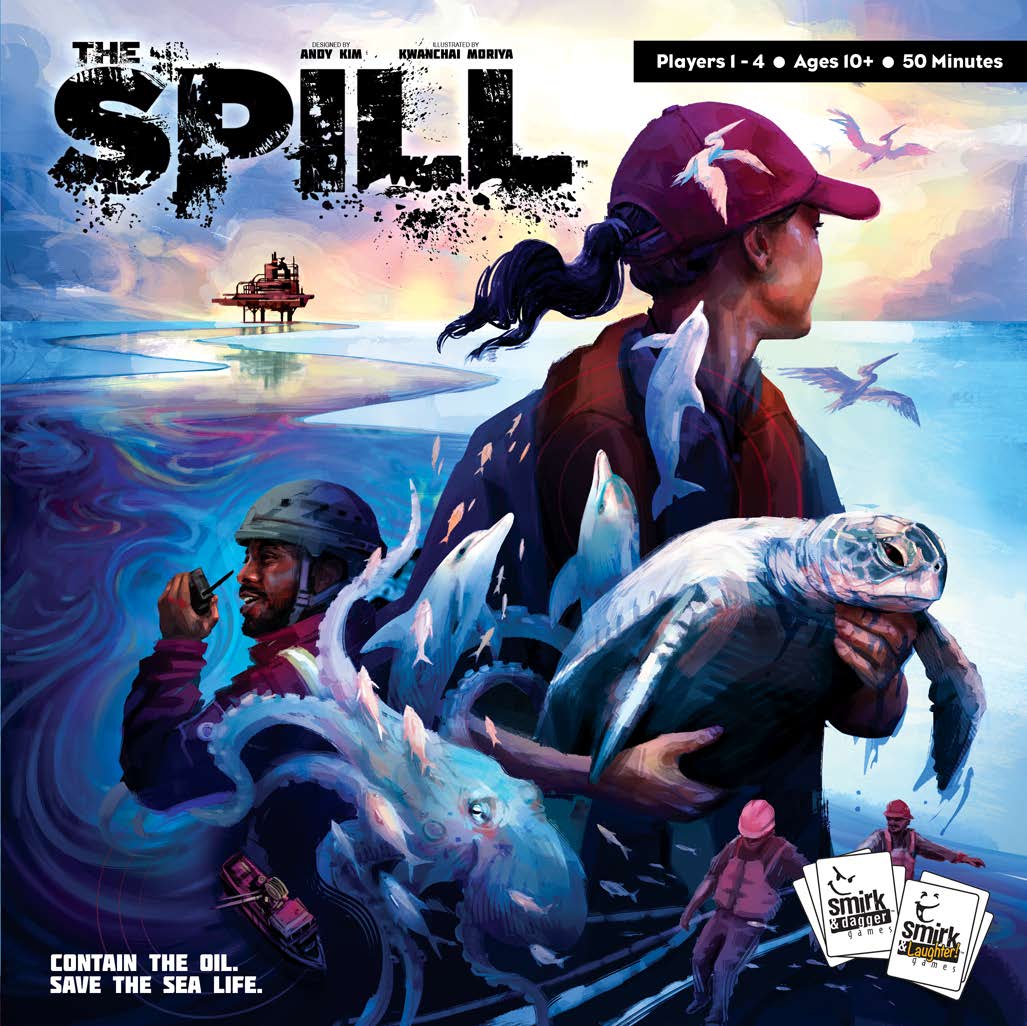
The Spill flips that, with players controlling ships belonging to a joint task force circling around the outside of an ever expanding oil spill. There are six possible specialists to choose from (either randomly or deliberately) the game is balanced to always have four specialists in play, regardless of the 1-4 player count for that game. Every game has the potential to have a unique mix of specialist abilities, which is important because there are also 9 possible sets of win conditions, and 15 Resource Cards (of which only three will be used) it’s incredibly unlikely that any of the win conditions would ever be fully completed without the judicious use of those abilities and resources. Even the easiest win condition cards quickly become daunting no matter how good you are. Any game I’ve won has come down to a single turn that will end with either the win conditions or a loss condition being met.
Because of that, I’m not going to go into the details of those variables, and focus on the most basic game mechanics. To do that, the first thing we need to look at is the bright orange oil rig dice tower at the centre of the board. On each player’s turn, three oil dice are dropped into the top of the tower and spill out from the bottom. those dice are then placed on the board in the quadrant they landed, in the column labelled by the number rolled. There are three spaces per column, and if all three are full it creates a “spill out” and the dice are placed in an adjacent column, which could result in another Spill Out. Six Spill Outs at the same time and the game is lost. Some columns have one or two marine animals in them. If the oil dice reach those animals they are contaminated by it, if a contaminated animal is not rescued by the end of that turn, they are removed from the board and moved to the sick bay. If the sick bay contains one of each of the six animal types or three of the same animal type, the game is lost.
Of course, all of these things can be mitigated by the players. That’s what makes this a game. Players control ship-shaped pawns that travel column/section by section around the outside of the board. Players have four Action Points (AP) to use. Movement cost 1AP. Returning an oil die to the bag costs 1AP or removing an oil die from the game costs 3AP (this is often part of the win condition). Rescuing a healthy animal costs 1AP or rescuing a contaminated animal costs 2AP (either of these could be part of the win condition). Removing dice and rescuing animals gain players activation cubes that are placed on the resource cards before their effects can be used.
Cooperative games are always challenging. They have to be because you’re competing against the game. Tower defence games, specifically, are designed to start out easy and very quickly get out of control. The Spill is hard. The Spill is VERY hard, but it’s still fun. I hate to end this review on a low note, but dealing with oil spills is also hard. It’s also unfortunately often necessary. Games like The Spill are an important part of keeping the conversation going. It’s a terrifyingly accurate analog for the real world situation and, if anything, this super hard game is easy by comparison.

TheRatHole.ca does not accept payments for our reviews but may have received a promotional copy of this product for review.