
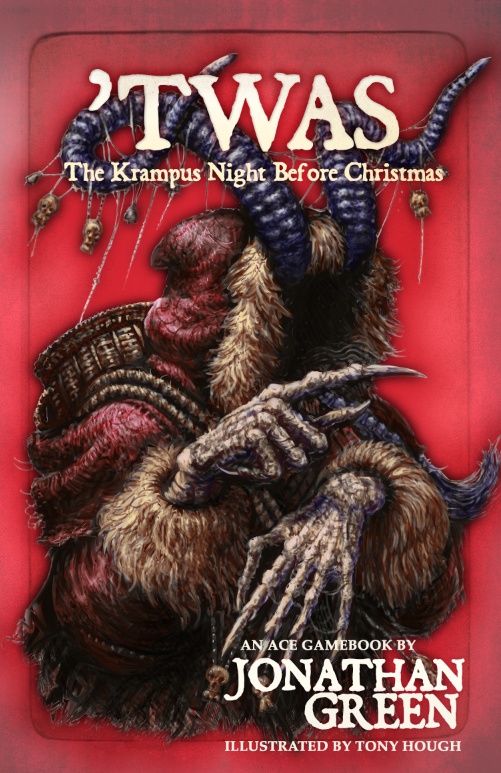
The whole nostalgia and retro thing has been huge for years. Lately though, it has unadulteratedly been smacking me in the face. As I write this, I think I’ve had five projects crop up that could have been straight out of my childhood, and a few things cross my path that straight up were part of my childhood. ‘Twas isn’t exactly a retro thing, and the nostalgia factor is more in the inspiration with a bit of my personal history.
The full title is ‘Twas The Krampus Night Before Christmas, so it makes sense to put this review up on Krampusnacht. Krampus (and Krampusnacht) is another one of those things that have only made its way to North American pop culture in the last 20 or so years. My first exposure to the Christmas Devil (one of many, often not terribly accurate, epithets for Krampus) was travelling through Europe with a show in the late 1990s. He was (and is) one of many things that benefitted from the communication revolution that the internet created. Since that time I tend to mail out Krampusnacht Cards rather than Christmas cards and he continues to inspire me to look out for winter holiday traditions of other cultures.
The other bit of nostalgia is in the inspiration. The brand has come back a bit in the last few years, but do you remember Choose Your Own Adventure books? Well, this is a very similar concept. Originally the reader would make a choice between (usually) two choices, and turn to a non-sequential page somewhere else in the book. You can read through ‘Twas like that if you want or need; deciding the outcomes of encounters and taking the resulting actions. There’s nothing wrong with that, but it does take away some of the roleplaying gameness of it. For the full experience of ‘Twas, you start by creating a simple RPG-style character. You have three main stat scores: Agility and Combat which both start at a base level of 6, as well as Endurance which starts at a base level of 20. From there you have another 10 points that you can assign between those three stats. These totals get recorded on a character sheet and as the game advances you’ll be adjusting your stats up and down; adding Equipment, saved up Meals, and Codewords that help guide the story based on your previous decisions. You also have three uses each of two Special Abilities: “The Pen Is Mightier” and “Naughty or Nice” both of which impact the story in slightly different ways and could actually land you in worse trouble than you were trying to avoid.
While all of those things tie together to impact the story, the biggest thing is arguably combat. When you encounter an opponent you roll two dice and add your Combat score to determine your Combat Rating. Then you roll two dice and add your opponent’s Combat score to determine their Combat Rating. Add any modifiers and whoever comes out on top wins the round with the loser losing points from their Endurance score. Assuming everyone survived the round, combat (usually) continues.
Personally, I rolled two different sets of two identifiable dice at the same time for combat. As strange as this seems, there may be people out there who don’t have four dice or even two dice but that might have a standard deck of cards, so there are rules to use that instead. Not being one to take the normal path, I used Jeff Daymont’s Dark Hand deck which has a light and dark half, with different numbers and suites on each.
It is nearly impossible to give “spoilers” to the story since there are a surprising number of interwoven paths to the ending. Assuming you survive to the end, of course. Nevertheless, I’m not going to touch on the plot beyond the first little bit.
The story begins as you, a character of unspecified age and gender, are snuggled warm in your bed as the clock chimes eleven, twelve, thirteen… Thirteen? As you wonder about that extra clock chime you hear a crash. You pull your dressing gown over your pyjamas, put on your slippers, and turn to section 1.
1: At the bottom of the stairs stands the offending grandfather clock and you are presented with four choices: Examine the grandfather clock, Open the front door, Open the door to the sitting room, or Open the door to the dining room.
You make your choice, turn to the appropriate section, and the adventure begins. Every choice you make takes you deeper and deeper into the unknown, and the entire story could be completely different every time you play. Even during your first play, you may encounter instructions if have certain keywords recorded, which really shows how tangles the plot threads can be.
I purchased the hardcover edition and later downloaded a free PDF of the Adventure (character) Sheet and Encounter Boxes (which can be used to help track an opponent’s stats during encounters) and I have only two complaints with any part of this book/game, and both of them have to do with those sheets. With the Adventure Sheet, there is limited room to write notes. Specifically, you are almost certainly going to need more space for the Codewords you’ll collect as you go. The sheet is a single book page, and it wouldn’t have taken much to format it onto a second page. My second issue, and it is even less of an issue than the first, is that the Encounter boxes have a space to write in your opponent’s Combat and Agility scores, but it should read Combat and Endurance. Neither issue is remotely game breaking but it could have been an easy fix for the PDF, at least.
Overall I absolutely loved ‘Twas. I played through it several times and expect to do so again in the future, probably several times again. The hardcover version I bought has a timeless feel to it but it is also available in softcover and PDF.
You can find author Jonathan Green online at jonathangreenauthor.com and publisher ACE Gamebooks at acegamebooks.com or on Facebook at facebook.com/ACEgamebooks.

As is the tradition in The Rat Hole at Christmas, we will end today’s review with a song. Today we give you ‘Twas the Night Before… from Cirque du Soleil. -dc