
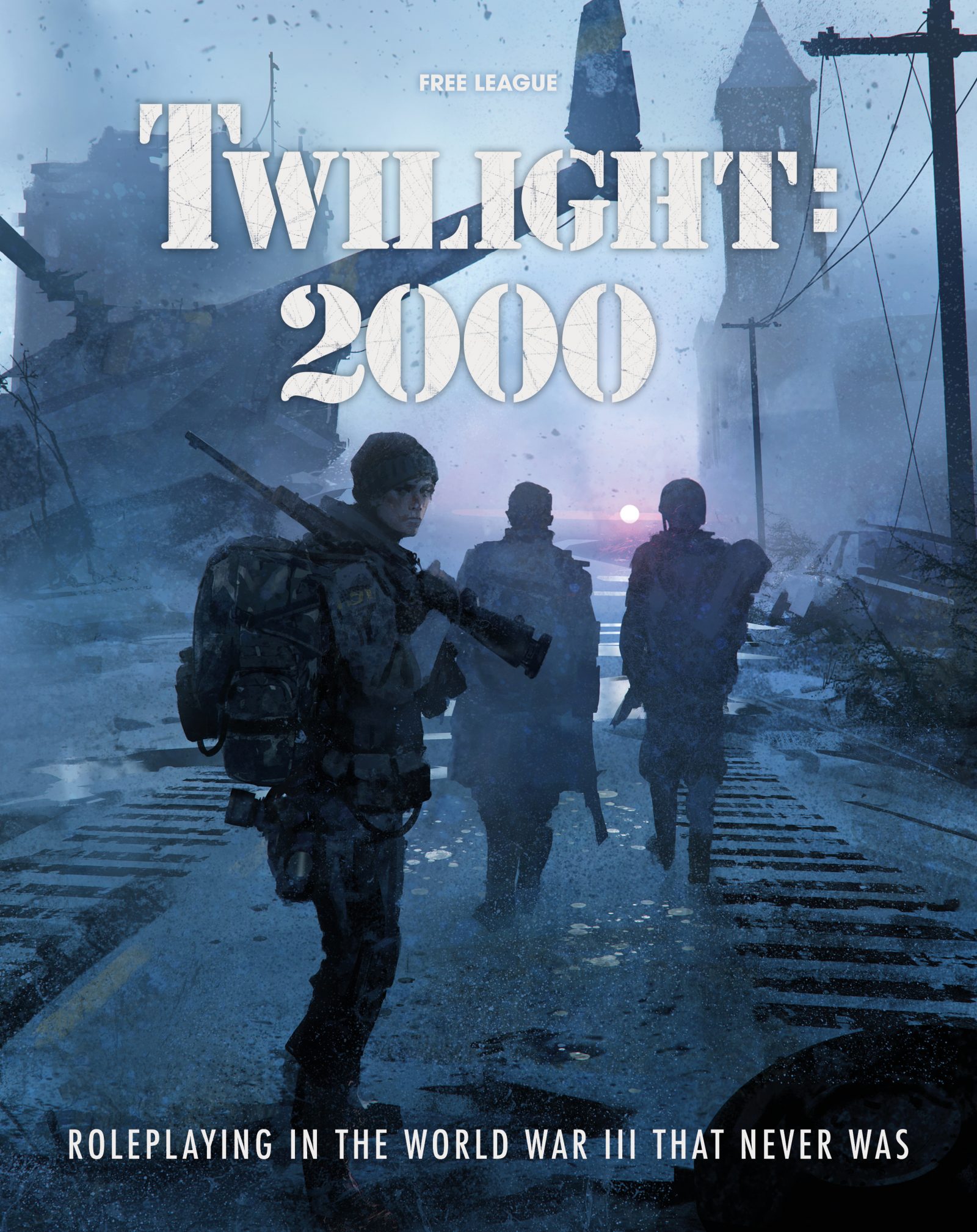
The new Twilight 2000 Starter Set is something I wanted to have posted before we hit our holiday reviews, but that obviously didn’t happen. I didn’t want to rush it since this is a very cool product and cool game. This is the Fourth Edition of Twilight 2000 which was first released in 1984 looking into a speculative future 16 years in the future. The third edition from 2008 only looked 5 years into the future (of roughly the same world), renaming itself Twilight: 2013. Now it’s 2022, and most of humanity has kinda given up speculating on what the foreseeable future holds. So Free League looks backwards instead, placing the game once again in the now relatively recent past of the year 2000.
The Referee’s Manual starts with a timeline of The Road To War beginning in 1989 with the fall of the Berlin Wall, the 1990 start of the Gulf War, and the reunification of Germany. These are entirely real, historical, events. Things start to change when the soviet coup d’état by the “Gang of Eight” against then-president Mikhail Gorbachev was successful, eventually leading to prolonged hostilities between the USSR and the combined US and NATO forces. These hostilities exploded into World War III and its devastating nuclear crescendo in 1998. By 2000 hostilities have effectively run out. Not ended, run out. Neither side can effectively wage war but there is no peace. This is the world players inhabit, cut off and alone, the final orders out of NATO HQ ringing true for all sides.
“Good luck. You’re on your own now.”
The starter set constrains itself primarily to Northwestern Europe, specifically Poland and Sweden, and only briefly brings in the rest of the world as needed. The US and Russia are the most heavily discussed, but mainly because those nationalities are playable in the game. There is talk in the books of releasing additional setting locations as well, but as it stands, these two countries are more than sufficient. [Editor’s Note: there’s an addendum at the bottom about this.- dc] The game is designed to be a completely open world. The story isn’t about having a predetermined beginning, middle and end, but rather a beginning, a bunch of loosely designed encounters at less loosely designed locations with a preplanned, but not predetermined, climax that doesn’t constitute an ending. For example, Players might be stranded American soldiers in Wtoszczowa, just southwest of the Polish city of Kielce. They move south and eventually hear a rumour of a town in northern Poland that has given sanctuary to others, with the intent to help them escape the country. Eventually, they make their way to Poznan while there they learn of a Russian “religious” leader who had attempted to take over the city and failed. Later in the game, they find the sanctuary town, now being controlled by this same Russian and his cultists. Who knows where that could lead. Perhaps they eventually end up on a boat crossing the Baltic Sea to Sweden. Along the way, they could have dozens of preplanned encounters, dropped into whatever location(s) they find themselves. Maybe they continued south, and still end up finding a sanctuary city controlled by the same cult. From there they hear rumours of a boat getting American soldiers across to Sweden. Without communications, they can’t know, but surely the American foothold in Sweden has continued and they can be sent home from this nightmare. By the time that comes up within a group, maybe Free League will have released an expansion with North America, and if not they could just create their own.
The starter set includes a bunch of semi-generic tokens that can be used on both the zoomed-out travel maps and the zoomed-in encounter maps to indicate any number of things. it’s also not terribly hard to create your own tokens if need be. All of the maps and tokens are included in the digital edition of the Starter Set, which makes life easier on a referee who wants to track details between game sessions. Twilight 2000 can evolve into an almost Legacy-style setting, more so than most TTRPGs, because of the sandbox style of exploring. or groups can just live in the moment (well, hopefully live anyways.)
Also included in the Starter Set box is a high quality, double-sided, travel map of Central Poland and Central Sweden. A quick Map search later, and these do seem to be in the real world 1 hex = 10 km scale it claims, so it becomes very easy to find and expands past these maps if need be. It also includes “scenario site” maps that are one or two pages in size, that are consistent in an unlabeled scale, and are completely connectable, but it’s easy to fudge just how big they are if need be. For context, a small two lane road without shoulders is about 5-7 meters wide and as I write that it feels very much like that 5m hexes are mentioned somewhere and I’m just forgetting where. There are five blank character sheets (with more easily downloadable) a detailed intelligence report handout for the suggested starting points in both Sweden and Poland. There’s a deck of encounter cards, initiative cards, and custom dice. Frustratingly the cards are only plastic wrapped instead of in a cardboard tuck box. That means finding a satisfactory way to keep the cards from flying all over.
Then, of course, there are the rulebooks. Two of them to be precise, a Player’s Manual and a Referee’s Manual. The Player’s Manual starts with a chapter titled after that same ominous quote I gave above, “you’re on your own now.” It walks a new player through the overall game including the most important (and one would think, obvious) goal of staying alive. Easier said than done, without easy access to medical supplies… or ammunition… or food…
From there the book goes into basic Player Character concepts and the two ways of creating them. Archetypes create a fully playable character that together forms a balanced group upfront. Life Paths start with a backstory and basic competencies, fleshing out the character through gameplay. In either case, you’ll choose a nationality, military branch (or lack of), rank and individual attributes. It’s assumed that players can communicate through a common language, but that’s not to say some entertaining miscommunications can’t drive roleplaying in interesting directions. (Have you ever watched ‘Allo ‘Allo? There is a British spy posing as a gendarme that is a perfect example of this.) The rest of the book is split amongst mechanics, rules, and physical gear.
The Referee’s Manual, on the other hand, is surprisingly rules light. It focuses on actually running the game and the setting at large. The Player’s Manual is intentional general about the world, allowing the Referee to adapt it as needed without breaking the canon of the game world. It goes into great detail about many of the military and civilian factions players might encounter, or that the Referee could adapt based on player choices. There are a handful of specific Scenario Sites, that correspond with the included maps, but with more details. Again, none of these details are player-facing allowing for on the fly changes and/or reuse of the maps. Finally, there is a set of Solo Rules. There are enough randomization tables to cover most situations and the included Encounter Deck doubles as an Oracle system to answer questions and drives in unknown directions without the need for a dedicated Referee.
Not included in the box set, but easily available separately, are a Referee screen and a deck of weapon cards. Neither is specifically “necessary” but both are definitely helpful. On one side, the weapon cards have an image and name of the weapon on the card, with the stats on the reverse. More generic weapons, like a knife or a hunting bow, only have the name and stat line. More specific weapons, such as a soviet SVD-63 sniper rifle or an M47 Dragon antitank missile launcher, also have some historic information between the name and stats. This is one of the more unfortunate layout choices. When I opened the cards the first few I saw were those generic cards; I thought “how cool I can tuck most of this card under my stuff and see the stats.” But with the rest of them, the name and stats are split up meaning you probably want to have the full cards visible. I’m all about efficient use of space, so that bugs me. The Referee Screen is what you probably expect. It’s a three-panel screen, landscape-oriented with all the tables a referee might want to have at their fingertips. Combat modifiers, critical injury tables, weather and terrain info, stuff like that.
As a whole, the game in general, and the Starter Set as a product, are a great investment. Twilight 2000 is a game that can be played with virtually zero prep work by the Referee running it. However, after a session or two, it’s probably a good idea to have a few ideas brewing at least. This isn’t a game that is as fulfilling as a one-off session. The longer you play, the further the world surrounding the characters will grow and shift. The included travel maps only cover part of Poland and Sweden, so you could expand those areas. Eventually, more areas will be officially covered and the world expands. This is a game that is best played as an ongoing campaign, but that doesn’t mean the group couldn’t randomly encounter a bunch of Zombies in October or an old man claiming to be Gwiazdor or Jultomten at Chrismas in between the regular sessions.
Addendum: This review was written and scheduled just before an announcement by Free League Publishing about the release of the Urban Operations expansion. Rather than re-write everything, below is the description from their media release:
The expansion is loosely based on the classic module Free City of Krakow for the first edition of Twilight: 2000 RPG, but designed to be used in any city environment. Krakow is described in it as one example town, another being Karlsborg in Sweden.
The expansion will include guidelines for playing in cities, new factions, new scenario sites, and introduce several plots to create longer story arcs. It will be a boxed set with a scenario book, city maps, scenario site maps, modular battle maps for urban environments, and new encounter cards for urban environments.
You can order the Starter Set now and preorder the Urban Operations expansion on the Free League website.
You can find Free League Publishing online at www.freeleaguepublishing.com or on Facebook at facebook.com/FriaLigan.

TheRatHole.ca does not accept payments for our reviews but may have received a promotional copy of this product for review.